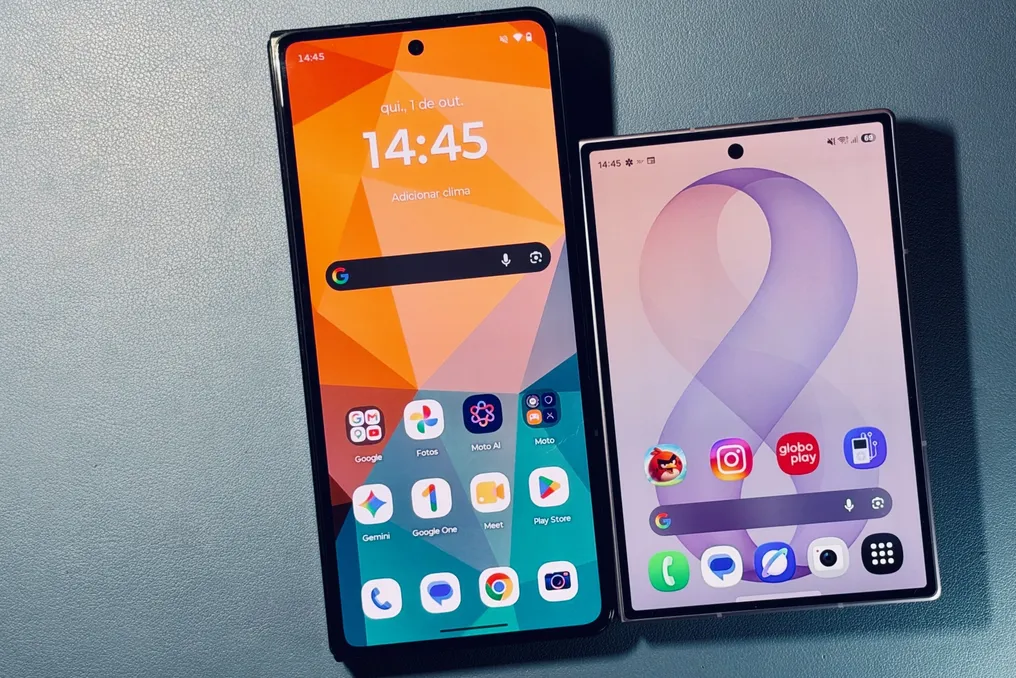
Although price and size may be points of criticism, foldable phones offer unique functionalities or enhance existing features. The Buying Guide conducted a comparative test between two recent models: the Motorola Razr Fold and the Samsung Galaxy Z Fold8, evaluating aspects such as design, cameras, multitasking, performance, and battery life.
In terms of cost, the Motorola device is priced at approximately R$ 16 thousand, while the Samsung starts at R$ 12.6 thousand, according to research conducted in online stores at the end of September.
Design
Both devices present distinct approaches. The Motorola Razr Fold prioritizes productivity, featuring large internal and external screens and including a stylus pen for notes. Its dimensions are 160.1 x 144.5 x 4.7 mm when open and 160.1 x 73.6 x 10.1 mm when closed, weighing 243 grams, making it larger and heavier than its competitor.
The Samsung Galaxy Z Fold8 adopts a passport-like format, featuring a wider external screen and an internal display comparable to a compact tablet. Its measurements are 161.4 x 123.9 x 4.5 mm when open and 123.9 x 81.9 x 9.7 mm when closed, with a weight of 201 grams. The crucial difference lies in the screen proportions.
On the Samsung, the external screen has a 10:16 aspect ratio, ideal for photography when the phone is closed. When opened, the device assumes a 4:3 format, better suited for watching videos and organizing apps. The Motorola, however, features a more elongated external screen with a 9:21 ratio, close to conventional smartphones, and the internal panel is nearly square, at 8:7.2. Although both are good for watching videos with the screen open, they display dark bars depending on the content format, as seen on Instagram and TikTok, or on the top and bottom edges of YouTube in full screen.
Larger screens benefit gaming by offering more visual space. However, both share the common problem of foldables: the visible crease on the internal screen, which is more pronounced on the Motorola. Furthermore, the glossy finish of the internal screens makes fingerprints appear easily.
Easier Multitasking
The ability to run multiple tasks simultaneously is a feature highlighted by manufacturers, although it is not new compared to traditional smartphones. This functionality operates very efficiently on both foldables, allowing the screen to be divided between apps like gallery and camera, or a website and notepad.
Motorola gains an additional advantage in this regard by including the Moto Pen Ultra stylus in the box. This Bluetooth pen has a rechargeable internal battery in the external case. Due to the thinness of the Razr Fold, it could not be stored inside the phone. It is worth mentioning that a Moto Pen Ultra sold separately costs around R$ 900.
Performance and Battery
Both models use top-tier processors: the Snapdragon 8 Elite Gen 5 for Galaxy in the Samsung and the Snapdragon 8 Gen 5 in the Motorola. During tests, neither device showed slowness or freezing. The Z Fold8 has 12 GB of RAM and storage options of 256 GB, 512 GB, and 1 TB, while the Razr Fold offers 16 GB of RAM and 1 TB.
In video tests, the Motorola achieved a slight superiority over the Samsung. The Razr Fold has a 6,000 mAh battery, compared to 4,800 mAh in the Galaxy Z Fold8. In tests using only the external screen, both exceeded 20 hours of autonomy, recording 20h47 on the Razr and 20h12 on the Galaxy. This difference, despite the distinct battery sizes, reflects the energy optimization implemented by each manufacturer, as actual duration depends on individual use.
Cameras
Photo quality is frequently cited as a challenge for foldable phones. However, the format gives foldables greater versatility, as they can be folded to serve as a stand or tripod, or use the main camera for selfies assisted by the external screen.
The Galaxy Z Fold8 has two rear cameras, both with a resolution of 50 megapixels (one wide-angle and one main). The Razr Fold has three rear lenses, also 50 MP (main, telephoto, and wide-angle). Under adequate lighting conditions, both devices managed to balance brightness, contrast, and exposure well when tested at maximum resolution.
With zoom and appropriate light, the results were similar, but a variation in the green tone in the background was noticed. Both models include Pro Mode for manual adjustments and optical zoom (2x on Samsung and 3x on Motorola). Despite the versatility, the Motorola exaggerated dynamic contrast in certain situations and showed color confusion in others, as seen in portrait mode photos.
The selfie cameras are dual on both. The Motorola uses 32 MP (internal) and 20 MP (external) lenses, while the Samsung employs 10 MP on both screens. Although the main camera performed better, a period of practice is necessary to coordinate the use of the main and front cameras.
Additionally, the models offer fun features. The Motorola has Guided Photo, which allows requesting a third party to take a photo at a tourist spot, fitting the person into the captured landscape. Samsung uses the AI-based Fancam feature to edit videos focusing on a single person, generating ideal cuts for social media.
Conclusion
Despite the high cost, foldable phones prove to be a more reliable alternative in 2026 compared to previous generations. The Z Fold8 represents Samsung's first foray into this smaller format, similar to what Apple introduced with the iPhone Duo. The Razr Fold is the first model