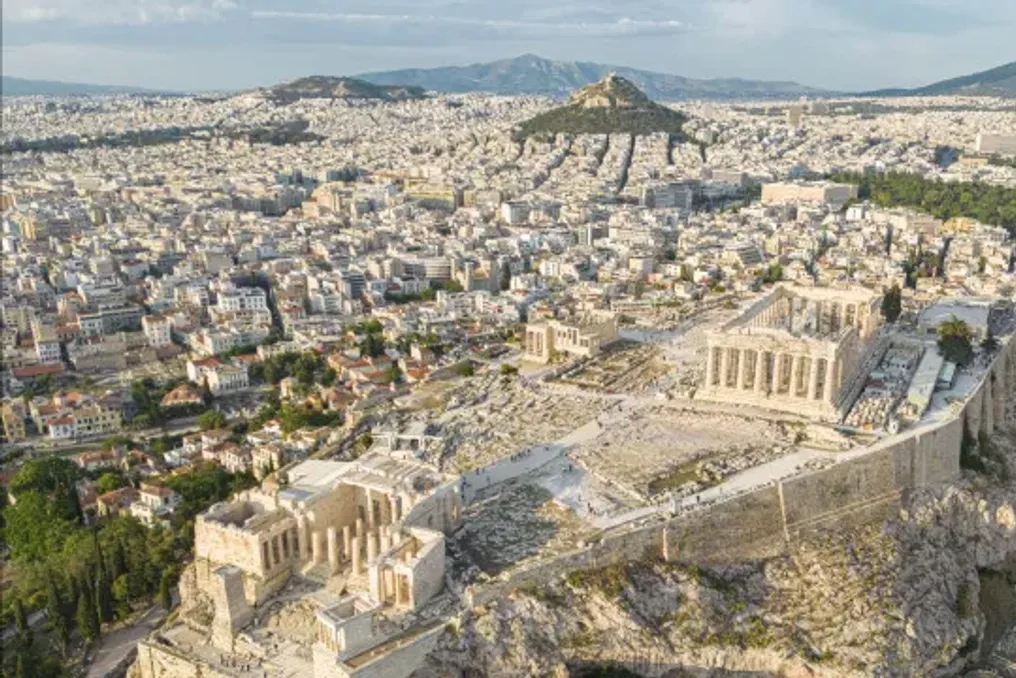
Archaeologists discover school in Mieza where Aristotle taught Alexander the Great in Greece
Read more
Noticias ao Minuto
noticiasaominuto.com

Archaeologists discover school in Mieza where Aristotle taught Alexander the Great in Greece

Archaeologist Efe Angeliki Kottaridi, who is leading excavations in the Emetia region, informed the agency Efe Angelikí Kottaridi that they are convinced this refers to a school founded by Philip II, King of Macedon, from 359 BCE until his assassination in 336 BCE.

The discovered archaeological site is the ancient Macedonian city of Mieza, which covers an area of about three hectares. It contains a complex of buildings, including banquet halls, a sports pavilion, an athletics stadium, a covered running track, and classrooms with stone desks.

Among the ruins, archaeologists found coins, pottery, and four styli used by students in antiquity for writing, which may provide clues as to who received education in this place.

According to the Roman historian Plutarch in his work 'Parallel Lives,' Alexander the Great was a student of Aristotle between the ages of 13 and 16. During this period, the philosopher taught him ethics, politics, literature, and natural sciences.

Two years later, the young man was ready for governance and leadership, participating in the decisive Battle of Chaeronea in 338 BCE, where Philip achieved victory over the combined forces of Athens and Thebes.

Kottaridi emphasized that Philip also founded other schools (gymnasia) in Amphipolis and Aigaia, the capital of the Macedonian kingdom. However, the school in Mieza represented what can be called an elite college today, where the sons of the most prominent Macedonians were prepared for war through lessons in tactics, strategy, and physical training.

This year, a complex of rooms next to the classrooms was discovered, which included a vestibule and two banquet halls. They preserved mosaic floors and raised platforms for placing couches, capable of accommodating up to 20 guests.

The school also had a covered running track (kystos) of 200 meters, surrounded by 64 Doric columns, which was used for physical training on days of extreme cold or heat.

The archaeologist noted that architectural and decorative elements similar to those of the Macedonian royal palace in Aigaia (modern Vergina), where Philip and Alexander lived, were found in this structure and other parts of the complex.

According to Kottaridi, the 'most impressive aspect' of the find is that it demonstrates that the 'history of state care for education in general and organized' began not in democratic poleis like Athens, where only private schools existed, taught by philosophers such as Socrates or Plato, but specifically in Philip II's Macedonia.

In 334 BCE, Alexander the Great began a military campaign in which he defeated the Persians, Egyptians, and Phoenicians, establishing a vast empire in just a decade, stretching from Greece to the Indus Valley, and from Egypt to Central Asia.

Across this territory, he founded dozens of cities, including Alexandria in Egypt, whose most characteristic feature was precisely these schools, which contributed to the spread of Greek culture and language among the 'people of that time,' notes the researcher.

Similar institutions have been found in distant places such as Afghanistan, in the ancient Hellenistic city of Ai-Khanoum, east of modern Kabul.

Excavations in Mieza began in 2024 and will continue this year with a focus on the sports pavilion area and classrooms.
Similar stories

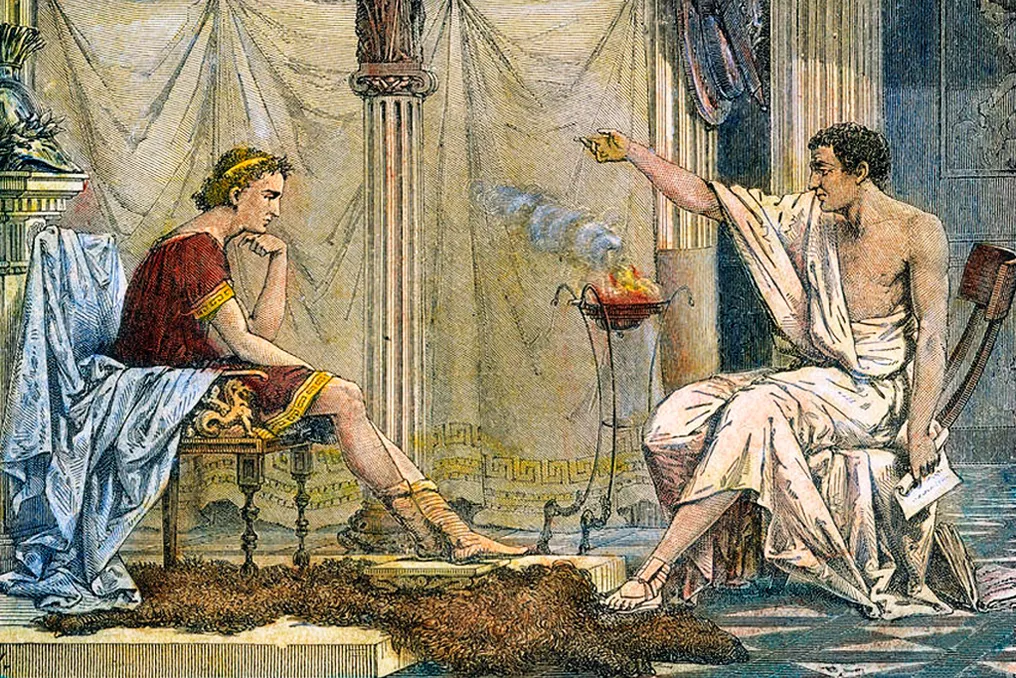
School where Aristotle taught Alexander the Great found in Greece
Read more
super.abril.com.br

School where Aristotle taught Alexander the Great found in Greece

The school where Aristotle taught Alexander the Great over 2,300 years ago was discovered in the ancient Macedonian city of Mieza, located in northern Greece. According to the Greek Ministry of Culture, the excavation work unearthed an architectural complex that included stone desks, two halls, a sports area, a stadium, and a covered veranda.

In addition to the infrastructure, the archaeological site preserved everyday artifacts of the students, such as coins, ceramics, and four styluses used for writing. The ruins of the school, dated to the 4th century BC, featured mosaic floors and columns, as well as rooms equipped with raised pedestals, where originally about a dozen sofas would have been placed.

To specialists, the architecture and decoration of this place resemble the royal palace of Macedon in Aigai (modern Vergina), where Alexander and his father, King Philip II, resided. The opulence of the site suggests that the attendees were sons of the most prominent members of Macedonian society, making it likely that Philip II ordered the construction of the school specifically to receive them.

Educational institutions in ancient Greek world, known as 'gymnasia,' offered a variety of subjects aimed at the comprehensive development of students. However, educating a future monarch represented a responsibility of greater magnitude. Philip II sought out Aristotle, whom he considered 'the wisest and most illustrious of philosophers,' to instruct the young prince Alexander, who was between 13 and 16 years old at the time.

As reported in Plutarch's work 'Life of Alexander' (c. 46 – 120 AD), the king made great efforts to bring the philosopher to Macedonia. Plutarch describes that 'Philip II rebuilt the city of Stagira, Aristotle's homeland, which he himself had destroyed, and repopulated it with exiled or enslaved citizens,' adding that 'he reserved the nymphaeum of Mieza for the master and the student to dedicate themselves to study.'

Aristotle remained responsible for Alexander's education for a period of three years. During these lessons, he covered various topics, including nature, logic, zoology, society, mathematics, politics, poetry, physics, and ethics. During this period, between 343 BC and 336 BC, the Greek philosopher was already over forty years old and had dedicated much of his life as a student of Plato in Athens.

After the assassination of Philip II in 336 BC, Alexander assumed the throne of Macedon at the age of twenty. Even after separating, the king retained some of Aristotle's teachings; notably, his deep appreciation for Homer's Iliad was directly influenced by the philosopher, who introduced him to the work. In his military campaigns, which culminated in the formation of one of the greatest empires of antiquity, Alexander always carried a copy of this work with him.

Plutarch mentions in his biography of Alexander the Great that the prince and Aristotle held their classes in the city of Mieza. For this reason, Angeliki Kottaridi, archaeologist and director of antiquities at the Greek Ministry of Culture, who led the excavations at the site, maintains that the discovered archaeological complex corresponds to the school where Alexander the Great studied.

The location of the site also coincides with Plutarch's records. Mieza is located in northern Greece, approximately 43 kilometers from Pella, the ancient capital of the Kingdom of Macedon. At that time, political assassinations were relatively frequent, and keeping the prince away from the center of power served as a protective measure. Thus, if the king were killed, Alexander would have a greater chance of surviving unharmed, which indeed happened.

Popular