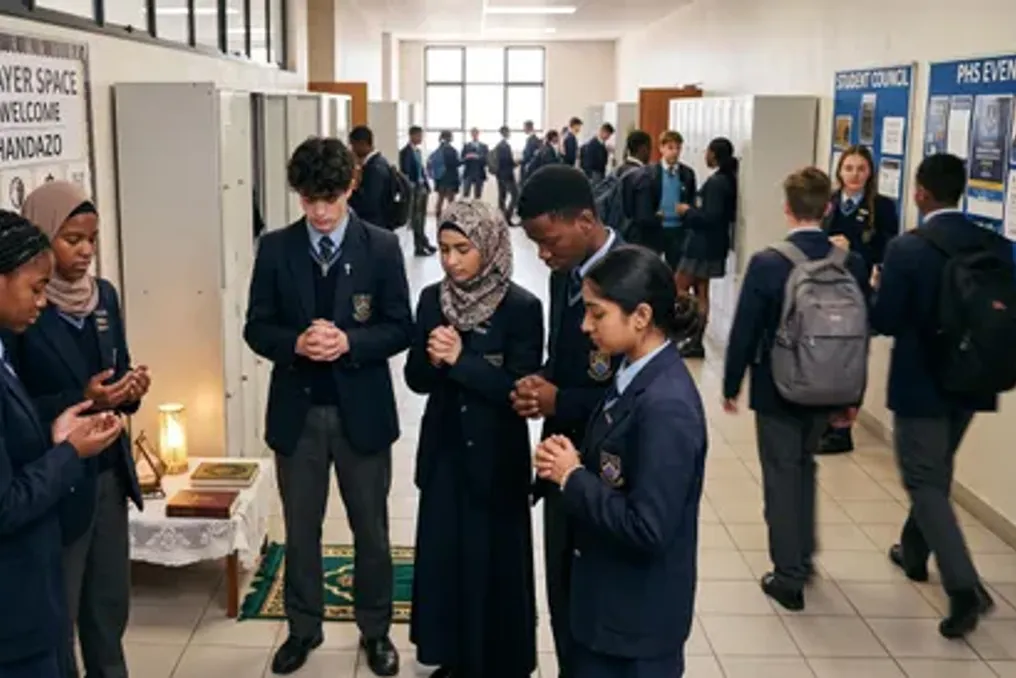
The call by Patriotic Alliance leader Gaiton Mackenzie to reinstate morning prayers in schools has triggered active debates regarding discipline, religious freedom, and how religious practice should be conducted within South Africa's diverse public school system.
The proposal to 'bring God back into schools' has become a catalyst for discussions on whether prayer can help address rising issues of violence, bullying, and indiscipline among students.
This statement was made after Gaiton Mackenzie, leader of the Patriotic Alliance (PA) and Minister of Sport, Arts and Culture, announced that his party intends to introduce morning prayers in educational institutions if they gain power after local elections.
He voiced this position during a recent launch of the party's mayoral campaign in East London (Qgompong) in the Eastern Cape. Mackenzie stated: 'You see, all our problems in South Africa stem from one thing. We have removed God from our schools. Under the PA regime, we will bring God back into schools. Our children will study sacred scriptures before they study anything else.'
While religious figures argue that prayer and spiritual guidance can foster moral and emotional development in children, questions remain about how such practices can be implemented in South Africa's varied public school system.
Reverend Cyril Pillay, founder of the Church of God in Chatsworth, believes that exposing children to prayer and sacred texts at an early age can promote literacy, moral foundations, and critical thinking. He noted that regular school prayer shapes a daily routine of self-reflection and influences behavior by encouraging humility, responsibility, and empathy, helping children absorb concepts of good and evil through spiritual accountability, not just rules.
Pillay added that an early spiritual foundation can serve as an 'emotional and moral anchor' when young people face difficulties. He emphasized that schools grapple with issues such as bullying, physical fights, and disrespect for authority. In his view, religious guidance and prayer directly address these problems by teaching self-discipline, conflict resolution, and the inherent value of every human life, thereby transforming the overall school culture.
Pillay also insisted that any approach must respect South Africa's religious diversity, suggesting that schools implement inclusive or reflective moments instead of imposing a single doctrine. This includes providing periods of silence, allowing voluntary prayer groups for different faiths, and objectively teaching about world religions to strengthen mutual respect.
Similarly, according to pundit Lokesh Maharaj, Chairman of the Indian Maha Sabha Council of Clergy in South Africa, starting the day with prayer or reflection can help children focus their minds and prepare for learning. He explained that in the Hindu tradition, transitioning from rest to action requires mental concentration, making the start of the day with reflection or prayer a form of mindful practice.
Maharaj added that early exposure to prayer and scriptures cultivates altruism and humility, as scriptural contemplation teaches that a person is part of a vast, interconnected universe. He also noted that regular prayer can reinforce values such as non-violence, truthfulness, and forgiveness, promoting self-control, while stressing the need to respect South Africa's religious diversity. He called on public schools to avoid imposing dogmatic or exclusionary teachings, preferring universal, non-confessional appeals focused on light, wisdom, peace, and unity. Practices like silent meditation, universal poems about peace, or general prayers of gratitude to the divine for truth and knowledge can honor each child's heritage and contribute to building a shared community bond.
Moulana Tariq Mohammed, Imam of Al-Aimiya Mosque in Phoenix, stated that starting the day with prayer will bring inner peace to children, but he added that prayer should ideally begin at home, not at school. He suggested that while prayer may play a role in solving common problems such as gun violence, assaults, and bullying in schools, the Department of Education should consider restoring guidance counselors. Regarding religious diversity, Mohammed stressed that students should not be exposed to any single form of prayer, and every child must be respected and allowed to pray according to their beliefs.
In turn, Vii Ghani, Chairman of the KZN Parents Association, opined that while faith holds significant importance in the lives of many South Africans, prayer and religion cannot be a panacea for the complex social, institutional, and managerial problems facing schools and communities. He pointed out that the root causes of many difficulties lie elsewhere: fraud, corruption, theft, poor management, lack of resources, outdated infrastructure, overcrowded classrooms, insufficient staff, and the absence of adequate support services like counseling. Ghani emphasized that discipline and accountability are crucial, and violence, bullying, destructive behavior, and indiscipline remain persistent problems in many schools. He stated that when disciplinary rules exist but are applied inconsistently, or when serious offenses do not result in appropriate consequences, the authority of the school weakens. Schools require clear codes of conduct, properly implemented disciplinary procedures, and meaningful accountability for offenders. He also noted that the Department of Education is obliged to support schools in creating a safe and orderly learning environment by ensuring the availability of staff, infrastructure, resources, and professional support to effectively address behavioral and social issues. Ghani concluded that if religious practice is introduced or expanded in schools, the issue of equal treatment cannot be ignored. He asserted that if religion is to play any role, that role must align with the constitutional obligation to equality, freedom of religion, and diversity.
Professor Sultan Khan of the University of KwaZulu-Natal Sociology noted that religious traditions often provide principles regarding good and evil, responsibility, honesty, compassion, justice, and respect, and therefore religious education can foster a student's moral development and prompt them to consider ethical issues. He added that religion can help schools and families pass down values across generations, such as respect for others, service, tolerance, generosity, and responsibility, which can be incorporated into educational curricula. Khan also observed that education helps students understand their own and others' religious traditions, which promotes cultural, historical, and identity understanding. Since schools are vital socialization institutions, religion can influence how students perceive their duties to family, community, and society. Religious instruction can encourage participation in community life and service to others. When religious education is taught comparatively and inclusively, it can introduce students to various beliefs and traditions, fostering religious literacy, dialogue, and mutual respect, especially in religiously diverse societies. However, he cautioned that the role of religion in education can also create challenges. In religiously diverse societies, schools must consider how to avoid favoring one religion over others. Questions arise concerning religious instruction, religious attire and practices, curriculum content, and the rights of students from different or non-religious backgrounds. In multicultural and secular societies, education must balance religious views with inclusivity, freedom of religion, critical thinking, and respect for diverse worldviews.