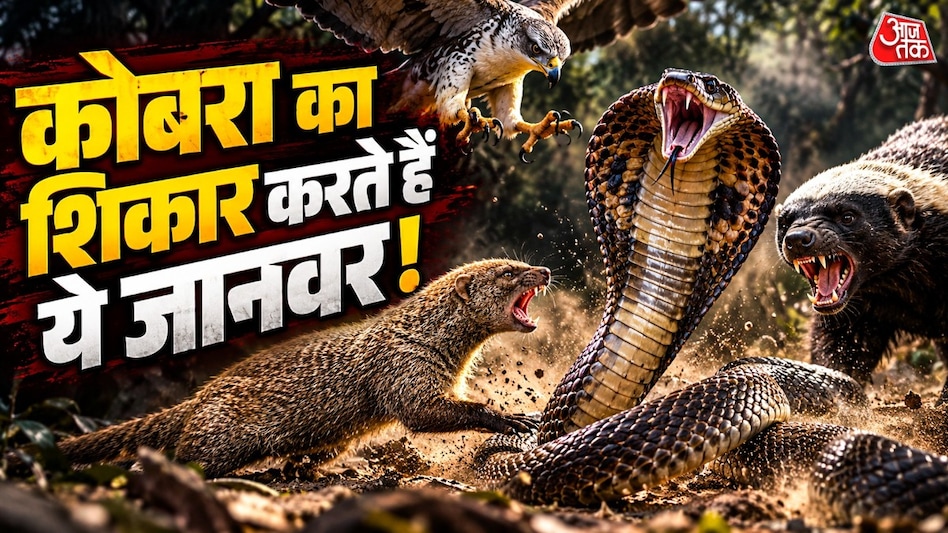
Animals that hunt cobras and can withstand venom
Read more
Aaj Tak
www.aajtak.in

Animals that hunt cobras and can withstand venom

The sight of a cobra often causes intense fear in many people, as this venomous snake poses a danger to humans when it spreads its hood. However, in the wild, there are animals that are not afraid of cobras, and some even hunt them. Among these animals are mongooses and certain predatory birds, whose resistance is not always overcome by cobra venom. Below is an overview of these animals and the ways they hunt cobras.

One of the most well-known adversaries of the cobra is the mongoose. Although smaller than the cobra, it possesses exceptional agility. When the cobra attempts to attack, the mongoose quickly evades the strike and, finding the right moment, counterattacks. This speed helps it in the confrontation with the cobra.

Another animal is the honey badger. This small but very tough creature is known for engaging in fights even with larger prey. Its thick skin provides some protection against the snake's attack, and according to reports, it is capable of resisting even venomous snakes like the cobra.

Despite the name 'Royal', the royal cobra also hunts other snakes. The royal cobra is classified as an ophio-phage, meaning it eats other snakes. Larger individuals of the royal cobra can hunt both small snakes and other young royal cobras.

The secretary bird is a predatory bird with long legs found in Africa. It specializes in catching snakes on the ground. Using its powerful talons, it can immobilize or injure the snake before attacking with sharp claws.

The spiny hamster can also resist snakes. The spines on its body provide it with a special kind of defense. If necessary, it can attack and even eat a snake.

It is also known that the king snake hunts snakes. Thus, in the world of snakes, one snake can be a predator to another. If a conflict occurs between a cobra and a king snake, the latter may attempt to attack and make the cobra its prey.

The snake eagle, as its name suggests, has a diet related to snakes. This predatory bird observes the ground from the height of its flight. Thanks to its keen eyesight and strong talons, it is capable of catching snakes on the ground, and a cobra can become its victim.

The wild boar is generally not considered a primary predator of the cobra. Nevertheless, while foraging in the forest, it may encounter a snake. The wild boar, possessing a sturdy body and thick hide, can kill and eat a cobra in such a situation.

Although the cobra is considered one of the most dangerous snakes in the world, in the forest any animal can become prey for someone. The agility of the mongoose, the toughness of the honey badger, the royal cobra's tendency to eat snakes, and the keen eyesight of predatory birds help them to resist the cobra.
Similar stories

Kimada Grande Island in Brazil: Territory Inhabited by Venomous Snakes with Restricted Access
Read more
www.aajtak.in

Kimada Grande Island in Brazil: Territory Inhabited by Venomous Snakes with Restricted Access

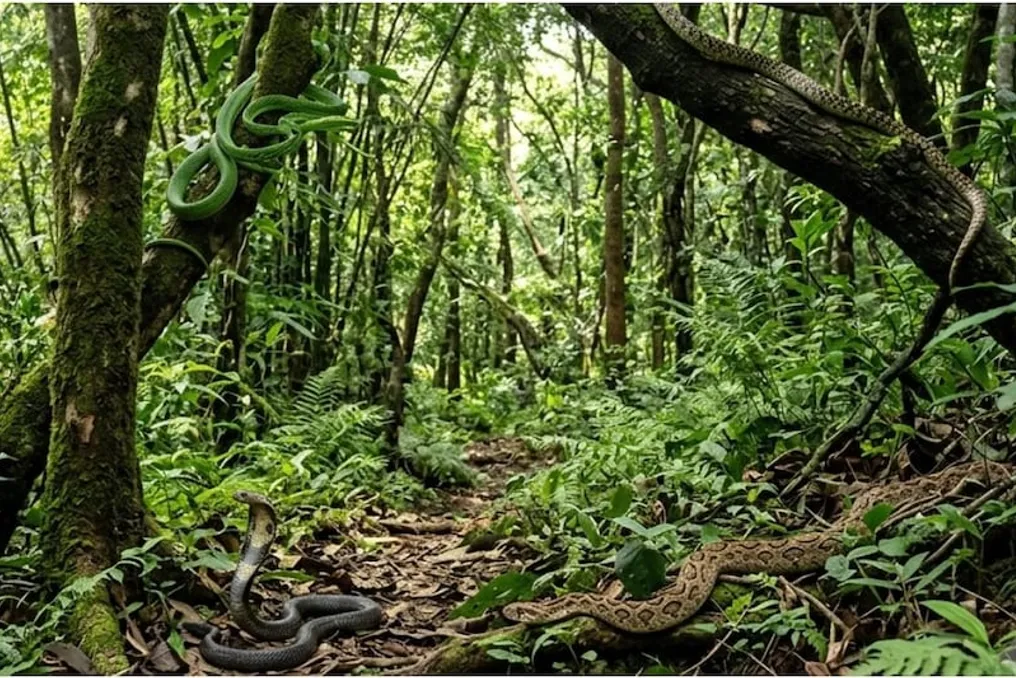
When a snake appears in a building or on the street, it causes a commotion. However, there is a place on Earth where every step is accompanied by encounters with venomous snakes. This refers to Kimada Grande, an island near the coast of Brazil, which looks like a picturesque tourist destination with blue water and many trees, but whose actual situation is completely different.

This island, known as Snake Island, is located approximately 35 kilometers from the southern coast of the state of São Paulo in Brazil. There are so many snakes here that ordinary tourists are prohibited from entering. Prior permission from the authorities, as well as thorough preparation and approval, is required for a visit.

A large number of snakes inhabit the island, including a highly dangerous species called Bothrops insularis, which is extremely venomous. It is believed that this island is home to these snakes, and they are found nowhere else in the world. Nevertheless, this population is under threat of extinction. Although it is assumed that there are many snakes there, the exact number is unknown; estimates reach three thousand individuals on a relatively small territory, meaning a snake could appear at any moment.

The island's territory includes forested areas, rocky regions, and marine zones. Besides snakes, other types of animals inhabit the island, and it also serves as an important stopover for migratory birds.

The reason for restricting access is not limited only to the fear of snakes. Kimada Grande is part of a protected federal territory, and protecting the endangered species there is of paramount importance. Therefore, access to the island is strictly controlled, and visits are permitted only to authorized personnel.

Scientific groups and researchers can visit the island after obtaining the appropriate permits to conduct research. Thus, the statement that 'nobody can visit this island' is not entirely accurate. In fact, free entry for ordinary tourists is forbidden, but access is possible under special permits for scientific research activities. Furthermore, the island has dense vegetation.

The history of the island's name is also quite interesting. In the past, local residents and fishermen tried to drive away the snakes by setting fire to the vegetation on the island. Sometimes these fires spread over large areas of the territory. This is why the island received the name Kimada Grande, which roughly translates to 'large burnt place.'

Popular