The International Air Transport Association (IATA) analyzed passenger behavior during flights, including issues related to battery carriage and actions during evacuation. According to IATA, which represents over 300 airlines covering more than 80% of global air traffic, passenger behavior remains one of the industry's systemic problems.
IATA tracks such incidents through the IDX (Incident Data Exchange) program, to which over 140 airlines report, and simultaneously conducts information campaigns, such as 'Save a Life, Not a Bag,' regarding evacuation conduct, while also providing recommendations for the safe storage of lithium-ion batteries.
The article examines unacceptable behavior according to the requirements of authorities and airlines, the legislation of Uzbekistan, rules for proper electronics transportation, norms of conduct during turbulence and evacuation, as well as actions in case of illness during the flight.
Contents
The following sections cover the definition of an 'unruly passenger,' passengers' rights and obligations under Uzbek laws, types of behavior to avoid, consequences of rule violations, reasons for keeping the seatbelt fastened, rules for transporting devices with lithium-ion batteries, permissibility of e-cigarettes, drones, and 'smart' luggage, conduct during emergency evacuation, and actions when feeling unwell.
What is an 'unruly passenger' and how often do such incidents occur
The International Civil Aviation Organization (ICAO) defines an unruly passenger as a person who fails to comply with conduct rules in the airport or on board the aircraft, or ignores instructions from staff or crew, thereby disrupting order and discipline. According to IATA, approximately 93,107 such incidents were registered in 2025, corresponding to one case every 355 flights.
This figure improved compared to 2024, when one such incident was recorded for every 307 flights. Passengers are most frequently noted for failing to follow crew instructions, which remains the most common violation, while cases of verbal aggression and intoxication on board have decreased. The most serious incidents—physical violence—have become noticeably rarer, but they entail the harshest consequences for the flight and its passengers.
This data is collected within the framework of IATA's IDX program based on reports from more than 140 airlines worldwide.
What does Uzbek law say about the rights and obligations of a passenger on board
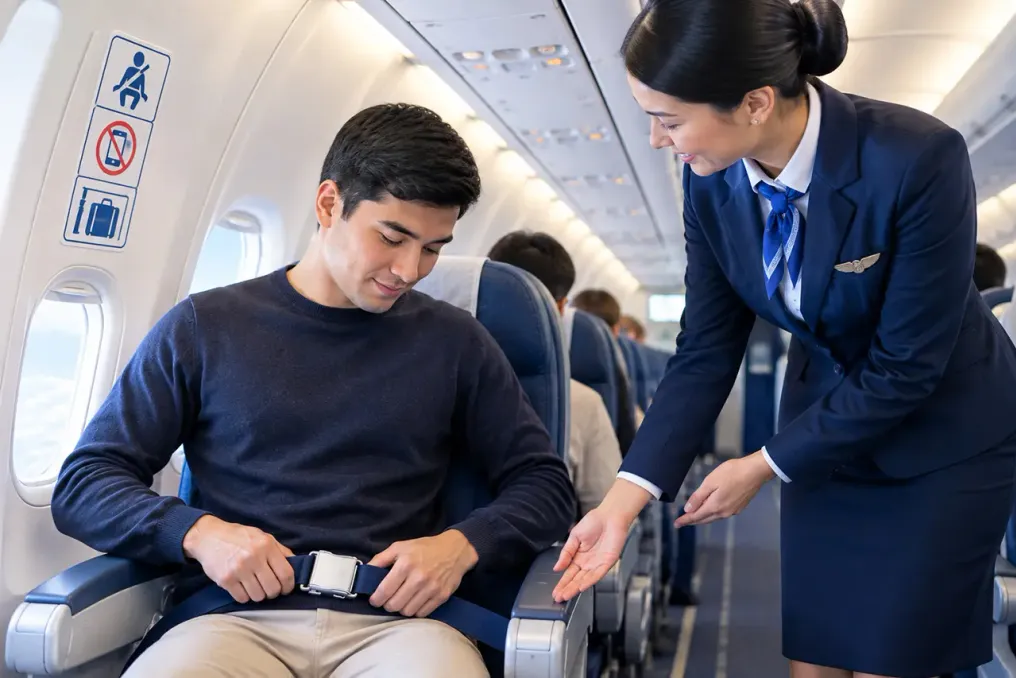
According to Article 92-1 of the Air Code of the Republic of Uzbekistan and the Passenger Conduct Rules adopted based on it, a passenger is obliged to follow the instructions of the aircraft commander or crew members, as well as to fasten their seatbelt as soon as the corresponding sign illuminates and keep it fastened until the sign goes out.
The Passenger Conduct Rules were introduced to implement Article 92-1 of the Air Code of the Republic of Uzbekistan, which was added to the Code in 2012 and registered by the Ministry of Justice. In addition to these obligations, the passenger also has rights: for example, they can ask crew members to take action against another passenger who violates public order or behaves aggressively without reason.
Violation of established conduct rules on board entails liability in accordance with the Code of the Republic of Uzbekistan on Administrative Liability, and the carrier has the right to refuse further transport to a passenger whose actions threaten flight safety.
Obligations include: complying with the Passenger Conduct Rules on board and following instructions from the commander or crew members regarding flight safety; occupying the seat indicated on the boarding pass, or another seat as directed by the crew; placing baggage only in designated areas; fastening the seatbelt when the sign is on and keeping it fastened until the sign turns off; and complying with inspection requirements to ensure aviation security.
What behavior should be avoided on board
Typical violations recorded by airlines include: failure to comply with crew instructions, verbal aggression, smoking (including e-cigarettes) in the cabin or lavatory, consuming alcohol beyond what is served by the crew, and physical violence against other passengers or flight attendants.
IATA notes that even seemingly 'minor' violations—such as refusing to wear a mask if mandated by policy, or refusing to fasten a seatbelt—are considered a basic level of unruly behavior and are usually resolved by the crew without escalation. Nevertheless, these episodes occur most frequently and distract flight attendants from other tasks.
Deemed unacceptable is: ignoring crew instructions, including requests to fasten a seatbelt or turn off an electronic device; smoking in the cabin or lavatory, including e-cigarettes—most airlines prohibit this by policy regardless of local legislation; consuming alcohol brought by the passenger instead of being served by the crew, or continuing to consume after a flight attendant refuses to serve a drink; displaying verbal or physical aggression towards other passengers or crew members; and filming or photographing other passengers or incidents on board without their consent.
What happens to a passenger who violates conduct rules on board
The consequences of unruly behavior on board can range from refusal of further transport and fines to criminal prosecution; jurisdiction is determined by the state of aircraft registration, which in practice often allows violators to avoid punishment upon landing abroad.
According to IATA, the main reason why approximately 60% of unruly passenger cases never reach a court hearing is the jurisdictional gap embedded in the 1963 Tokyo Convention: local police at the arrival airport often lack the authority to investigate an incident that occurred on board an aircraft registered in another country. To close this gap, the International Civil Aviation Organization (ICAO) calls on states to join the Montreal Protocol 2014 (MP14), which expands jurisdiction to the state of arrival and the state of the aircraft operator.
Some countries, including Australia, France, Finland, New Zealand, and Singapore, have implemented administrative fine systems allowing police or aviation security personnel to issue a fine on the spot to the violator without initiating a criminal case, provided the incident is not among the most serious.
Why should you keep your seatbelt fastened even when the sign is off
More than 90% of injuries sustained during severe turbulence occur with passengers and crew members who were not belted at the time the turbulence occurred; therefore, the U.S. Federal Aviation Administration (FAA) recommends keeping the seatbelt fastened throughout the entire flight, not just when the sign is illuminated.
According to the U.S. National Transportation Safety Board (NTSB), of 123 passengers seriously injured by turbulence on American airline flights between 2009 and 2018, only one was belted at the time of injury. The 'fasten seatbelt' sign illuminates when the crew is already aware of impending turbulence, but so-called clear-air turbulence occurs without visible warning signs and is not always predicted—which is why the FAA directly recommends keeping the belt fastened while seated, regardless of the sign status.
Recommendations include: keeping the seatbelt loosely fastened throughout the flight, even if the sign is off, because severe clear-air turbulence (without visible clouds) can strike suddenly; buckling up immediately after landing and not unbuckling until the crew announces safety, even if asleep; children under two years old are safer secured in a certified car seat or aviation infant seat rather than held on laps; if standing, return to your seat and buckle up as quickly as possible, without lingering in the aisle longer than necessary; and immediately cease movement in the cabin and sit down when turbulence is announced.
How to properly transport phones, laptops, and other devices with lithium-ion batteries
IATA offers seven rules for the safe transport of devices with lithium-ion batteries: do not carry unnecessary gadgets, transport devices and spare batteries only in carry-on luggage, insulate the contacts of spare batteries, check with the airline the conditions for batteries exceeding 100 Wh, and immediately notify the crew if a device overheats or starts smoking.
The requirement to store electronics in carry-on luggage rather than checked baggage is due to the fact that if a battery catches fire in the cargo hold, the crew cannot quickly detect and extinguish it, whereas cabin crew are trained to react immediately to such incidents. A separate instruction concerns devices stuck in seat crevices: passengers should not attempt to move the seat themselves, as the mechanism may damage the battery and cause a fire—instead, they should call a flight attendant.
For passengers flying Uzbekistan Airways on domestic and international routes, a similar rule applies: devices up to 100 Wh are allowed in carry-on without prior approval, while batteries up to 160 Wh require prior airline permission.
It is recommended to: only take devices and batteries that are truly necessary for the trip; keep all phones, laptops, cameras, and spare batteries in carry-on luggage, never check them in; if carry-on luggage is removed at the gate for check-in, remove all devices and batteries from it in advance; store spare batteries and power banks in their original packaging or tape the contacts to prevent short circuits; for batteries exceeding 100 Wh (e.g., large photographic equipment or drones), check the airline's requirements in advance; batteries exceeding 160 Wh are generally not permitted on passenger flights; and immediately inform the crew if a device overheats, smokes, or is damaged, without trying to cool or move it yourself.
Are e-cigarettes, drones, and 'smart' luggage allowed on board
The use or charging of e-cigarettes on board is generally prohibited even by airlines that allow them to be carried in carry-on; drones and cameras with installed batteries are allowed in carry-on, while a 'smart' suitcase with a non-removable built-in battery may not be accepted for transport at all.
IATA notes that differences in airline rules are due to various national regulations (some countries completely ban vapes), each carrier's own risk assessment, and restrictions on certain routes. Therefore, there is no single international standard covering all such devices, and it is best to confirm current conditions directly with the airline before departure.
Regarding e-cigarettes and vapes: rules vary between airlines—check in advance; use or charging on board is almost universally prohibited; drones and cameras with installed batteries: allowed in carry-on; spare batteries must also be transported in carry-on, properly protected; 'smart' suitcase with a removable battery: the battery must be removed and transported separately in carry-on; 'smart' suitcase with a non-removable battery: may not be accepted either as checked or carry-on—this depends on the airline.
How to behave during an emergency evacuation from an aircraft
During an emergency evacuation, the passenger must immediately follow the crew's instructions, leave all luggage behind, and exit the cabin as quickly as possible, without stopping to record the event on video—a delay of even a few seconds increases the risk of injury to the passenger and to
মাধ্যম