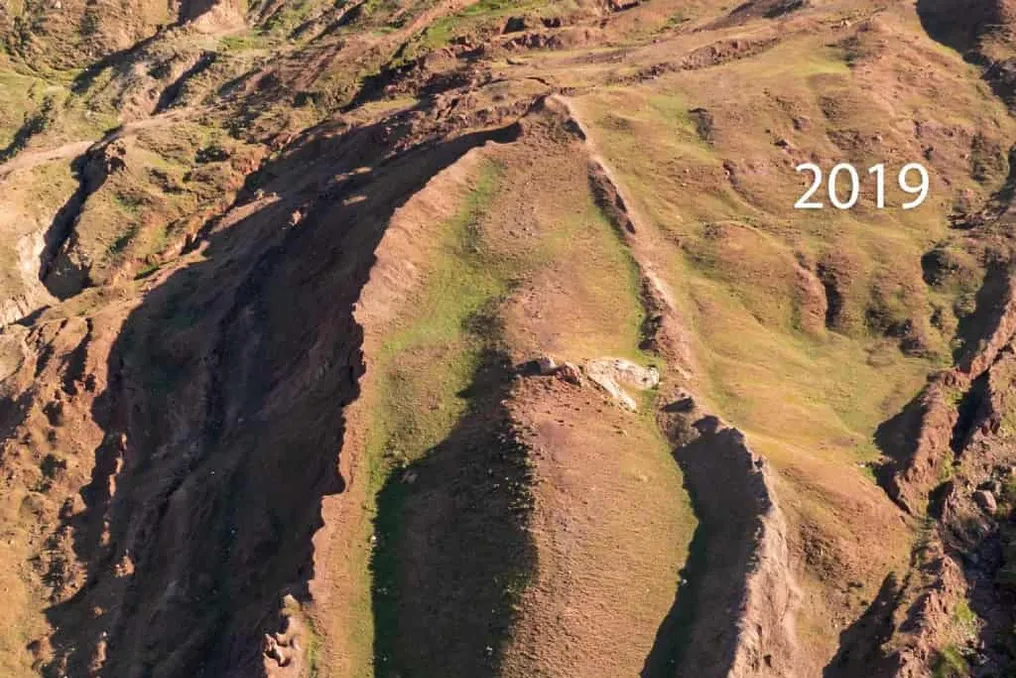
Researchers have once again begun studying a geological formation in eastern Turkey that has been considered a potential location for Noah's Ark for decades. The group, led by Professor Cenkcer Atilay, gathered twenty-five scientists from various countries to study the Durupnar formation.
The research was conducted without excavation, utilizing radar, as well as two-dimensional and three-dimensional models. The work concluded in September, and the results are planned to be published in 2027. Nevertheless, previous studies have already established that this structure has a geological origin.
The connection to the biblical vessel stems from the narrative of the Book of Genesis, according to which after the great flood, the ark supposedly came to rest on the 'mountains of Ararat.' The interpretation of this passage led to the region becoming the target of expeditions for centuries.
The Durupnar formation is located not directly on Mount Ararat, but approximately 29 kilometers from the summit of Mount Ararat and is part of Mount Tendürek. Its oval shape, resembling the bow of a ship, is one of the reasons supporting this hypothesis.
The new study is the result of cooperation between Turkish researchers and the North American group Noah’s Ark Scan. This organization prioritizes methods that allow the area to be studied without the need for ground work.
The hypothesis has attracted attention again in recent years. In May 2025, the publication Olhar Digital published a report about an archaeological find that reignited discussions about the possible location of Noah's Ark.
The work began in June 2026 and was completed on September 11. The team intends to create detailed models of the formation and conduct radar analysis to study the contents beneath the surface. This dataset is expected to help clarify the origin of the peculiar shape of Durupnar, with results publication scheduled for 2027.
The project also has a commercial aspect: the group responsible for the research operates tourism in the area, selling tickets for $3600 (about 18.6 thousand reals).
Among the factors that may help interpret this formation is the strong skepticism of geologists and archaeologists regarding the hypothesis that Durupnar is a ship. In 1996, researchers from the University of California, Monterey, published a study on this site and concluded that it is a normal geological structure.
According to the authors, the shape can be explained by the weathering of volcanic minerals, mud movement, and landslides. One of them, David Fasold, initially believed that the formation could contain ship remains, but changed his mind after visiting the site in the 1990s, calling the story 'the oldest ongoing hoax.'
Skepticism is shared by Christian creationist groups that view the Book of Genesis as a historical account. Therefore, although the new investigation may provide additional data on Durupnar, the existing material does not contain evidence confirming that the formation is Noah's Ark.