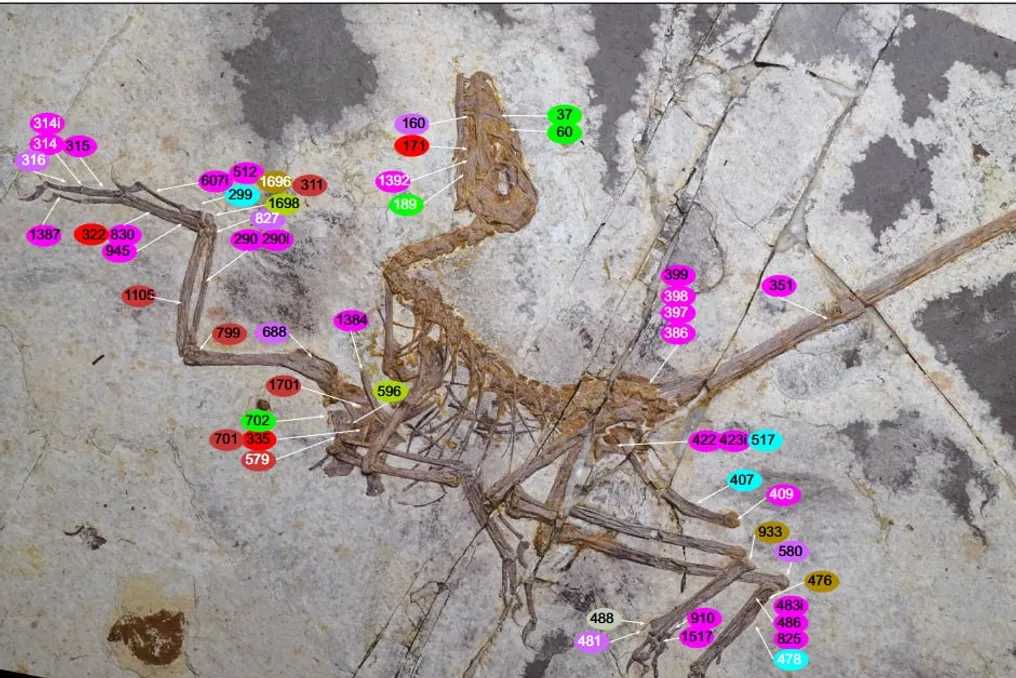
Scientists have presented the description of a new species of small feathered dinosaur, named Norellraptor barsboldi. This species was found in modern-day China. Thanks to its well-preserved skeleton, researchers were able to gain a new understanding of how traits associated with flight began to form in ancient creatures.
The dinosaur was about 57 centimeters long. Traces of feathers were found on its skeleton, preserved on both its tail and forelimbs. The animal is classified as a small predatory dinosaur closely related to the ancestors of modern birds.
The main conclusion of the scientific study is that similar characteristics observed in these dinosaurs and ancient birds may have arisen independently. This means that different groups of animals could have achieved adaptations for flight through different paths, rather than inheriting them from a single common ancestor.
Researchers conducted a detailed comparison of numerous structural features of these dinosaurs and ancient birds. It was established that approximately 30 percent of the traits that appeared in the studied group of dinosaurs were also present in the lineage that led to birds. However, scientists did not find any coincidences in the order in which these traits emerged.
This discovery calls into question the previous concept that similar anatomical features in early bird relatives inevitably evolved along the same trajectory. Consequently, the authors suggest that the history of the development of the ability to fly might be significantly more complex than previously assumed.
Additional information about the animal was obtained by studying its bones. Their structure indicated that the dinosaur died at a young age, although its body had undergone a significant part of the growth process. Furthermore, the development features of its forelimbs differed from those characteristic of modern flying birds.
The specimen itself was discovered near the city of Lamadun, in Liaoning Province, China. A local farmer handed over this fossil to the Hebei University of Geology Museum in 2023. Specialists verified both the preservation of the find and its original discovery site.
Previously, fossil remains of another dinosaur that lived approximately 75 million years ago were found in Karakalpakstan. This paleontological find was made in the Sultan Uvais mountains as part of a joint expedition by scientists from Karakalpak State University and the State Geological Museum of Uzbekistan.