October promises to be an interesting month for sky watchers due to Space Week, major planetary movements, a spectacular meteor shower, and a potential launch of a revolutionary mission to the moons of Mars.
It is important to note that all specified dates and times are based on observations from Brasília (DF) and may vary slightly depending on location. For accurate tracking, it is recommended to use applications such as Star Walk, Stellarium, or SkySafari, which show the precise position of celestial bodies relative to your location.
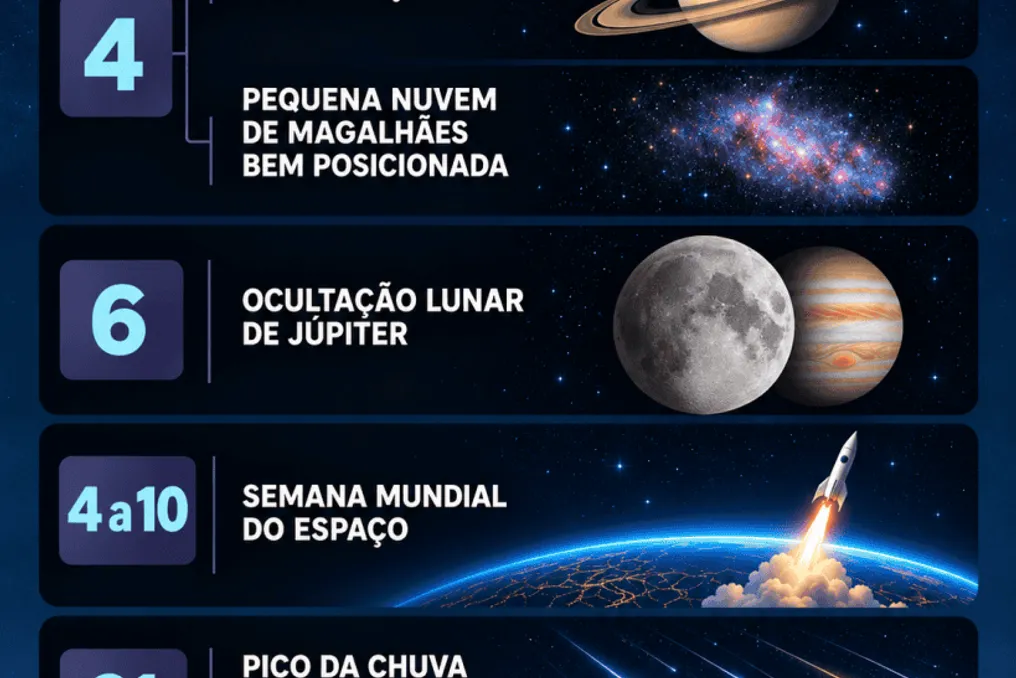
October 4: Saturn Opposition. During this period, the ringed planet becomes even brighter and more visible than at any other time of year, making it an ideal moment for observation.
October 4: Galactic Satellites. Galactic satellites orbit a larger galaxy under gravitational influence, similar to how planets orbit the Sun. In the case of the Milky Way, the most well-known are the Large and Small Magellanic Clouds. Both can be seen with the naked eye, but the best time for observing the Small Magellanic Cloud is on this day.
From October 4 to 10: International Space Week
International Space Week is the largest annual space event in the world, organized by the United Nations (UN) to highlight the contribution of technology to humanity. In 2026, the global event will be dedicated to the theme 'Space Revolution,' covering achievements in space exploration and the development of new launch vehicles.
October 6: Jupiter's Lunar Eclipse. The Moon will pass in front of Jupiter in a phenomenon called a lunar eclipse. This event will cover parts of the eastern United States, eastern Canada, the Caribbean, and a vast strip of Africa. Since the alignment depends on the point of observation, Brazil will be outside the eclipse zone but will see both celestial bodies very close during conjunction.
October 21: Peak of the Orionids Meteor Shower. This phenomenon can be observed in both the Northern and Southern hemispheres. However, the Moon will be very bright on this night, making the sky brighter and potentially interfering with the observation of fainter meteors.
During this month, the MMX mission (an abbreviation for Mars Moons Exploration) is also scheduled for launch. The Japan Aerospace Exploration Agency (JAXA) plans to send a spacecraft to the Martian system. The main goal is to study the moons Phobos and Deimos in detail, including the first landing on the surface of Phobos.
The probe will use PlanetVac to collect soil. This is one of two sample collection systems. This technology, which received financial support from the Planetary Society during tests in 2013 and 2018, uses gas jets to eject regolith into a container.