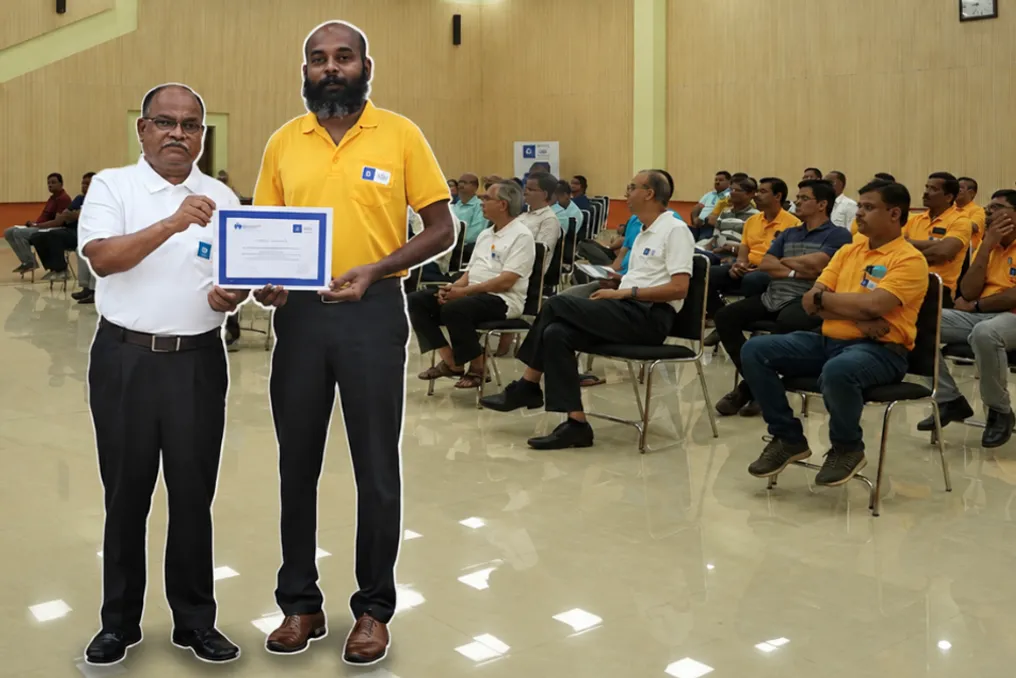
Kester Dawson, an instructor with nearly 27 years of experience in industrial training, noticed a significant difference between students' practical work and theoretical classes. Many students who begin their studies after the 8th grade may struggle with basic arithmetic or formulas, yet in the practical laboratory, they demonstrate greater confidence, curiosity, and readiness for experiments.
The main challenge was integrating this energy into lessons that required sitting, listening, or reading. For a long time, Kester relied primarily on videos and presentations to supplement his classes. The situation began to change after he attended a 12-day training program at the L&T Skill Trainers Academy (STA) in August 2025.
Larsen & Toubro launched the Skill Trainers Academy on March 15, 2021, with the aim of strengthening the qualifications of trainers, who are a vital link between professional education and the workplace. Within the Academy, Kester learned about interactive methods such as Kahoot quizzes, icebreaker games, and activity-based learning.
Upon returning to his classroom, he started applying these methodologies. Instead of immediately moving to theory, he used icebreaker games to make students feel comfortable and introduced Kahoot, allowing them to participate rather than just listen.
For Kester, this transition was not about replacing practical training but about finding more effective ways to connect theory with how his students learn best—through action and participation.
The Importance of Trainer Upskilling for India's Vocational Education System
The establishment of the L&T Skill Trainers Academy arose from an urgent need to strengthen trainers within India's vocational education system, a point noted by Mr. A M Naik, Honorary Chairman of L&T, when he was appointed Chairman of the National Skills Development Corporation (NSDC) in November 2018.
Trainer K Ramakrishnan, Executive Director of L&T Skill Development Mission, explains that his work goes beyond simply imparting technical knowledge. He, along with B. S. Saluja, Head of Strategic Partnerships at L&T Skill Trainers Academy, and about 70% of the Academy's trainers, who are former L&T employees, share their extensive experience for the benefit of society.
He defines meaningful skill development through three components: knowledge, skills, and attitude. While knowledge gives the student an understanding of the profession, and skills help apply that knowledge, he believes that attitude has a broader impact on how a person works. Ramakrishnan asserts: 'Attitude resolves a lot or has a big influence regarding quality, safety, and productivity.' He also emphasizes that this fosters work with greater zeal and passion.
This responsibility is particularly crucial in India's ITI system, which, according to Ramakrishnan, comprises about 15,000 ITIs, roughly 5,000 of which are government institutions. He also points to gaps in infrastructure and equipment, administrative burdens, and mismatches between vocational teaching and local labor market demand in some areas.
This is where the STA approach starts with the trainer, not the student. Saluja notes that the Academy primarily works with instructors nominated by state departments of vocational education and skill development. He says: 'We work with the departments of vocational education and skill development in different states and collaborate with them so that their trainers participate in the program.'
Maybel Abraham, Head of Corporate Social Initiatives at Larsen & Toubro Limited, believes that this focus on trainers provides the initiative with a broader systemic effect. She states: 'While many skill development programs are designed for direct instruction of students and beneficiaries, this effort aims to address a critical gap in India's skills landscape by strengthening the trainer ecosystem itself.'
By upskilling, enhancing pedagogical skills, and preparing a larger pool of capable, industry-ready trainers, the initiative seeks to create a multiplier effect across all skill development programs. Abraham adds: 'Given the growing demand for skilled manpower in India, strengthening the talent pool is a vital condition for long-term workforce development.'
This multiplier effect is reflected in the program's reach. From the fiscal year 2022–23 to the present, the program has trained over 4,500 trainers. Based on the estimated reach of one ITI instructor training 20 students per year, and a diploma/SSC trainer covering 60 students per year, the program has recorded an annual impact on 135,480 beneficiaries.
Inside the L&T Skill Trainers Academy
At the L&T Skill Trainers Academy in Mumbai, the training is designed to combine teaching methodologies, technical training, and practical experience. The standard residential program usually lasts 12 days. The first one and a half to two days are dedicated to 'platform training,' which covers interactive teaching methods and digital interaction before participants move on to technical training in specific professions.
Ramakrishnan explains that out of the seven days allocated for technical training, about 30% is dedicated to theory, and 70% to practical work. The pedagogy component also includes learning how to plan, conduct, and assess a lesson. At the end, each trainer conducts a five- or seven-minute demonstration session, assessed on aspects such as eye contact, voice clarity, subject knowledge, engagement, and participation.
Daily formative assessments are also used to provide feedback during the program. The experience extends beyond the classroom: participants start the day with yoga, attend theoretical sessions and practical labs, and take part in events focused on communication, teamwork, time management, and personal effectiveness. Field trips are tailored to their professions, and activities like sports competitions, photography contests, and punctuality awards stimulate participation.
Digital tools are also part of the training. Trainers are introduced to tools like Kahoot and Nearpod for interactive assessment, while optional sessions cover GenAI tools, prompt engineering, and presentation tools. Ramakrishnan notes that tools like Kahoot allow students to answer questions on their phones and see their results immediately, turning repetition into an engaging exercise rather than another lecture.
The learning continues after participants leave the Academy. Trainers stay connected through WhatsApp groups where they share implemented practices, and the Academy conducts targeted online sessions and visits ITIs to understand what has changed since the training. For STA, the main goal is simple: to strengthen the trainer, improve what happens in the classroom, and allow these changes to reach the students.
When the Training Reached the Classroom
For Kester, the real test of what he learned at STA was returning to his classroom. One of the first changes was that he stopped viewing theory as the starting point of every lesson. He recalls: 'L&T instructed us not to start with the theoretical part immediately. We needed to conduct an icebreaker session.'
The experience also changed Kester's view on participation. About 40% of his students feel comfortable presenting at the board, while others struggle with vocabulary and confidence. He realized that putting hesitant students on display could lead them to withdraw instead of participating. He admits: 'I couldn't sustain this process' regarding one such lesson, as it could overwhelm them.
Instead, he focused on approaches that allow a larger number of students to participate without causing discomfort. Today, Kester teaches about 40 students and reports that interactive methods help motivate and engage them. He notes an improvement in attendance by 10–15% and an increase in academic performance by 10–20%.
However, numbers are only part of what he observes. In the practical laboratory, students complete tasks independently, repeat them, and identify malfunctions, even if their pace differs. For Kester, this progress is directly linked to what he always wanted for his students: the ability to turn acquired knowledge into employment opportunities.
Over the years, his students have completed advanced training courses, participated in state-level skills competitions, and gained employment opportunities. He remembers 80 students who successfully passed the written exam for recruitment to the Tamil Nadu Electricity Board and moved to the practical selection stage. Kester emphasizes: 'Beyond education, getting a job for my students is the most important thing. Everyone can share knowledge. But having the knowledge to secure them a job is the most important.'
Planning to transition into a trainer position, he now wants to develop other trainers and pass on the knowledge gained. Here, his experience connects with the overall idea of STA. The learning did not remain in the Academy; it traveled with him to his classroom, shaped his approach to working with students, and gave him new methods to exchange with fellow instructors. As Kester says, teaching is more than a profession or academic activity. 'It is an emotional connection.' And sometimes this connection begins with something simple, like giving a student a chance to participate, try again, and discover what they are capable of.