
Generation Z values work-life balance, flexibility, and growth opportunities in the labor market
Read more
Aaj Tak
www.aajtak.in

Generation Z values work-life balance, flexibility, and growth opportunities in the labor market

In the past, a good job was defined solely by high salary, employment stability, and timely career advancement. However, with changes in the working environment, people's expectations from work are also transforming. For Generation Z, the office is not just a place to earn money, but a significant part of their day. Therefore, they also evaluate the atmosphere at work, how much time they have for their personal life, and whether the job offers them opportunities for career growth. Thus, for Generation Z, the question is not only 'how much salary will I receive?' but also 'what will my life be like in this job?'

The Importance of Work-Life Balance

Generation Z prefers jobs that ensure harmony between professional activity and personal life. They dislike it when calls, messages, or expectations to complete work tasks constantly arrive after the end of the workday. It is critically important to them that work does not dominate their entire lives.

Learning and Development Opportunities

For Generation Z, career growth is not just about increasing salary. They strive to acquire new skills, perform diverse tasks, and have chances to move forward in their careers. If a position lacks prospects for learning or advancement, they consider other options.

Positive Work Culture

The work environment is also a priority for Generation Z. For them, respectful communication, support from managers and the team, and the freedom to express their opinions are important, rather than simply coming to work, following instructions, and blindly obeying superiors.

The Significance of Flexibility

Generation Z values some freedom in how they work. Hybrid formats, the ability to adjust working hours according to needs, and convenience in managing responsibilities can make work more attractive.

Recognition at Work

It is also important for Generation Z to understand if their work has any purpose. They want to do something where their opinion is taken into account and where they are perceived not just as an employee, but as an integral part of the team.

In conclusion, for Generation Z, the job offer package is only one component. A good work culture, learning opportunities, time for personal life, respect, and career growth are also included in their expectations from work.

Similar stories

Reasons Why Generation Z Does Not Stay in One Job for Long Periods
Read more
www.aajtak.in

Reasons Why Generation Z Does Not Stay in One Job for Long Periods

With the emergence of Generation Z, changes are being observed in corporate culture regarding work approaches. Generation Z is gradually becoming part of the working culture and adapting old work methods to suit their needs. This is evident in refusing to work outside of scheduled hours, demanding salary alignment with workload, and using headphones in the office.

Generation Z views work not only from the perspective of salary but also places great importance on learning, career growth, and work-life balance. However, the question arises as to how long they are willing to remain in one organization.

According to a survey conducted by 'Naukri.com', more than one in three Gen Z professionals in India does not wish to stay in the same position for longer than two or three years. These professionals prioritize career advancement, work-life balance, and mental health. The reason for frequent job changes lies not only in the pursuit of higher salaries but also in the lack of opportunities for learning and improving work-life balance.

In the Indian corporate environment, transparency is extremely important to Generation Z—meaning clear information regarding work and growth prospects. This report is based on the study 'Voices @ Work: The Gen Z Work Code' and includes responses from over 23 thousand Gen Z professionals working in more than 80 industries. This report indicates that India's young workforce now views career stability completely differently.

It is often assumed that Generation Z frequently changes jobs for a higher salary, but the report does not confirm this. The main reason for job changes among Gen Z is the absence of new learning opportunities in the current role or a deterioration of work-life balance. In such cases, they begin considering a job change, even without expecting an increase in income.

According to the report, for Generation Z, career growth does not just mean a promotion or a salary increase. For 57% of people, growth means acquiring new skills at work, while 21% linked career growth to increased salary, and 12% to a promotion. This opinion was particularly pronounced in industries such as design and advertising, where 78% of people cited learning something new as the most important factor for career growth.

The report also shows that 81% of Gen Z professionals consider receiving training, certifications, and opportunities to participate in new projects necessary, rather than just praise. Only 9% felt that praise alone was important. However, among individuals with an annual income of 15–25 lakh rupees, there was a greater interest in monetary rewards. Nevertheless, across Gen Z representatives with varying salary levels, opportunities for career advancement and acquiring new knowledge proved to be more prioritized.

The report also addresses the topic of workplace stress among Generation Z. 34% of people named lack of work-life balance as the main source of stress, while 31% considered a lack of growth opportunities as the cause. Furthermore, 19% of Gen Z professionals indicated toxic colleagues in the office as a cause of workplace stress.

How the use of exclamation marks in messages affects the working life of Generation Z
Read more
www.aajtak.in

How the use of exclamation marks in messages affects the working life of Generation Z

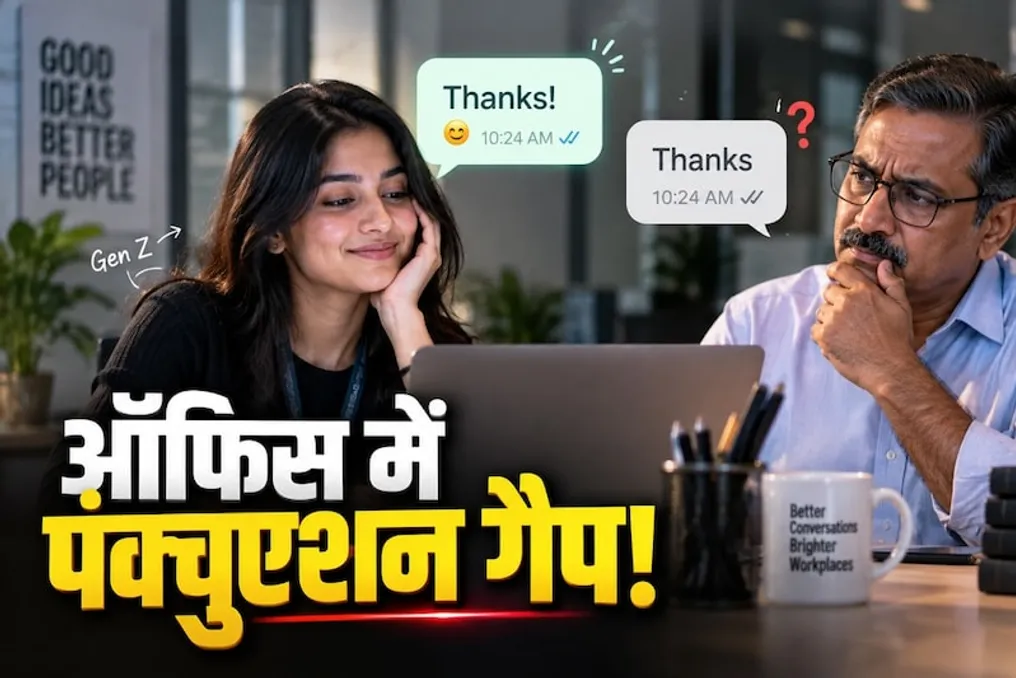
Communication methods in the office are rapidly changing. If previously most interaction took place in person or via email, now office chats occupy a significant share. In this environment, even a small word or just an exclamation mark (!) can change the meaning and tone of a message.

For example, if a manager writes in an office chat: 'Please send the notes from today's meeting,' and the reply is 'OK,' this is a completely standard response. However, if the reply sounds like 'OK, thanks!', this message might seem friendlier and more positive. Thus, in digital communication, the mood of a message can be changed not only by the words themselves but also by small signs like the exclamation mark.

The difference in office communication manners between Generation Z and older generations is now being documented in studies. In July 2026, Censuswide conducted a survey among 2400 employees in the US to study workplaces. According to this survey, 80% of Gen Z employees stated that differences in language and communication styles between generations create problems at work. The proportion of such statements among baby boomers was 30%.

According to the report, 51% of Gen Z representatives noted that linguistic discrepancies are a constant or frequent challenge in their office environment. Researchers believe that manner of speaking, use of short words, and minor nuances in office vocabulary can affect teamwork, trust, and rapport.

In a study published in the journal 'General of Experimental Social Psychology' in 2025, five different studies attempted to understand how people perceive the exclamation mark and what impact it has on the message's image. The essence of the difference lies not only in the exclamation mark itself but in the overall communication style. For Generation Z, chats and social networks are part of daily communication, so their communication may be more informal. Whereas for other generations, office communication remains more formal.

That is, for a manager, 'thank you' might just be gratitude, whereas for an employee, 'thank you!' sounds friendlier. The words remain the same, but the way they are understood can differ. The main difference lies not so much in punctuation marks as in different habits and expectations in communication. For Generation Z, chats and social media are a daily practice, while for older generations, office dialogue is more formalized. Thus, every small digital detail is not necessarily a sign of attitude; often it is just a reflection of a changing communication style.

Popular