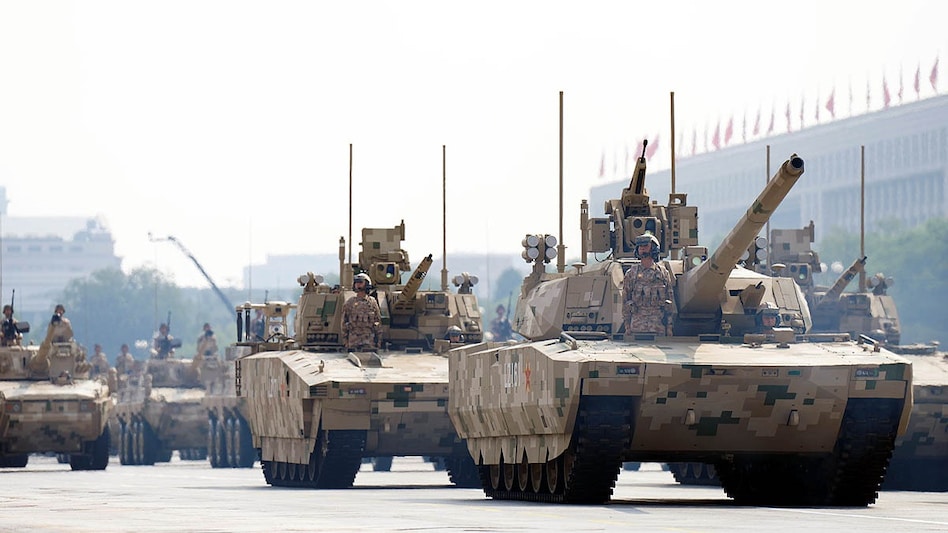
Researchers from China's defense complex have presented an innovative concept: the creation of a 60-ton main battle tank powered by atomic energy and equipped with a powerful railgun. According to reports, including those from Military Watch Magazine, this research was conducted by scientists from the First Machinery Group State Laboratory, the Special Department of Vehicle Design and Manufacturing, and researchers from Beijing Institute of Technology.
The article, published in the Chinese journal Acta Armamentaria in June 2026, sets a target for the post-2045 period. The concept includes a small modular reactor of 10 megawatts class and a 50 megajoule railgun capable of launching a projectile at approximately 3.5 kilometers per second, achieving a range of about 450 kilometers. This idea aims to overcome the limitations of traditional tanks and shift ground combat towards high-precision long-range firepower.
The researchers proposed implementing this system in stages rather than all at once. The first stage is planned before 2035. It involves installing a 10 megajoule railgun on an existing platform, with an estimated range of about 150 kilometers. For power supply during this stage, a 1500 horsepower diesel generator, supercapacitors, and a flywheel are planned, along with adding armor thickness of 2 megajoules. The goal of the first stage is to test electric weaponry based on existing technologies, avoiding a complex nuclear system.
The second stage approaches 2045. Here, the railgun power will increase to 20 megajoules, and the range will reach approximately 300 kilometers. The energy system will include a 2000 horsepower diesel generator and about 5 tons of advanced energy storage. The capability for electromagnetic armor will increase to 10 megajoules. This stage focuses on strengthening control and energy storage systems using technologies such as solid-state batteries, superconducting storage, and the vehicle's microgrid.
The third and final stage occurs after 2045. In this phase, the entire system will switch to atomic energy. A small modular reactor of 10 megawatts class, which will fit within a volume of about 2 cubic meters, will power the tank. This will enable the launch of a 50 megajoule railgun, providing a firing range of 450 kilometers at a projectile speed of 3.5 km/s. The entire concept is based on an atomic energy microgrid, where the primary weapon is the launcher.
Although this idea looks attractive on paper, its practical implementation faces serious difficulties. The main problem lies in creating a reactor that is compact and safe enough to fit into a 60-ton tank and protect the crew from radiation while maintaining the limited weight of shielding. The railgun requires a huge energy impulse in a very short time, which is planned to be provided by systems such as supercapacitors and flywheels.
Furthermore, the tank must withstand off-road impacts, requiring reinforcement of the reactor. Unlike traditional tanks, where there is a risk of ammunition explosion, railgun projectiles may be safer, and the need for ammunition will be lower. Issues of energy management, heat dissipation, and reliability remain significant. China's goal of 50 megajoules exceeds the previous figure of the American naval railgun program, which was initially around 32 megajoules but later slowed down.
If this system becomes a reality, the role of the tank could change drastically. Traditional tanks are primarily designed for direct fire and close combat. Weaponry with a range of 450 kilometers would transform the tank into a platform for high-precision long-range attack. Electromagnetic armor can help deflect enemy projectiles. Electricity-based systems can also improve the performance of engines, sensors, and other components.
China views this as a direction for the development of future ground warfare, where the energy source determines the power of the weapon system. Nevertheless, at present, it is only scientific work, and no official program or funding has been announced. Simulations, tests, and overcoming practical obstacles must be completed. This research demonstrates a long-term vision of Chinese defense technology, focusing on small nuclear installations and electrical weaponry, which aligns with global trends. However, issues of safety, cost, maintenance, and international regulation of a nuclear tank remain complex, as reactor damage in the field could pose a serious radiation threat. Experts believe that the first two stages are more realistic, while the third stage currently resembles science fiction. Overall, the idea shows that China is considering modernizing its ground forces by combining electrical and nuclear energy, and the future of this project depends on progress in energy storage and railgun technology.