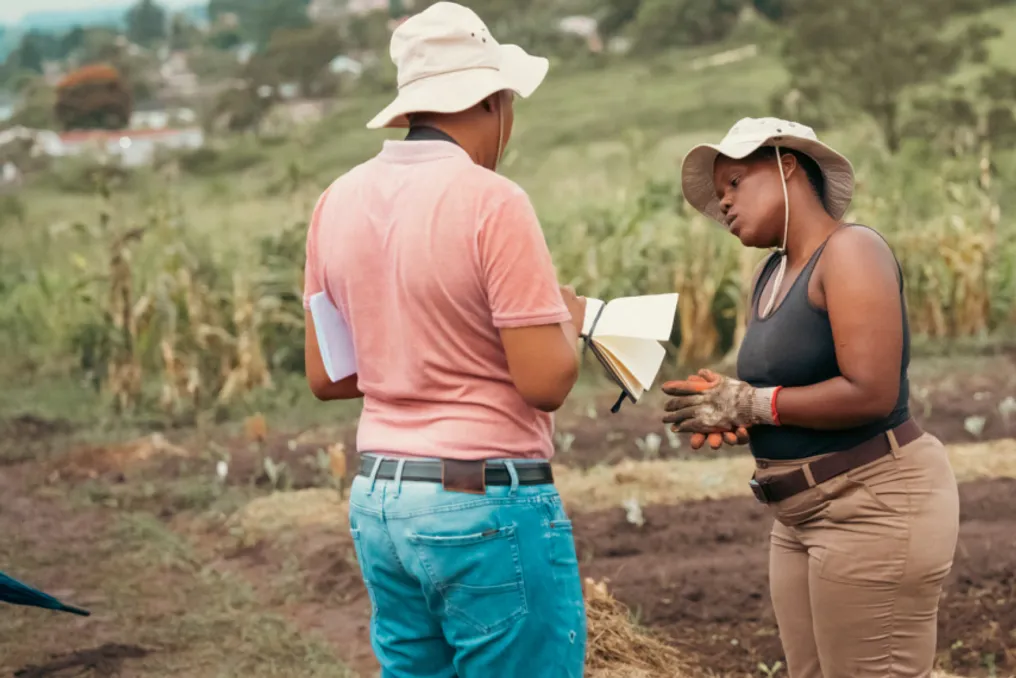
When evaluating development projects, it is important to look not only at the number of achieved indicators but also at what remains after funding ends. Dr. Siphesile Kange, head of the agricultural program at the Seriti Institute, explains how the Inchang Agroecology Center in eThekwini uses cross-sector partnerships and permaculture principles to build long-term food systems owned by the communities in KwaZulu-Natal.
Between 2022 and 2026, 697 people were trained and employed at the Inchang Agroecology Center in eThekwini municipality, KwaZulu-Natal, and 171 farmers participated through training, mentorship, technical support, and access to production resources. Three youth cooperatives were registered, and the adoption rate of agroecological practices at the center reached 71%.
While these figures are important, behind each one is a person—a farmer who has mastered a new soil management method; a young person who has begun to view agriculture not just as a means of subsistence, but as an economic opportunity; or a community member who has gained a chance to earn a living, contributing to the well-being of the entire community.
Community development is often measured by the number of people trained, farmers supported, jobs created, or funds invested. However, working with communities, farmers, and partners, Kange concluded that there is another equally important question: what will remain when the project ends?
In recent years, the Inchang Agroecology Center has brought together the eThekwini municipality, the South African Food Laboratory (SAFL), the Seriti Institute, farmers, community members, government departments, researchers, development organizations, and private partners.
Each party contributed uniquely. The municipality provided land, infrastructure, and institutional support. SAFL provided technical knowledge and expertise in agroecology. The Seriti Institute helped translate ideas into practical action, coordinating implementation and partnerships with farmers and communities.
The interest of this experience lies not only in the actions of each organization individually but in what became possible through their joint work. Over time, Inchang transformed from merely a vegetable growing site into a space where people could learn, work, conduct experiments, exchange ideas, and view agriculture anew.
Agroecology is sometimes presented as a set of farming methods: composting, soil management, biodiversity, water conservation, and regenerative production. These practices are important, but agroecology is also about how people interact with their land, communities, and food systems.
At Inchang, farmers were able to see these concepts in action: they observed composting, regenerative production, biodiversity conservation, and water-efficient farming, instead of just hearing about them in a classroom. This matters because farmers are not empty vessels waiting to be filled with technical knowledge. They possess their own knowledge of their land, crops, weather, and communities. Sound development does not replace this knowledge; it creates conditions for the meeting of different forms of knowledge, allowing farmers to experiment, ask questions, and decide for themselves what suits them.
Scott Drimm, co-director of the South African Food Laboratory, was involved in the partnership on behalf of SAFL. He states that the site is perceived this way thanks to 'John Nzirai from Ukuvuna, who worked with the center for several years, and his contribution was to encourage people to design the site as a whole, rather than as a collection of separate activities on one piece of land.'
The chicken coop, compost pit, garden beds, trees, and wetland were arranged so that each element supported the other. Seeds are saved on-site, and feed is grown rather than bought. This is why a walk through Inchang gives a farmer something no classroom can—they see the interconnectedness of the parts.
Drimm added that 'the full permaculture design will be completed as the site is handed over, and that is part of the work that will likely outlive us all.' Drimm also clearly defines what agroecology is and what it is not. He believes that simply replacing purchased fertilizers with compost is not necessarily agroecology if the broader systems remain unchanged. 'It's about how far the site has progressed. At Inchang, we aimed to move decisively towards genuine agroecology, not just to claim the term and be honest about what that claim means.'
This is one reason why partnerships are vital. No single organization holds all the answers. A municipality may have land and infrastructure but lack the capacity to run every agricultural program. A technical organization may understand agroecology but lack the connections necessary for effective community engagement. An implementing organization may be good at managing programs but dependent on others for specialized knowledge. Farmers themselves possess knowledge that none of these organizations can replicate. Partnerships work when these differences become strengths, not obstacles. At Inchang, the network eventually expanded beyond the initial three partners to include organizations dealing with natural resource management, research, markets, certification, farmer development, and government agricultural services.
Perhaps the most valuable thing created is the relationships. Relationships are often difficult to capture in a monitoring system; they do not always appear in the budget or logical framework. Nevertheless, they can determine whether something survives the end of funding. A good example is the link between the center and PGS 1 000 Hills. This organization continues to support farmers' product certification, shipments, sales agreements, and the weekly market. These are not just project activities; they are relationships and systems that can continue after individual funding cycles end.
Drimm emphasizes: 'If you asked me which part of Inchang is most likely to function in five years, I would name PGS 1 000 Hills. It is the mutual certification of farmers' products and the running of the weekly market, and neither of those depends on our funding cycles. Projects pay for things. Structures like that sustain their operation.'
This brings us back to the complex issues of sustainability. Development projects have a beginning and an end. Funding organizations eventually leave. Contracts expire. Staff retire. Programs close. This is not necessarily a problem. The problem arises when everything built within the project disappears with it. The Inchang experience demonstrated both opportunities and challenges.
There is now infrastructure, a network of farmers, practical knowledge, partnerships, and systems that did not exist before. At the same time, questions remain regarding financing, infrastructure maintenance, markets, and the transition to stronger local ownership.
Therefore, sustainability cannot be discussed in the last month of a project; it must be part of the design from the very beginning. When we engage with a community, we must ask: Who will own this? Who will maintain it? Who will use it? Who will make decisions after we leave? What relationships need to exist for this work to continue? And, importantly, what does the community itself want to preserve?
These questions do not always have simple answers, but discussing them early changes the approach to development. It shifts the focus from project implementation to creating something that can endure. For the author, this is one of the strongest lessons learned from Inchang.
The legacy of a community development program should not be limited to built infrastructure or the number of participants. It should consist of confidence, knowledge, relationships, institutions, and opportunities that remain in the community. The goal should never be to make communities perpetually dependent on development organizations. The goal should be to make themselves less necessary over time. This does not mean completely leaving communities. It means changing our role: from implementer to partner, from providing solutions to strengthening local capacity, and from creating projects to helping build systems that communities and institutions can own.
Agroecology provides a powerful space for this kind of development because it unites people, land, knowledge, livelihoods, and environment. But agroecology will not succeed just because farmers are taught to compost or conserve water. It will succeed when farmers have the knowledge to make informed decisions, when youth see viable opportunities in agriculture, when markets recognize the value of farmers' produce, when institutions work together, and when communities have a significant stake in the systems built around them. This is the main lesson of Inchang.