For Gen Z employees, work today means more than just a monthly salary; they place equal importance on personal time, work-life balance, and mental health. Because of this, the cohort's view of the workplace differs from that of previous generations. Generation Z aims to convey that they are ready to fulfill all their duties during designated working hours, but after that, the time must remain theirs. They view work as part of life, not as their entire life.
In the context of these changing perceptions, a dialogue between a Gen Z employee and their CEO became a topic of discussion online.
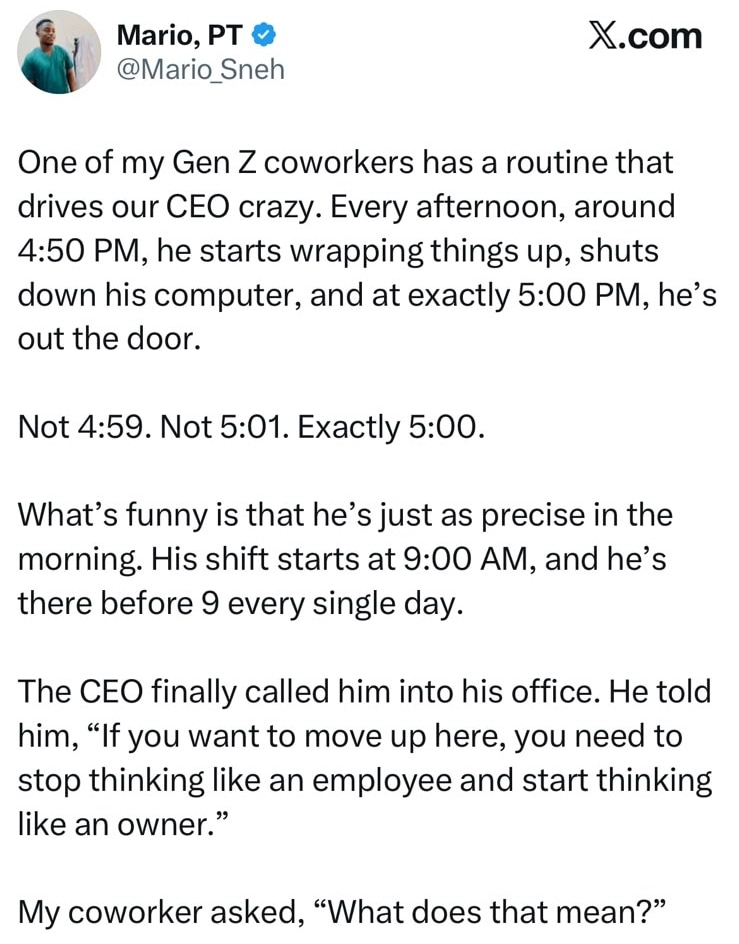
One user on X shared their experience, recounting how their Gen Z employee's habit surprised the company's CEO. According to the CEO, his employee arrived at the office before 9 AM daily, but around 4:50 PM, he would start wrapping up his tasks. He would shut down his computer and head home exactly at 5 PM, not at 4:59 or 5:01.
When the CEO noticed this trait, he called the employee into the office and advised him to 'think like an owner' for career advancement. The employee asked the CEO what exactly he meant by this advice.
According to the CEO's account, 'thinking like an owner' means the employee should not finish work simply by the clock. They should continue working as necessary until the task is completed and treat the company's work as their responsibility. In the CEO's opinion, the employee should not limit themselves only to their job duties but should also care about the company's future.
The employee nodded in agreement and asked the CEO a counter-question: 'Then will you give me 50% of the shares?' He directly asked if being expected to think like an owner would result in him receiving 50% of the company's shares. He argued his position by stating that the position of an owner and an employee are different. An owner holds a stake in the company, makes decisions, takes risks, and receives a share of the company's profits. Meanwhile, an employee receives a fixed salary for their work.
Following this dialogue, people began sharing their own experiences. Some argued that if an employee completes their work on time and achieves set goals, simply sitting in the office longer cannot be considered proof of diligence. One user noted that if an employee finishes their work within the established time, they do not need to stay extra minutes just to demonstrate commitment. Another person, sharing 42 years of work experience, recounted working for a long time where they were expected to show the same diligence as an owner but received the salary of a regular employee.
This entire conversation has once again raised an old question in the world of labor: is a good employee one who spends the most time in the office, or one who performs their work with full responsibility within the set time? The perception of time, effort, and responsibility is changing amid evolving work culture. For workers, work is not just a place to earn a salary, but it does not mean that extra effort and overtime must always be considered a standard duty. Perhaps the right balance is found where the company expects dedication from its employees and, in return, respects their time, effort, and boundaries.