Despite India's ODI victory in Guwahati, where 811 runs were scored, Gautam Gambhir expressed dissatisfaction
Read more
Aaj Tak
www.aajtak.in

Despite India's ODI victory in Guwahati, where 811 runs were scored, Gautam Gambhir expressed dissatisfaction

India defeated West Indies in the ODI match in Guwahati, winning by 8 wickets after setting a target of 406 runs. In this match, the total number of runs scored reached 811, with Shubman Gill scoring 223 runs off no dismissal. However, the head coach of the Indian team, Gautam Gambhir, was not satisfied with this high score and raised questions regarding the pitch in Guwahati.

After the game, in a conversation with a broadcaster, Gambhir stated that there should be more confrontation between the bat and the ball. He noted: 'You talk about cricket, but it is not cricket, it is just a game of baseball' (literally: 'it is only batting').

Earlier, batting first, West Indies scored 405 runs in 50 overs, losing 7 wickets. India, having won the toss, chose to field first, but at the beginning of the over period (powerplay), the bowlers again failed to exert pressure. John Campbell and Shy Hope formed a partnership of 110 runs, laying the foundation for a big score; both players scored a century, and Amir Jangu also scored a century.

Although West Indies reached 405 runs, given the pitch conditions favoring baseball and India's attacking potential, this score did not look entirely safe. In response, Rohit Sharma and Shubman Gill added 255 runs in the first 26 overs. Rohit scored 101 runs. After his dismissal, Gill took the initiative and guided India to the target in 43.3 overs, scoring 223 runs off no dismissal in 133 balls.

Gambhir emphasized that on this type of pitch, the situation becomes difficult for young bowlers. In his opinion, if the opponent had scored 400 runs and then India chased 400, it could have been great from a statistical and spectator point of view, but as a cricket coach and fan, he cares about the bowlers. He noted that while big scores please broadcasters and spectators, balance between the ball and the bat is necessary in cricket. Gambhir insisted that on such a pitch, there must be opportunities for bowlers to operate.

He also commented on bowler statistics. In Gambhir's view, sometimes a bowler's statistics might look poor, but that does not mean they bowled poorly. In such circumstances, the bowler should receive some support and an extra reserve. Gambhir advised the coaching staff to first assess whether the bowler correctly executed their game plan. He warned that excessive strictness towards bowlers based solely on numbers can hinder the preparation of young players.

Citing the debutant Akib Nabi, Gambhir said that he conceded 84 runs in 8.5 overs and took no wickets, but in such conditions, he needs support. According to him, there were not many opportunities for any bowler that day. Gambhir also explained the reason for giving Nabi his debut: the team could have given him a chance in the next match, but the series might have already been decided then. In his opinion, giving him a chance under pressure was more beneficial, as the World Cup is also a high-pressure game.

Gambhir also commented on Gunar Barara. He noted that experience playing in difficult conditions, whether in the first 10 overs or at the end of the match (death), is more valuable for players than achieving good statistics in easy conditions. India's victory in Guwahati gave them a 2-0 lead in the series, but after the match with a total score of 811, Gambhir made it clear that he was not impressed by just a rain of runs. His focus is on the confrontation between the bat and the ball in cricket. Thus, despite the win on the Barsapara ground, he raised questions, and his remarks are justified, as cricket is not just a game of baseball; bowlers must also receive sufficient opportunities.

Similar stories

Kuldeep Yadav reaches 200 ODI wickets, surpassing Shane Warne in balls bowled
Read more
www.aajtak.in

Kuldeep Yadav reaches 200 ODI wickets, surpassing Shane Warne in balls bowled

In the match between India and West Indies, players from the West Indies demonstrated strong play, dealing a serious blow to the Indian bowlers. John Campbell, Shai Hope, and Amir Jangu each scored a century, bringing the West Indies total to 405 runs. In rainy conditions, Kuldeep Yadav recorded a significant record.

In his 123rd ODI match, Kuldeep Yadav completed his 200th wicket, becoming the second fastest bowler in Indian history to reach this milestone. He is only surpassed by Mohammed Shammi, who took 200 wickets in 104 ODIs. Following him are Ajit Agarkar (133), Zaheer Khan (144), and Anil Kumble/Javagal Srinath (147).

Kuldeep secured his 200th wicket of Kemi Paul, who was caught by Virat Kohli in the long-on region after 45.1 overs. This moment marked Kuldeep's achievement of a double century in ODIs. Furthermore, Kuldeep surpassed Shane Warne in the number of balls required to achieve 200 ODI wickets, completing them in only 6319 deliveries. Among spinners, only Shaklan Mushtaq (5451) and Rashid Khan (5782) achieved this result with fewer balls. Following Kuldeep are Adam Jampa (6385), Adil Rashid (6881), and Shane Warne (6983).

Despite the record attack by the West Indies, Kuldeep remained among the few Indian bowlers who managed to partially contain the pace of the game. In his full quota of 10 overs, he took 2 wickets, conceding 65 runs, resulting in an economy rate of 6.50.

Before the West Indies reached 405 runs, Campbell scored 101 runs off 68 balls, Hope scored 104 runs off 94 balls, and Jangu scored 114 runs off just 77 balls. This was a rare sight in one ODI match where three batsmen score a century.

Second ODI between India and West Indies: Focus on Indian fast bowlers and Virat Kohli's form
Read more
www.aajtak.in

Second ODI between India and West Indies: Focus on Indian fast bowlers and Virat Kohli's form

Despite having a star-studded batting lineup, the main focus in the upcoming second ODI against the West Indies will be on the Indian fast bowlers. In the first match, the performances of Virat Kohli and Shubman Gill, who scored 296 runs, were insignificant, but the absence of Jasprit Bumrah and Hardik Pandya cast doubt on the fast bowling attack.

This match will take place in Guwahati at 14:00. In the first ODI played in Tiruvannamalai, India achieved its goal in less than 42 overs. Gill captained the side, Kohli scored in his characteristic style, and Kuldeep Yadav took four wickets, demonstrating his skill with the ball.

However, the picture regarding the fast bowlers was not entirely clear. Due to preparations for the upcoming World Cup next year, India introduced Nitish Kumar Reddy and rested Mohammed Siraj. This experiment did not meet expectations; Reddy, returning from injury, struggled for rhythm and lost 18 runs in his seven-ball over.

The main question now is whether India will give Reddy another chance with the new ball or bring back Mohammed Siraj. Jasprit Bumrah is in Japan for the Asian Games, and Hardik Pandya awaits fitness clearance. Thus, the squad for the second ODI could be significant in terms of World Cup preparation.

There might be an opening for the Jammu and Kashmir pacer, Akib Nabi. Although Nabi was included in the Indian team for the Test series against Sri Lanka, he has yet to make his international debut. India constantly looks for players who can contribute with both bat and ball. It was with this thought that Naman Dhir was included in the first ODI.

Dhir scored 33 runs in five overs but did not get a chance to bat. If Siraj returns, one of the all-round options will have to be dropped. Furthermore, including Nabi would require a complete reassessment of the team balance with an additional specialist bowler.

Regarding the batting, the most significant news for India is Virat Kohli's form. In the first ODI, Kohli looked completely in control, scoring a hundred runs off just 74 balls, making him the second Indian player after Sachin Tendulkar, who scored 15,000 runs in ODI cricket.

Kohli is now returning to the Baraspara stadium, where he scored his 45th century against Sri Lanka in January 2023. His current form heightens the tension for the second ODI. The only question is whether the West Indies bowlers can stop the Kohli-Gill duo this time.

For the West Indies, this match is a 'fight or die' situation, as they need a win to remain in the series. Their fielding also disappointed in the first ODI. Gill received early assistance and capitalized on it by scoring a hundred.

Coach Darren Sammy's team will attempt to end the long wait against India. The West Indies last won an ODI series against India in 2002. Therefore, the second ODI will feature a combination of Kohli's hot streak and close attention to the composition of the Indian fast bowling attack.

The Indian squad includes: Shubman Gill (captain), Rohit Sharma, Virat Kohli, Rituraj Gaikwad, K.L. Rahul (vice-captain), Dhruv Jurel, Nitish Kumar Reddy, Ravindra Jadeja, Kuldeep Yadav, Prasidh Krishna, Gurnoor Batra, Mohammed Siraj, Akib Nabi, Yashasvi Jaiswal, Naman Dhir.

India wins match against Japan by two runs despite low score
Read more
www.aajtak.in

India wins match against Japan by two runs despite low score

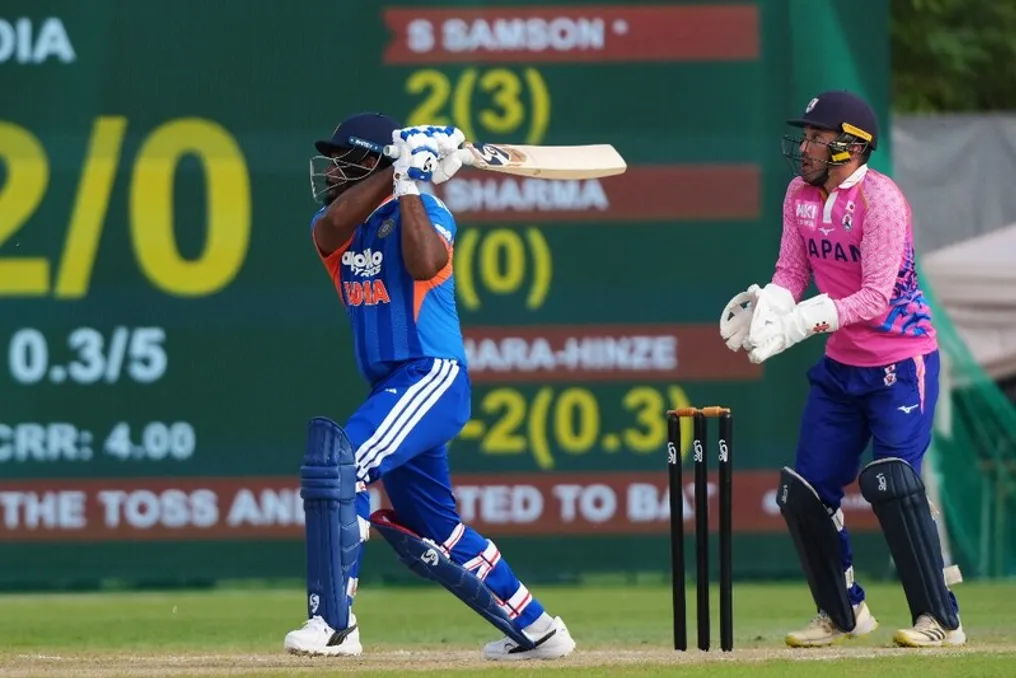
Despite the perceived large gap between India and Japan, the match at Sanno International Stadium on Tuesday, played in a five-over format, completely changed perceptions of the upcoming rivalry. The Japanese team, whom many considered incapable of facing Indian bowlers, managed to keep India under pressure until the final delivery. Ultimately, India won by only two runs, but this result raised several questions.

One of the most significant issues was Vaibha Suryavanshi's inability to participate in the match. Due to rain, the game was shortened to five overs. Under these conditions, India kept its starting pair of Sanju Samson and Abhishek Sharma, leaving Vaibha out of the squad. Abhishek returned after coming onto the field without scoring a single run, while Samson managed only 9 runs.

India had the option of using Vaibha for an aggressive game approach, but the team management decided to stick with the established starting combination. The situation was complicated by the fact that the Indian attack stumbled, losing four batsmen while scoring 32 runs in five overs.

Since Vaibha Suryavanshi was not in the squad, he was seen on the field during the match distributing water to the players. The young batsman, from whom bright shots were expected, served solely as a 'water boy' in this game. He was visible on the field handing water to the players, and his facial expression was captured by the camera.

This match also held significance in the context of celebrating the 75th anniversary of diplomatic relations between India and Japan. Both teams are preparing for participation in the Asian Games, where India is scheduled to start its tournament in the quarterfinals. Thus, this confrontation served as an opportunity for India to test its readiness for the Asian Games.

When the match was shortened to five overs due to rain, the question naturally arose as to why the young and explosive batsman Vaibha Suryavanshi was not used. However, the Indian team retained the opening pair of Sanju Samson and Abhishek Sharma, and Vaibha did not get a spot in the squad. The result was the halting of India's score at 32 runs against the Japanese spinners.

The problem for the Indian batsmen was not the strength of the known bowlers, but the Japanese spinners, against whom it was expected that the Indian players would hit powerfully. The pitch was humid, and the ball spun more than expected, which became a weapon for the Japanese bowlers.

Charlie Hara edged Abhishek Sharma for zero. Abhishek attempted a slog sweep but lost his timing. Following this, Ibrahim Takahashi forced Samson to play in the air for 9 runs, and he was caught at mid-wicket. Ishan Kishan also returned with three runs; he continued to try hitting against constant spin and was caught at mid-off.

Captain Shreyas Iyer scored 16 runs, but even he could not play freely due to the slow pace and spin of the pitch. In the Indian innings, only three-quarters were scored.

With such a small target of 32 runs, one might have assumed India would finish the match by several runs. However, in this unusual five-over contest, this small score became a pressure point for India. In the third over, Ravi Bishnoi earned 10 runs for Japan, and Washington Sundar conceded seven runs in the fourth over. In the last over, Japan needed only eight runs.

It was the experienced Akshar Patel who saved India. With over 150 IPL matches of experience, Akshar did not give the Japanese batsmen a chance to flourish in the last over. He placed the ball in such a way that Shirai Patmore and Benjamin Ito-Davis were unable to hit powerful shots.

Due to the rain, the pitch was also slow, which complicated matters for Japan. On the last delivery of Japan, a boundary was required, but Akshar Patel prevented this. Shirai Patmore tried to hit over the line, but the ball hit the pad and went towards the fine leg, and the batsman could only run one run. Thus, Japan's hope for a historic comeback ended, and India won a very tense match by a margin of two runs. Disappointment was evident on the faces of the Japanese batsmen, as they were confident they were very close to one of the greatest turns in cricket.

The drama in the last over intensified when umpire Chris Torgate called two wide balls against Patmore, who was attempting a reverse slog. India's captain Shreyas Iyer expressed disagreement with the on-field umpire Chris Brown. The decision on the second wide was ultimately overturned. This meant that in the final moments of the match, India was fighting not only against the Japanese batsmen but also against the decisions of the umpires.

Vaibha remained out of the game, but the match raised a second question.

Popular