
Springboks need to improve defense and attack before the World Cup
Read more
IOL
iol.co.za

Springboks need to improve defense and attack before the World Cup

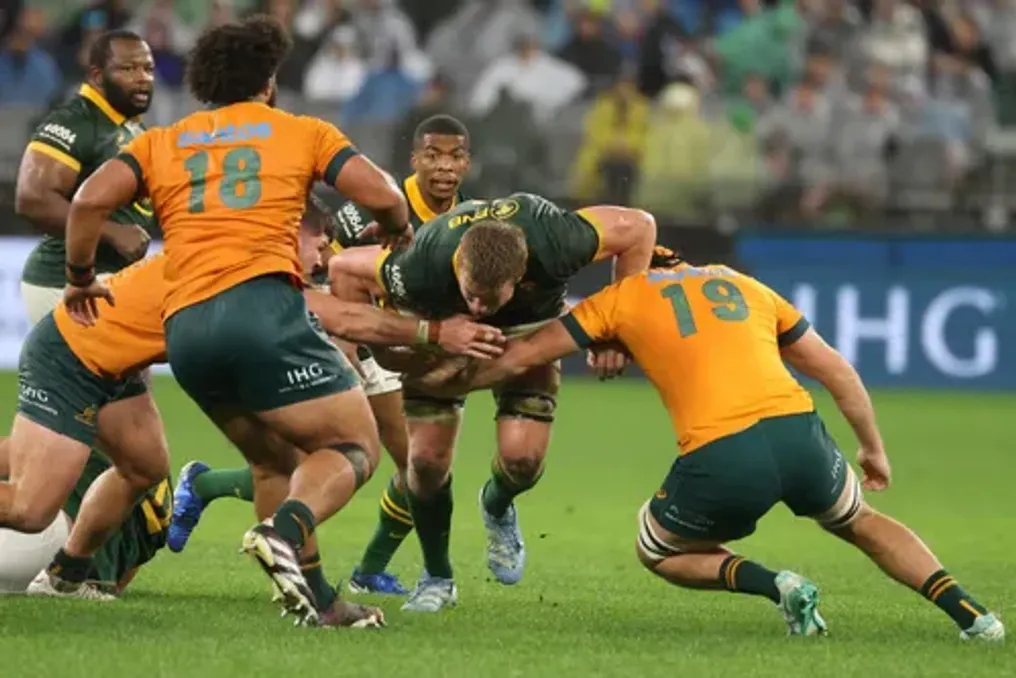
Despite winning the series against the All Blacks, the Springboks coaching staff, including head coach Rassie Erasmus, is not entirely satisfied with the results of recent months. Following a demanding period in the Southern Hemisphere, which included intense rivalry in the Rugby's Greatest Rivalry series against the All Blacks and a match in Perth against the Wallabies, the team must undertake significant work ahead of the upcoming World Cup in November.

The double world champion team remains a global benchmark in rugby, but recent match statistics point to several issues. Weaknesses have begun to show in the Springboks' armor against opponents, including porous defense in wide channels and uncharacteristic errors in finishing attacks within the 22-meter zone.

Although the team's fundamental foundation remains at the highest level, the margin between teams in elite test rugby is extremely small. This requires the coaching staff to define priority areas for work before traveling to the Northern Hemisphere. Considering the upcoming matches against Italy, France, and Ireland, it is urgently necessary to refine these aspects.

To maintain their dominance outside of home grounds, Rassie Erasmus and his management must improve these areas over the next month.

Strengthening Wide Channel Defence

The Springboks' defensive wall showed alarming breaches in the flanks, forcing the team to rely on chaotic defense. Conceding 22 touchdowns in five test matches—averaging more than four per game—is a startling statistic for a team built on defensive solidity. The Boks allowed 129 missed tackles compared to 99 by the All Blacks, as opposing attackers regularly found space on the wings. While efforts in chaos saved them from several certain scores, Jerry Flannery's defensive system must restore its cohesion by November.

Clinical Edge in Wide Attack

Despite demonstrating moments of dynamic ball-in-hand play, South Africa's wide attack remains ineffective in the opponent's 22-meter zone. In the series against the All Blacks, New Zealand scored 17 touchdowns against 14 for the Boks, made more line breaks (35 against 28), and showed significantly greater clinical efficiency upon entering the zone (3.5 points versus 2.6). Although counterattacks showed noticeable improvement during the Baltimore match, it was the direct running and power play of the Boks that helped them gain the series advantage. The team needs to bridge the gap between its power play and execution in the wide attack to maximize the return from numerous entries into the 22-meter zone via scrum and maul penalties, instead of allowing disappointing turnovers.

Lineout Consistency and Defensive Pressure

Although the Springboks' lineout proved very effective against New Zealand—they lost only two throws while forcing eight turnovers from the All Blacks—the set-piece play noticeably faltered in the match against Australia. The absence of Malcolm Marx exposed vulnerabilities in the throws, and the defensive contest mysteriously disappeared in Perth. Lineout accuracy and pressure on the opposition cannot depend on the lottery dictated by player substitutions. Before the World Cup, the Boks must achieve absolute stability at the hooker position and find a player capable of matching Marx's influence so that their primary attacking platform remains reliable.

Similar stories

Ruud Gullit states that South Africa and developing countries have approached the level of football elites
Read more
iol.co.za

Ruud Gullit states that South Africa and developing countries have approached the level of football elites

Netherlands legend Ruud Gullit highly praised the historic performance of Bafana Bafana at the World Cup, noting that improved physical fitness and defensive structure in smaller nations make international football more challenging for established giants like France and Spain.

Although the Bafana Bafana team reached the World Cup playoffs for the first time in its history, they were ultimately eliminated in the Round of 32 after facing co-host Canada. The future of South African football remains very promising even after head coach Hugo Broos departed following a five-year period of transformation.

Gullit, who played for the Netherlands 66 times between 1981 and 1994, emphasized that performances like this are clear evidence of the rapidly growing quality of world football.

He told ComeOn: 'Countries like South Africa have closed the gap with France and Spain in many aspects, and international football will become even harder for big, established teams in the future.'

Gullit specified that the basic philosophy of the game has remained unchanged, but the intensity of modern football has sharply increased. He noted that regardless of the tactical scheme (be it 4-4-2, 4-3-3, or 4-2-3-1), the tactical fundamentals remain the same. However, the pace and pressure on the field have significantly changed.

In Gullit's opinion, football has become much harder due to the increased intensity and exceptional physical condition of modern players. Defenses have become much harder to break down because every athlete is strong, organized, and capable of controlling the ball. This was evident at the World Cup; so-called small nations are incredibly difficult to defeat because each team can run, and every squad executes basic elements flawlessly. Although tactical principles remain, the overall standard of world football has risen everywhere.

Test match between Springboks and Wallabies in Perth seen as preparation for the 2027 Rugby World Cup playoffs
Read more
iol.co.za

Test match between Springboks and Wallabies in Perth seen as preparation for the 2027 Rugby World Cup playoffs

The upcoming test match between the Springboks and the Wallabies in Perth provides the Springboks team with an opportunity to conduct practical training ahead of the 2027 Rugby World Cup playoffs.

Despite the immediate goal of winning away against the Wallabies, the coaching staff under Rassie Erasmus is already analyzing all logistical and game details in anticipation of defending the title next year in Australia.

The Springboks are scheduled to return to this venue in October 2027, where they will face Romania in the third group match of the World Cup, making this test match a strategic operational rehearsal.

The group match itself is expected to be predetermined, as the Boks are likely to easily defeat the Romanian team. However, it is the first playoff match in Perth that will command the full attention of the Springboks.

Since the Springboks are likely to finish first in Group B, they will face the best team that finished third in Groups D, E, or F in the Round of 16. Siya Kolisi's team is expected to meet one of the teams from Japan, Samoa, or Tonga in this match before a possible quarter-final clash against their long-time rivals, the All Blacks.

Playing in Perth next Saturday allows the Boks to adapt in advance to the specific environmental conditions and logistical features of the city. Furthermore, Western Australia has a large South African community, and the upcoming match will give the Boks insight into the loud support in 'Perthfontein' that they might expect in 2027.

When South Africa meets Romania next year, as well as whoever awaits them in the Round of 16, the opponents may differ, but the environment will remain the same. By conducting rehearsals at the stadium, hotels, and training facilities now, Erasmus ensures that his team eliminates unknown variables, striving to reach peak form by the start of the main World Cup stage.

In the World Cup campaign, where success is determined by minor advantages, this early reconnaissance in Perth could prove to be a subtle yet decisive edge.

Popular