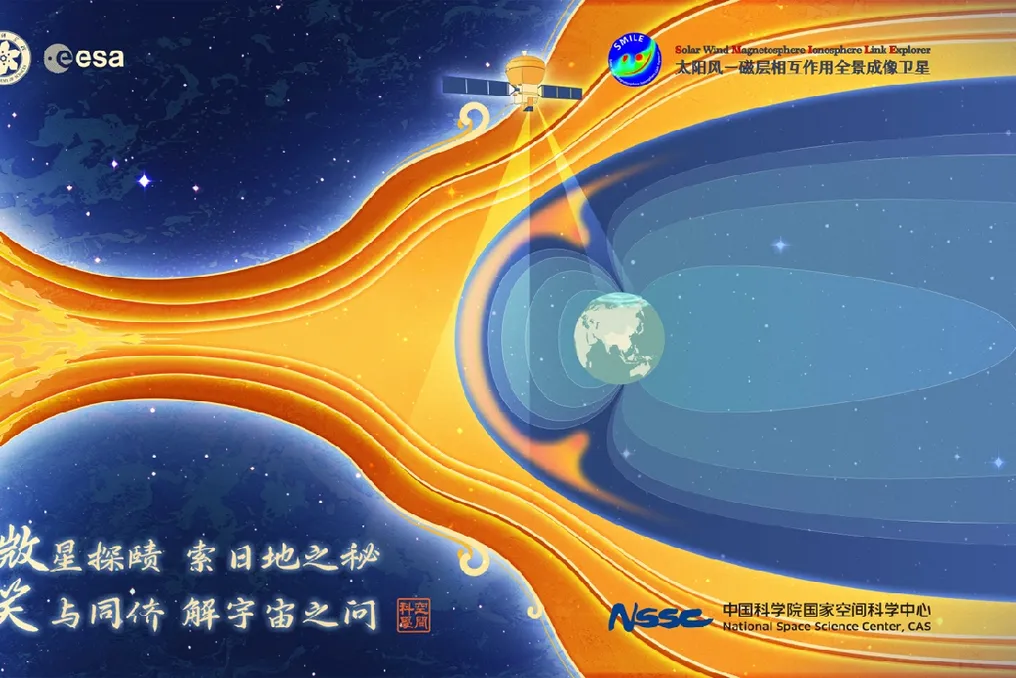
The Solar Wind Magnetosphere-Ionosphere Coupling Explorer (SMILE), a joint satellite mission by China and Europe, has successfully completed its in-orbit functionality check and entered the scientific operations phase, according to the National Space Science Agency of the Chinese Academy of Sciences (CAS).
The SMILE mission will provide scientists with the first panoramic visualization of the interaction between the solar wind and the Earth's magnetosphere. This process is the cause of space weather, which can disrupt the operation of satellites, power grids, and communication systems.
On Wednesday, China and Europe published the first batch of data and images obtained by the mission's four instruments. These include continuous panoramic images of the aurora borealis taken by the Ultraviolet Imager; an image of a supernova remnant in the Large Magellanic Cloud recorded by the Soft X-ray Imager; as well as the first high-precision data from very high near-Earth orbits collected by the Magnetometer and Low Energy Ion Analyzer.
The launch of SMILE took place on May 19, 2026, from the European Spaceport in Kourou, French Guiana. The mission reached its observation orbit on June 20, with a perigee of 5,120 km and an apogee of 120,900 km. The in-orbit check confirmed the normal operation of all mission elements, and the CAS team independently completed all payload operations.
Developed jointly by CAS and the European Space Agency, SMILE is the concluding mission of the CAS Strategic Priority Research Program in Space Science (Phase II). It continues the Double Star mission from 2003, and both parties have termed this a new stage in mission-level cooperation.
This mission is expected to provide a new perspective on the physics of space and help predict and mitigate threats associated with space weather.