Architecture in Latin America during this period reflects a constant dialogue about the issue of dwelling, cultural heritage, and the ways in which architecture can connect current life with established knowledge and places. From the International Architecture Biennial in Buenos Aires and initiatives focused on traditional construction methods and archaeological heritage, to new cultural infrastructures and housing developments in Argentina, Ecuador, and Peru, recent developments point to diverse methodologies for working with regional contexts. Across the area, themes such as memory, community, landscape, and material practice continue to influence both architectural projects and broader conversations about how cities and territories are occupied.
Urban Life: Biennials, Heritage, and Cultural Memory
The International Architecture Biennial of Buenos Aires is celebrating its 40th anniversary with its 20th edition, gathering approximately 100 architectural firms, 15 exhibitions, 50 conferences, and 40 international participants from over 55 cities. With free programming from September 22nd through October, as part of Buenos Aires' Design and Architecture Month, the event centers on the theme HABITAT, investigating the connection between individuals, architecture, cities, territories, and communities. The main exhibition, held at the National Museum of Fine Arts, is complemented by shows covering various subjects, from Antarctica and nature to the work of César Pelli and Diana Balmori, in addition to a cultural circuit throughout the metropolis.
The focus on habitat is also manifested in actions in other regions that treat heritage as living knowledge. In Valparaíso, Chile, the 'Oficios en Obra' meeting will bring together master craftsmen, industry professionals, educational institutions, heritage entities, and local communities between October 9th and 11th. The objective is to analyze ancient construction practices through workshops, demonstrations, debates, and heritage routes. This meeting covers the transmission of trades such as carpentry and rammed earth, alongside new technologies, sustainable construction, and conservation.
In Lima, meanwhile, Red Lima Milenaria is working to obtain UNESCO recognition for a group of pre-Columbian archaeological sites located within the modern city—including El Paraíso, Huaca Pucllana, the Campoy fortress, and sections of the Surco Canal—highlighting how historical sites persist in urban dynamics.
Cultural Institutions and Temporary Landscapes Expand Latin American Narratives
Cultural infrastructure is also changing in Buenos Aires, where MALBA announced an underground expansion, designed by Taller Frida Escobedo, as part of its 25-year program. This project, situated beneath Plaza República del Perú, will nearly double the museum's exhibition space, adding temporary galleries, an auditorium, multi-functional rooms, workshops, storage, offices, and a new patio square. By implementing the expansion under the park, the proposal maintains the existing public space while establishing new connections between the museum, the landscape, and adjacent avenues. This expansion is added to the recent inclusion of the Daros Latinamerica Collection and is scheduled to open in late 2029 or early 2030.
A distinct approach to the cultural agenda appears at Macondo Park, a ephemeral landscape designed by Bjarke Ingels Group (BIG), Komodo, and Vampire for Shakira's season in Madrid. Inspired by Gabriel García Márquez's fictional town of One Hundred Years of Solitude, the 185,000 square meter park surrounds the concert venue and extends the programming through areas dedicated to art, dance, gastronomy, literature, cinema, and fashion. Twelve thematic pavilions and a central plaza are interconnected by paths and over 500 trees, forming a transient cultural landscape parallel to the shows. The structures were assembled using light fabrics, modular scaffolding, and recyclable components, with initial planning for disassembly and reuse, while the trees will be returned to local nurseries after the season ends.
Featured Projects
Located in the Monkul swamp, Chile—a coastal ecosystem recognized by the Ramsar Convention—the Kay Kay Boardwalk and Viewpoint of Monkul, designed by Gonzalo Verdugo and Carlos Seguel Arquitectos, offers a low-impact wooden path. This allows visiting the public to experience the landscape while minimizing any interference with its delicate environment. The intervention, covering 1,110 square meters, follows the geography of the swamp through a yellowish and fully accessible boardwalk, equipped with three viewpoints containing scientific and cultural information. Developed in partnership with the Mateo Nahuelpan Community, the project dialogues with the ancestral territory and the Mapuche Lafquenche culture, while creating a succession of views, moments of pause, and meeting points. Its reversible construction and careful installation respect the existing landscape, uniting environmental interpretation, accessibility, and cultural heritage in a discreet intervention.
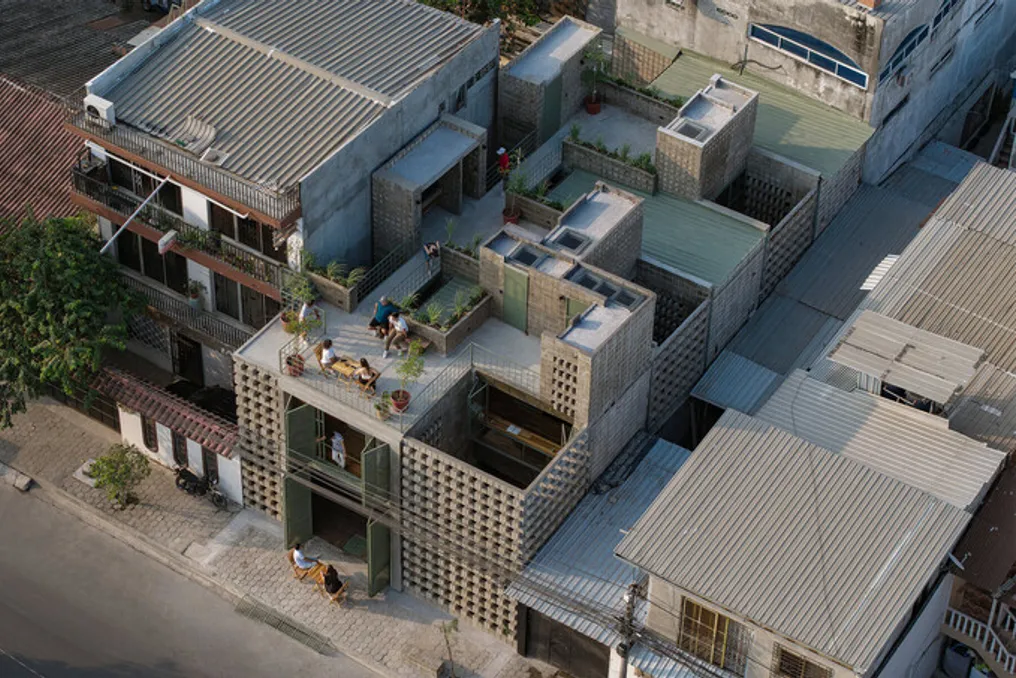
Situated in Durán, a satellite city of Guayaquil, Ecuador, the La Colmena project converts an old 70s residence into a housing complex consisting of three units, reconnecting housing with the neighboring neighborhood. Instead of occupying the entire 10 by 20 meter plot, the 335 square meter project preserves the original structure and incorporates six courtyards that filter rainwater and act as climatic corridors, improving ventilation and reducing internal temperatures in a city subject to seasonal flooding. A corridor planned as an extension of the sidewalk, shared terraces, gardens, and a cultural-gastronomic space further connect the houses to the street, generating places for meetings and productive activities. The use of local concrete blocks and wood, combined with traditional artisanal techniques, strengthens the project's link to its immediate surroundings.
Residencia KUSKA / Taller MACAA (Mission of Architecture, Construction, and Art in the Andes)
Located at an altitude of 3,100 meters near Cusco, the KUSKA Residence, by Taller MACAA, reformulates Andean construction traditions into a modern refuge intended for someone dedicated to writing and craftsmanship, while also hosting family, friends, and resident artists. The 400 square meter complex is organized into four interconnected volumes that form a sequence of patios, trails, galleries, and common areas, defining distinct relationships between private, communal, and surrounding landscapes. Built with 40-centimeter thick adobe walls on stone foundations, and covered with eucalyptus and reed, the building uses traditional materials to respond to the region's thermal variations. Additionally, solar energy systems, rainwater harvesting, biofilter, biodigester, and dry toilets allow the house to operate autonomously from conventional infrastructure.
Highlights Events
The XXX Colombian Biennial of Architecture and Urbanism, organized by the Colombian Society of Architects, will mark its 30th edition in 2026, continuing a biennial platform dedicated to recording and recognizing architecture produced in Colombia. This edition will expand its regional scope through the I Latin American Biennial of Architecture of Colombia, which will foster the dialogue of projects from all of Latin America with Colombian practice. In parallel, the VII Colombian Biennial of Architecture Students will highlight academic research and experimental projects by emerging architects. The biennial aims to provoke reflection on architecture in relation to its urban, historical, environmental, social, and cultural aspects, bringing together professionals, institutions, the academic community, and the general public.
Design Week Mexico will return from October 5th to 11th for its 18th edition, integrating architecture, design, craft, and art throughout Mexico City through exhibitions, creative residencies, installations, guided tours, and other public activities. The 2026 edition will feature Chile as Guest of Honor Country and the Middle East and North Africa as Guest Region, with events at locations such as Casa Ortega, National Museum of Anthropology, G.56 Creative Hub, Design House, Espacio CDMX, and Lincoln Park. As part of the program, ArchDaily will also promote the Next Practices Live in Mexico event at Design House on October 12th, gathering winners of the Next Practices Awards 2026 and former award-winning firms based in Mexico to debate the potential for transformation and action in architecture.