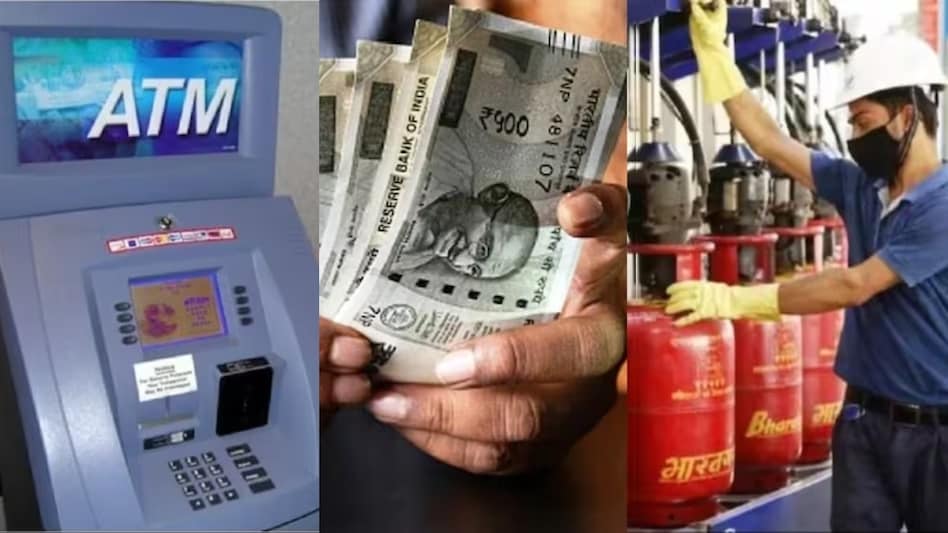
Ten major financial changes take effect on October 1, affecting various sectors from LPG to banking operations
Read more
Aaj Tak
www.aajtak.in

Ten major financial changes take effect on October 1, affecting various sectors from LPG to banking operations

Ten significant financial changes will come into force in the country in October, which may affect citizens' wallets. These changes cover a wide range of topics—from rules concerning liquefied petroleum gas (LPG) to transaction fees at SBI ATMs, as well as regulations for Fixed Deposits (FD) and the National Pension System (NPS).

In the realm of Fixed Deposits (FD), the Reserve Bank of India (RBI) is modifying the methods for determining and publishing interest rates for wholesale fixed deposits by commercial banks. The new provisions will become effective on October 1, 2026. Under the updated structure, banks are required to publish their wholesale deposit rates in advance and provide daily information on rates effective at 10 am. Although banks may set rate variations based on specific conditions, they are generally expected to apply a uniform interest rate for identical wholesale deposits.

Starting October 15, 2026, a UPI MDR transaction fee will be introduced for sellers for certain operations. This fee will apply to seller transactions exceeding ₹2000. Transactions up to ₹2000 and those conducted by small traders under the zero MDR structure will remain free.

The Pension Fund Regulatory and Development Authority (PFRDA) has amended the rules of the National Pension System (NPS) and NPS Lite regarding the charges collected through Points of Presence (POP) from customers. These revised charges will take effect on October 1, 2026. According to the new scheme, customers registering through POP must pay a one-time registration fee of ₹200 for each PRAN. It is important to note that this amount will not be debited from the customer's account in a single lump sum.

Home LPG consumers who have not yet completed biometric authentication need to complete this procedure before October 1. Otherwise, subsidies may be suspended. After completing the authentication, consumers will be able to use both the ordering service and subsidies.

As is customary monthly, there may be an LPG price change on October 1. This is particularly relevant against the backdrop of heightened global tensions and difficulties in oil and gas supplies from the Middle East. Prices for gaseous fuel and commercial LPG may be adjusted.

SBI is making changes to the rules for using SBI cards at other banks' ATMs and Automated Teller Machines (ADWM) for salary account holders. The updated rules will take effect on October 1, 2026. For all types of SBI salary accounts, the number of free ATM transactions at other banks will be reduced from ten to five per month across all centers. For Basic Savings Bank Deposit (BSBD) accounts, four free cash withdrawals per month are permitted, after which every subsequent transaction will incur a charge of ₹15 plus GST.

Regarding NRI investments, the process for a foreign national to purchase property previously required more paperwork compared to standard transactions. However, this process will change starting October 1, as the Income Tax Department simplifies the TDS procedure for expat buyers. From this date, residents and HUF families purchasing property from NRIs will not require a separate tax deduction and TNN for TDS; instead, the buyer can claim, deposit, and report TDS using their PAN card.

On October 1, the submission of documents for obtaining a Life Certificate begins. If you wish to receive a pension, you must submit a life certificate either online or offline. This process commences annually in October.

It should also be noted that October will have 16 bank holidays. Before visiting a bank in October, it is recommended to review the official list of RBI bank holidays. Despite this, banking operations, as well as transactions via online banking and ATMs, remain available.

Furthermore, on October 1, prices for home electronics such as televisions, refrigerators, and air conditioners may increase. This is linked to the projected rise in raw material prices during the festive season.


Similar stories

10 major changes take effect in the country starting October 1: from LPG prices to ATM usage rules
Read more
www.aajtak.in

10 major changes take effect in the country starting October 1: from LPG prices to ATM usage rules

As September ends and October begins, the country will see a series of significant transformations (Rule Change From 1st October). These changes will affect not only the prices of liquefied petroleum gas (LPG) cylinders but also the rules governing bank ATMs and fixed deposits. Furthermore, an increase in prices for televisions, refrigerators, and air conditioners is anticipated before the start of the festive season. Below are 10 major changes taking effect on October 1, 2026, that will impact every household and pocket.

The first change concerns the cost of LPG cylinders. Oil marketing companies review LPG cylinder prices monthly and publish new tariffs on the first day of each month. Attention will be focused on this issue regarding October 1, 2026. Although the prices of commercial 19 kg LPG cylinders have changed multiple times, the cost of domestic 14 kg LPG cylinders remains stable. Currently, the price in Delhi is 942 rupees, in Kolkata it is 968 rupees, in Mumbai it is 941.50 rupees, and in Chennai it is 957.50 rupees.

The second change, also related to LPG, will come into effect on the first of October. The government plans to introduce a new regulation for obtaining subsidized domestic LPG cylinders. Users will now need to undergo authentication via Aadhaar biometrics or complete the e-KYC process to receive the LPG subsidy. Those who have already completed this procedure do not need to repeat it.

The third change, concerning LPG users, will happen at the beginning of next month. An OTP-based LPG delivery service may launch on October 1. This means that when delivering an LPG cylinder, not only a paper receipt but also verification of a one-time password sent to the customer's registered mobile number will be required.

On the first day of the month, oil marketing companies change not only the prices of LPG cylinders but also revise the tariffs for Aviation Turbine Fuel (ATF Price). Any changes in this area affect air passenger expenses. Currently, ATF is sold in Delhi at a price of 1,04,927 rupees per kiloliter, in Kolkata at 1,09,450 rupees per kiloliter, in Mumbai at 98,247 rupees per kiloliter, and in Chennai at 1,09,873 rupees per kiloliter.

The fifth change affects State Bank of India (SBI) customers and will take effect on October 1, 2026. Holders of SBI savings and salary accounts may have to pay higher fees for cash withdrawals. According to the bank's website, customers with Basic Savings Bank Deposit (BSBD) accounts opened through a branch will pay 15 rupees plus GST for each ATM withdrawal after four free withdrawals per month. For SBI salary account holders, the rules change from the beginning of October: the monthly limit of free transactions decreases from 10 to half, i.e., 5. Upon exceeding the free ATM withdrawal limit, a fee of 23 rupees plus GST will be charged for the sixth transaction. After exceeding the free limit for non-financial transactions, a fee of 11 rupees plus GST will apply.

The Reserve Bank of India (RBI) is set to change the Fixed Deposit rules (FD Rule Change), and these changes concern the interest rates on FDs, which will be effective from October 1. Under the new rules, banks must update FD interest rate details daily by 10 AM and display all details on their website. Furthermore, banks are mandated to provide uniform interest rates for deposits received on the same day without any discrimination. The rule regarding differential interest on large deposits linked to maturity rates will also change.

The eighth change relates to birth and death registration, taking effect on October 1, 2026. Rules are being tightened in cases of delay. Reports indicate that a strict fine may be imposed for untimely registration after 21 days. Moreover, submitting an affidavit may now be required for late registration after the stipulated period.

The ninth change warns that purchasing home electronics such as televisions, refrigerators, and air conditioners may become more expensive during the festive season. If you plan to purchase home electronics, including TVs, refrigerators, and air conditioners, you should consider the potential price increase.

RBI introduces changes to urgent deposit rules; new norms effective from October 1st
Read more
www.aajtak.in

RBI introduces changes to urgent deposit rules; new norms effective from October 1st

The Reserve Bank of India (RBI) plans to make adjustments to the structure regulating interest rates on large fixed deposits (FDs). These new rules will come into effect on October 1, 2026. The RBI's goal is to enhance transparency and improve the system.

Furthermore, the central bank aims to provide banks with some flexibility regarding liquidity requirements, which necessitates these changes.

Under the revised rules, banks are required to disclose information about large fixed deposits daily by 10 AM. Banks will be given 10 minutes to update rates. When paying interest on deposits, including large sums, banks must adhere to the rates displayed on their websites, regardless of the amount deposited.

These changes will increase depositor confidence and ensure greater transparency. A large deposit is defined as a fixed deposit of ₹30 million or more. Interest rates applied to such deposits may differ from those offered on regular savings accounts.

Another significant change is the prohibition of setting different rates for the same amounts. Previously, banks could apply varying rates across their different branches, but now all branches must offer the same rate for large deposits received on the same day.

However, this structure allows banks to differentiate rates under certain circumstances related to liquidity requirements. Banks may offer different interest rates on large deposits depending on the withdrawal rate applicable within the Liquidity Coverage Ratio (LCR) framework.

Popular