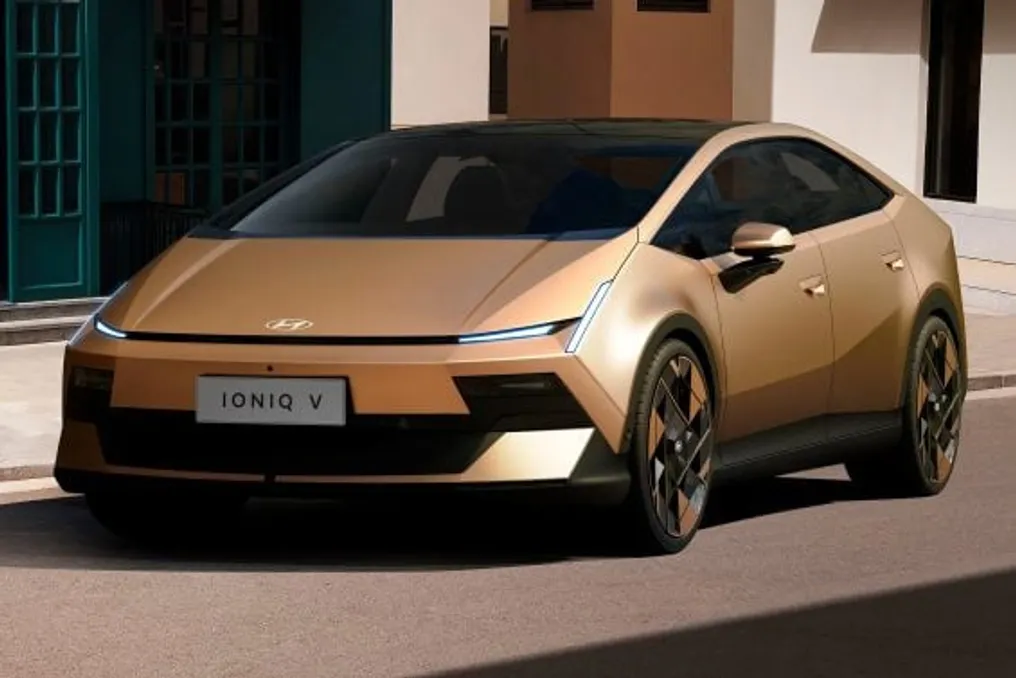
Hyundai introduced the Ioniq V model in China on Tuesday (29). This electric sedan features a wedge design that has been notably compared by critics and the public to Lamborghini supercars.
The vehicle is marketed by Beijing Hyundai, which operates as the South Korean manufacturer's joint venture in China. Currently, it has an initial promotional price starting from R$ 76 thousand (equivalent to 99,900 yuan) and offers a range of up to 650 km under the Chinese CLTC cycle.
There are five configurations available for the Ioniq V. After the pre-sale period, the prices will rise to a range between R$ 83.6 thousand (109,900 yuan) and R$ 106.4 thousand (139,900 yuan). Launch discounts, varying between 8,000 or 10,000 yuan depending on the version, temporarily reduce this range to something between R$ 76 thousand and R$ 100.3 thousand (131,900 yuan).
The Ioniq V represents the production version of the Venus concept, which was displayed in April at the Beijing Auto Show, maintaining practically the same aesthetic as the prototype. Its features, such as the wedge front, thin blade-like headlights, angular surfaces, and highly inclined windshield, led to the nickname 'Temurario,' an allusion both to the Lamborghini Temerario and the low-cost Chinese product website, Temu.
Some analysts also identified elements of the Lamborghini Countach, a 1970s icon known for popularizing the wedge shape.
The model adopts the new Origin visual language, which replaces Hyundai's traditional electric vehicle pixels with light streaks that follow the body lines. With a fastback profile and frameless doors, the sedan has dimensions of 4.90 meters in length, 1.89 meters in width, 1.47 meters in height, and 2.90 meters in wheelbase, presenting a stature similar to a Toyota Camry.
However, the similarity to Lamborghini ceases when it comes to performance. Built on the E-GMP platform, the Ioniq V is equipped with a single electric motor, which can generate 190 hp or 228 hp, depending on the version. In contrast, the Temerario, which uses a hybrid V8 engine, produces 920 hp.
The lithium iron phosphate (LFP) batteries, supplied by CATL, have capacities of 53.48 kWh or 66.85 kWh, ensuring ranges of 540 km or 650 km. Furthermore, the 800-volt system optimizes the recharging process.
The vehicle's interior is centered around a 27-inch 4K screen, powered by a Qualcomm Snapdragon 8295P processor, and includes a head-up display as an option. The central system incorporates Ernie Bot, Baidu's AI assistant, and Doubao, from ByteDance, allowing independent voice commands for four distinct cabin areas.
The driving assistance package, developed in partnership with the Chinese company Momenta, includes features such as assisted navigation on roads and in urban environments, as well as automated parking.
This sedan inaugurates a series of 20 electric and extended-range vehicles that Hyundai plans to launch in China over the next five years, aiming to reach the goal of selling 500,000 units in the country by 2030. Although the CnEVPost website indicates that the Ioniq V may be available in other markets, the brand itself has not yet disclosed details about which locations these would be.