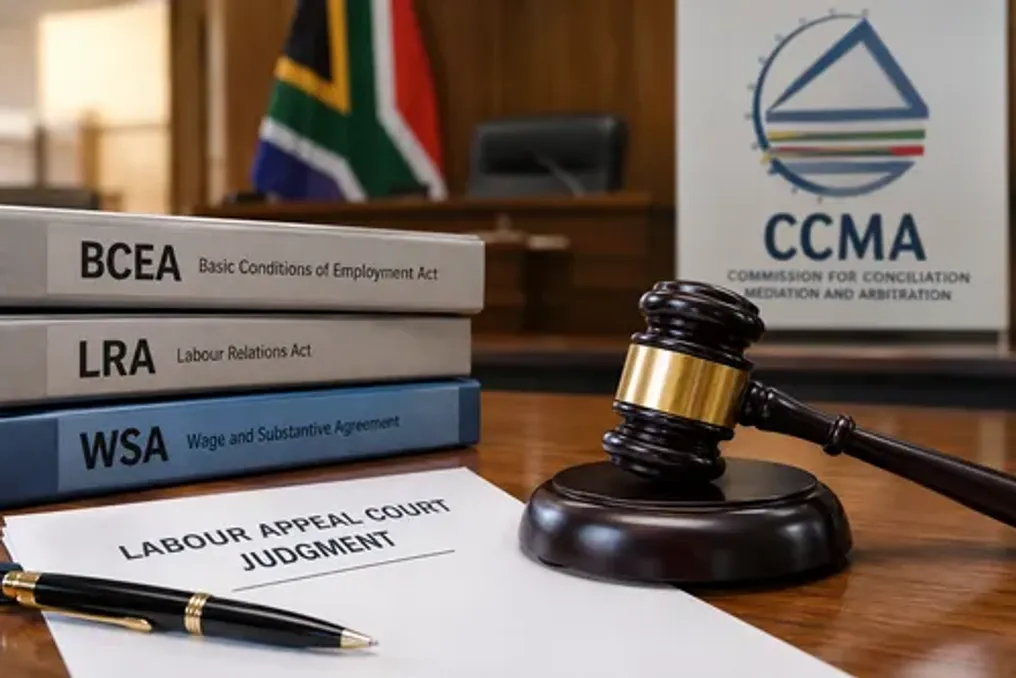
The Labour Appeal Court overturned a ruling that required the Commission for Conciliation, Mediation and Arbitration (CCMA) to pay a former commissioner over R176,000 in outstanding salary arrears. The court ruled that the Labour Court had mistakenly treated the collective agreement as the contractual basis for the remuneration claim.
The appeal concerned SN, who challenged his salary after transitioning from the status of a partial CCMA commissioner to that of a full commissioner. SN approached the Labour Court asserting his right to be paid at the P6 salary level.
He put forward two alternative arguments. The first was the existence of an implied or express term in his employment contract stipulating that his remuneration should not be lower than what he received as a partial commissioner. Secondly, he referred to the CCMA Wage Structure Agreement (WSA) concluded with the Commission Staff Association in January 2018.
The Labour Court dismissed the argument regarding the implied contractual term allowing him to maintain his previous income. However, it upheld the alternative claim, establishing that the WSA applied to him after he became a full commissioner, granting him the right to remuneration at the 80th percentile of the P6 level. Consequently, the court ordered the CCMA to pay him R176,174.32, which represented the difference between the remuneration received and the amount the court believed he should have received according to the WSA. Subsequently, the CCMA appealed this decision.
SN disputed his salary from the outset
SN was appointed as a Level B partial commissioner in July 2017 for a fixed term expiring in June 2023. In October 2020, he successfully applied to transition to the status of a full commissioner and was transferred from the CCMA regional office in Cape Town to Tshwane. Both changes took effect on December 1, 2020.
When he became a full commissioner, he was offered an annual package exceeding R615,000, equivalent to more than R51,000 per month at the P7 level. He disputed the remuneration amount from the beginning. According to his evidence, he earned approximately R61,500 per month while fully engaged as a partial commissioner, based on a daily rate of just over R2,900 for 21 days.
He also insisted that he should be placed at the P6 level. Initially, SN refused to sign an employment contract because he felt the salary did not correspond to the category attached to his appointment. After discussions with the CCMA HR manager, he eventually signed the contract on January 28, 2021, adding a handwritten clause regarding the remuneration dispute and stating that his signature should not be construed as acceptance of the offer. The CCMA rejected his request for modification, insisting that he was correctly placed within its salary progression system. He continued to work and received R51,281 per month until his dismissal for misconduct on February 22, 2022.
The appeal focused on the source of the right to salary
The Labour Appeal Court stated that the core issue in the Labour Court's decision was that it failed to determine the contractual source of SN's alleged right to P6 remuneration. The appellate court noted that remuneration is a material term of an employment contract, and that SN explicitly rejected the remuneration offered by the CCMA. Therefore, it reasoned, the Labour Court should have first established whether the parties had reached an agreement on the remuneration obligation before deciding what salary SN should receive.
The court held: 'In the absence of convincing evidence on this point, the basis for enforcing an alleged contractual transaction becomes questionable.'
The Labour Appeal Court pointed out that the Labour Court dismissed SN's claim based on the implied term and also found no explicit agreement to pay him remuneration at the P6 level. Thus, it effectively imposed a remuneration condition that was not demonstrated to arise from an agreement between the parties.
The dispute concerning the collective agreement followed a different legal path. The appellate court also found that the Labour Court had mixed two different jurisdictions. SN pursued his case as a contractual claim under Section 77(3) of the Basic Conditions of Employment Act (BCEA). But after dismissing his contractual claim, the Labour Court ruled that the WSA applied to him, interpreted its provisions, and used this interpretation to establish his right to P6 remuneration. The Labour Appeal Court emphasized that the dispute regarding the interpretation and application of the collective agreement falls under Section 24 of the Labour Relations Act (LRA).
The court stressed that jurisdiction depends on the true nature of the dispute, not the label assigned by the applicant. The court stated that the Labour Court should have determined whether SN established a contractual right to P6 remuneration. Instead, it found that the Labour Court moved directly from interpreting the WSA to concluding that SN had a contractual right to the corresponding remuneration.
'The Labour Court never answered this question,' said the appeal court, referring to the contractual source of the alleged right.
WSA was not automatically part of the employment contract
The Labour Appeal Court further determined that the WSA is a tool of collective bargaining and is not in itself a term of SN's individual employment contract. Consequently, the question was not merely whether the WSA supported its interpretation of salary structures. The critical question was whether he had established a contractually enforceable right under Section 77(3) of the BCEA to the remuneration he claimed.
The court found that the Labour Court failed to explain how the WSA was incorporated into SN's employment contract or how it created a specific contractual right that he sought. Instead, the Labour Court effectively created this right by interpreting and applying the WSA, and then enforced it as if it were a contractual right. The Appeal Court ruled that such an approach blurs the distinction between contractual disputes under Section 77(3) of the BCEA and collective agreement disputes under Section 24 of the LRA.
Labour Court's ruling is set aside
The Labour Appeal Court concluded that the Labour Court erred significantly by granting relief on a legal basis that was not supported by the cause of action asserted by SN. It noted that after dismissing the alleged implied contractual term, the Labour Court should have found another contractual basis for the P6 right. It failed to do so. Instead, it ventured into the territory of interpreting and applying the WSA, which is a collective agreement dispute governed by Section 24 of the LRA. Therefore, the Labour Appeal Court upheld the CCMA's appeal and set aside the Labour Court's ruling. The substituted order dismissed SN's claim and ordered him to pay the CCMA's costs. The Appeal Court also ordered SN to pay the CCMA's costs for the appeal.