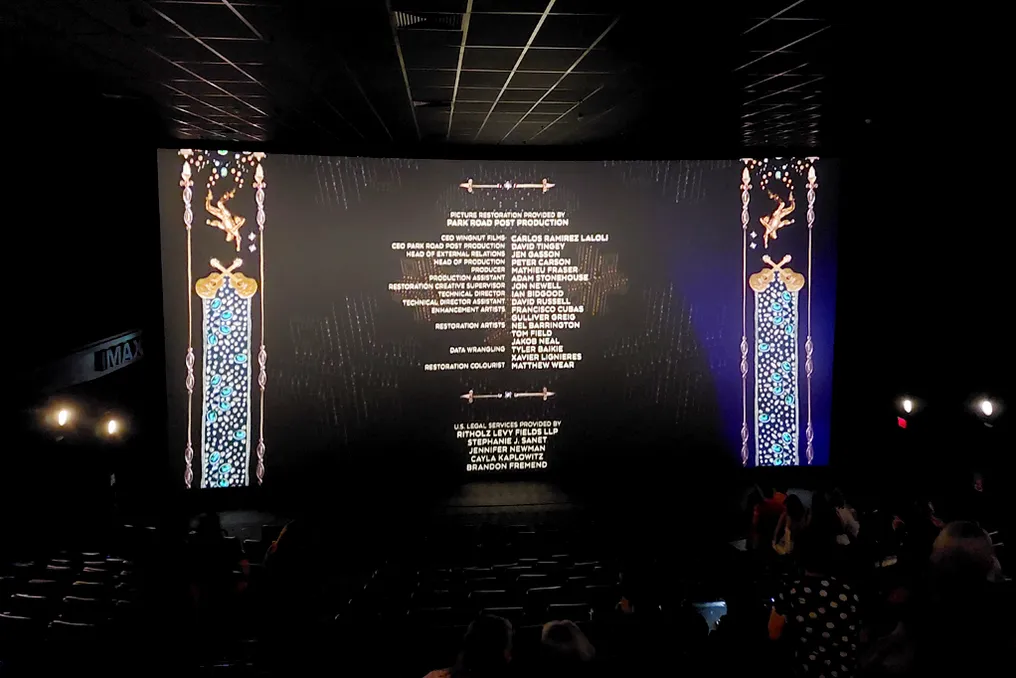
The inclusion of credits at the end of cinematic films was a gradual process. In the late nineteenth and early twentieth centuries, it was not necessary to mention the participants of a work. Credits began to appear around 1910, driven by public interest in knowing the actors' names.
Initially, placing them at the beginning served as a form of advertising, highlighting the star that would be presented. Florence Lawrence, for example, earned the nickname 'the Biograph Girl' before her name was widely publicized. In 1910, when producer Carl Laemmle hired her for his company, he began promoting her as a central figure and attributing her name to the films. Thus, the so-called star system began to transform actors into attractions as relevant as the productions themselves.
For much of cinema's history, main credits were shown before the first scene; first came the names, and then followed the narrative. However, gradually, filmmakers began experimenting with this order.
In 'Citizen Kane' (1941), the actors were introduced at the end of the film, simulating the moment of applause in a theater. The credits also indicated that many of the protagonists were newcomers to cinema and were part of the Mercury Theatre, a theatrical group founded by Welles and John Houseman.
In 1956, the end credits took on a particularly elaborate format. 'Around the World in 80 Days' did not have opening credits. After the last line, a sequence of approximately six minutes began, conceived by designer Saul Bass. This animation summarized the adventure while listing the names of the actors and the crew. Since several artists had brief appearances, their names were linked to the scenes in which they appeared, and even the film's title only appeared at the end.
The notion of integrating credits into the spectacle itself persisted in subsequent years. 'West Side Story' (1961), for example, relegated the credits to the end, presenting them as graffiti scattered across a stylized New York. In the following decade, works like '2001: A Space Odyssey' (1968) also almost abolished opening credits, allowing the story to begin without the traditional list of names.
George Lucas was one of those responsible for definitively consolidating this idea. 'Star Wars' (1977) begins practically without credits. After the studio logos and the title, the plot already starts with the famous text ascending through space. Lucas wanted to maintain this dramatic beginning without being interrupted by names.
When producing 'The Empire Strikes Back' in 1980, this choice created a conflict with the Directors Guild of America, which required the director's identification at the beginning. Lucas opted to keep the credits at the end, paid a fine of over US$250 thousand, and distanced himself from the organization.
From that point on, placing credits at the end ceased to be seen as a peculiarity of certain directors and became an increasingly common practice. Currently, most films start directly with the narrative, reserving the long list of collaborators for the end.
The word 'credit' has its own origin, deriving from the Latin 'creditum,' which is linked to the verb 'credere,' meaning 'to believe' or 'to trust.' In English, the term 'credit' also came to mean honor or recognition for someone's merit, and the use of credits to designate those responsible for a film production has been documented since 1914.
In summary, although the position of the credits has changed, their function has remained the same: continuing to be the means by which cinema recognizes who deserves credit for what has been watched.