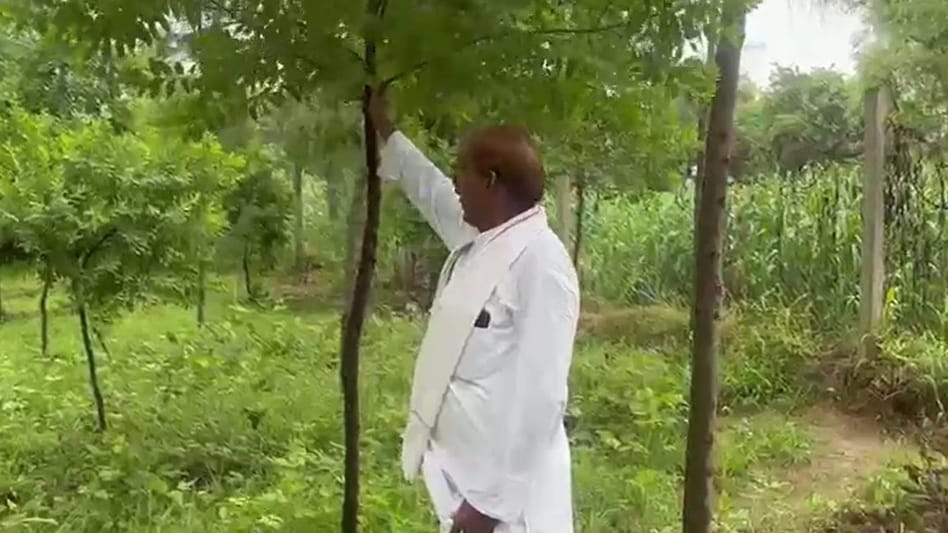
In partnership with the Forest Stewardship Council (FSC India), this story details how forest certification is transforming the living conditions of small landowners in India. The narrative begins with Leelamani H.G., who resides in the Shivamogga district of Karnataka state. Her plot of land, measuring only 0.37 acres, was initially degraded and yielded no income for her.
Meanwhile, in another region, in the Kanyakumari area where rubber is cultivated, K.M. Thomas has been managing his plantation since childhood. Although bamboo and rubber are dissimilar, for Leelamani and Thomas, these small parcels of land represent sources of livelihood, assets, and long-term investments, as well as part of a system that requires responsible approaches from forest product producers.
For a long time, it was believed that the certification system was intended for large forest estates and organized producers. However, a significant portion of India's forest landscape is managed in smaller units, such as family plantations, home gardens, farms, community forests, and scattered plots.
Many small landowners relied on experience-based methods and local knowledge but had limited access to markets or systems that allowed them to demonstrate their land management. This is where the Forest Stewardship Council (FSC) comes into play.
FSC is an international non-profit organization dedicated to promoting responsible forest management worldwide. Its certification system aims to ensure that forests are managed in an ecologically sound, socially beneficial, and economically viable manner. In India, FSC collaborates with forest owners, small landowners, enterprises, and communities to encourage sustainable forestry practices, protect biodiversity, and strengthen agriculture.
From a Small Plot to a New Income Source
For 55-year-old Leelamani H.G., the starting point was one acre of agricultural land in the village of H Kallukoppa, located in the Purappemane Grampanchayat of Hosanagara Taluk, Shivamogga District, Karnataka. She and her husband grew areca nuts, but the income was seasonal. To supplement it, she also engaged in local catering.
Leelamani told The Better India that managing a small plot primarily dependent on areca nuts limited their income and made it vulnerable to the agricultural cycle. Since they only had one acre, opportunities to increase earnings from existing land were minimal, leading her to pursue catering for an additional and more stable income stream.
The opportunity arose in 2022 when an Industree team visited her village to speak with farmers about cultivating bamboo. She had a plot of degraded land measuring 0.37 acres that was not producing any harvest. Instead of leaving it fallow, she decided to plant bamboo.
Leelamani noted that the change was also psychological. 'Adopting bamboo cultivation gave me the confidence to make this decision and try something new on our land.' Today, there are about 60 healthy clumps of bamboo growing on this plot. She added that witnessing this transformation gave her confidence that even a small farmer can utilize underutilized land to create a new source of income.
In 2025, Leelamani became part of an FSC-FM group certification. Her story demonstrates how a global standard can reach the level of small landholding, providing farmers with tools to transform modest plots into recognized, productive, and more sustainable livelihoods.
How to Make a Global Standard Work Locally
A certificate may carry a global standard, but compliance with that standard is achieved directly on the ground. To understand how certification can assist small landowners in India, The Better India interviewed Dr. Suresh Gairola, the Director of FSC India. Dr. Gairola, a former employee of the Indian Forest Service, possesses over forty years of experience in forest management and has held positions such as CEO of the Indian Council of Forestry Research and Education and Additional Director of Forests (Wildlife).
According to Dr. Gairola, India requires 'global standards with local relevance.' The FSC system comprises 10 principles and 70 criteria covering legal compliance, worker rights, communities, biodiversity, and forest monitoring. However, applying these requirements to thousands of small farms differs significantly from applying them to a large plantation.
This is where group certification helps. Several small farms can be included under a single FSC certificate. The farmers retain ownership and management of their land, while the Group Structure handles common systems for training, monitoring, documentation, and compliance. This means small landowners do not have to manage the entire certification process independently; they receive support while continuing to make decisions about their land.
Dr. Gairola emphasized that the system for India must account for farm size. He pointed out that the situation in India is unique because the average landholding size is 1–2 hectares, whereas in other countries, small landowners might possess 200–300 hectares. Therefore, the needs of a large number of small landowners must be naturally understood.
This difference in scale is crucial for the accessibility of certification. In India, responsible forestry must operate across thousands of small plots with systems that support the farmers rather than treating them as owners of large plantations. He stated that India has a specific FSC certification standard for small plantations under 20 hectares, which is a significantly simplified version for ease of understanding, compliance, and auditing.
Plantation Following the Supply Chain
In Kerala and the neighboring Kanyakumari district, rubber is the primary crop. For 71-year-old K.M. Thomas, rubber cultivation began in his childhood. His parents owned a small rubber plantation, and this experience stayed with him even after two decades working in Saudi Arabia.
After retiring, Thomas returned to India and began seeking investment opportunities near Kanyakumari. He decided that investing in land and a rubber plantation would secure his retirement.
Today, Thomas manages approximately 15 acres of mature rubber plantation at Betel Estate in Kanyakumari district. Latex is supplied to New Ambadi Estate under contract. He also has about 30 acres in Green Earth/Green Valley Estate in Kannan Kuzhi, planted in 2021 with approximately 5,000 rubber trees. He expects these trees to be ready for tapping in 2028.
For Thomas, managing the plantation has become a long-term process of record-keeping and oversight. He explained that at the beginning of rubber cultivation, before tapping starts, care must be taken of the trees. After that, only tree fertilization and plantation maintenance are required, which ensures long-term income.
He regularly visits the plantation, checks operations, and monitors the plantation's activities. He asserts that all proper records are kept: records of labor, harvest logs, pesticide use, management of corrective actions, and Continuous Improvement Process (CIP).
Even for Thomas, planting material is part of the decision-making process. He believes that selecting seeds from Ambadi is healthier, citing seed selection in the nursery, plant growth monitoring, and removal of plants upon detecting issues.
When Trees Become Part of the Farm
Further west, in the village of Wagner, Ukai Taluk, Tapi District, Mohanbhai Sambhaji Gamit adopted a different approach. His farm combines eucalyptus with rice cultivation. He manages about five acres of eucalyptus plantations located in various spots while continuing regular agricultural cultivation. He also sells milk to a local dairy and produces and sells organic fertilizer.
He told The Better India that he integrated eucalyptus planting with conventional farming. This approach means the trees are not merely replacing food crops; they are becoming part of a broader agricultural and economic system.
Mohanbhai also uses organic fertilizers on his farm, producing and selling them on the open market. He noted that after FSC certification, he gained a clearer understanding of what happens outside the farm, learning more about the supply chain operations.
For Mohanbhai, this intervention also led to increased income. He stated that there was an increase of almost 30–40%. His experience shows that certification itself does not create livelihoods, but the surrounding systems help farmers understand production practices, supply chains, and the requirements associated with accessing responsible markets.
The People Behind the Certificate
In Karnataka, Kerala, and Gujarat, cultures differ, as do the circumstances under which these farmers began engaging in forestry. Leelamani started with a degraded plot of land. Thomas returned to rubber after retirement. Mohanbhai integrated trees into the existing farming system. Nevertheless, their experiences point to the same shift: certification can transform the daily decisions of people managing small plots of land into something that can be documented, tracked, and recognized within a larger market system.
Thus, the impact lies not just in the certificate itself, but in the knowledge and systems that small landowners build around it.
The Bigger Forest Picture
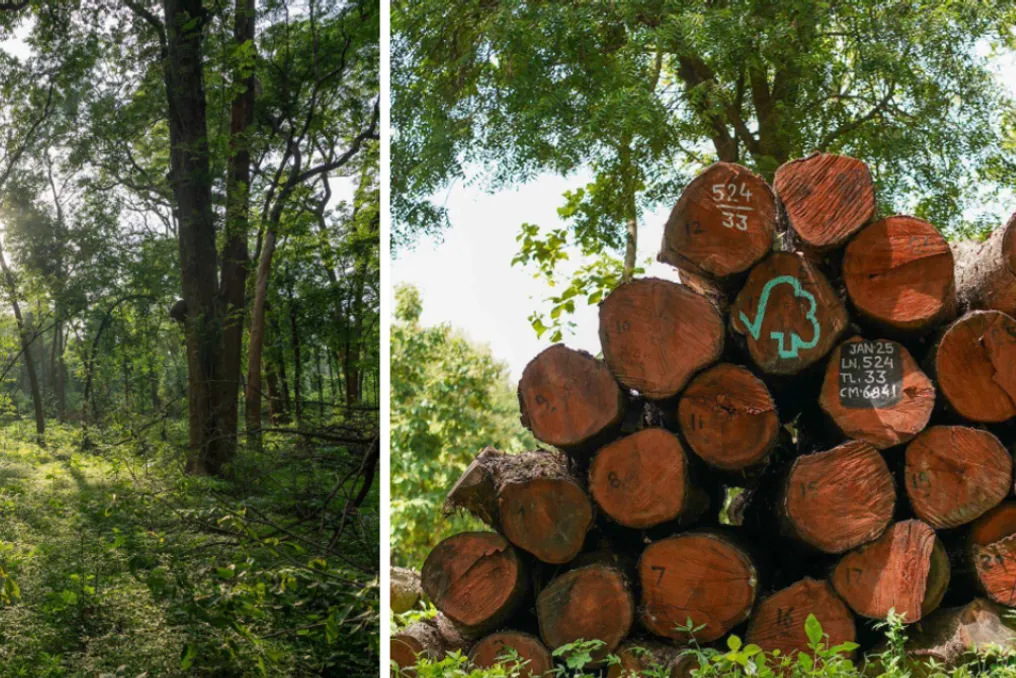
Dr. Gairola views this issue within the context of a larger ecological crisis. He stressed that urban and industrial emissions are one of the main causes of greenhouse gas increases and climate change. Trees remain one of the best options because, as they grow, they absorb carbon. Even after logging, the carbon remains locked in the wood for many years. Furthermore, trees act as sponges and help improve groundwater levels.
He called for discussing the details but explaining them in simple language, striving for a global standard with local relevance and embedding sustainability as a lifestyle. This phrase reflects the main objective. India has a large number of small and marginal landowners. Bringing them into responsible forestry systems cannot rely on the same approach used for a large, single-owner plantation.
This is where the importance of certification emerges. For Leelamani, it meant a different perspective on a degraded 0.37-acre plot. For Thomas, it meant tracking the plantation's operation and latex beyond the trees themselves. For Mohanbhai, it meant understanding how his eucalyptus and rice farm fits into the broader supply chain. Thus, the impact of responsible forestry is measured not only by certified hectares but also by whether the people working on those hectares have the tools, knowledge, and market access to manage them.