As temperatures rise, people often resort to using air conditioners, coolers, and other electronic devices to keep homes cool. However, there is a way to make the wall of the house itself resist heat penetration, and this does not require expensive or high-tech materials; ordinary red bricks used in construction are sufficient.
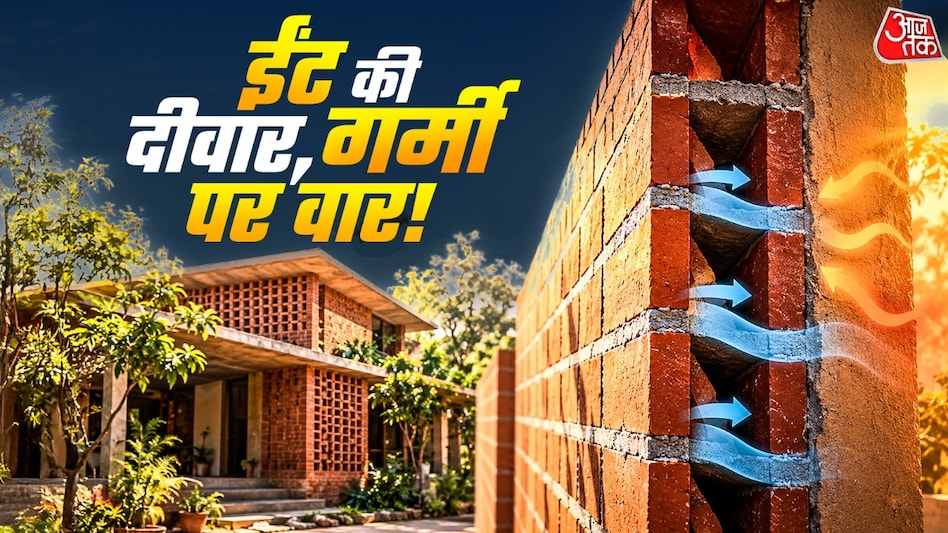
Traditionally, bricks are laid flat in the wall, along their length. But when using the Rat Trap Bond technique, bricks are installed vertically, on their edges. This method creates small air cavities inside the wall. The trapped air acts as a kind of insulator for the wall, slowing down the direct influx of external heat into the house.
Rat Trap Bond is a brick wall construction method where, instead of standard horizontal laying, bricks are placed vertically on their edges. Although the exterior wall looks like ordinary brickwork, an empty space is formed inside. It is this internal void that makes the technology special, as the air within it helps reduce heat transfer.
Thus, solar heat does not reach the room through the wall as quickly as it might in a solid wall. This internal cavity can be considered a natural air insulation within the wall. The air trapped between the bricks prevents the direct penetration of external heat, reducing thermal impact through the wall and allowing the house to remain cooler than conventional buildings.
Thanks to this technology, which helps control the indoor temperature, especially in hot regions, it also has other advantages. Unlike traditional solid brick walls, using Rat Trap Bond may require less brick and mortar because there are voids inside the wall. This leads to reduced consumption of building materials and a decrease in the weight of the wall itself. Thus, one technology benefits in terms of material savings, reduced structural load, and thermal insulation, allowing it to be classified as energy-efficient and climate-adaptive construction.
Furthermore, these internal cavities can be used to organize electrical wiring or service pipes according to the design. The advantage is that less wall demolition may be required in the future to access utilities. Nevertheless, before concealing wiring and pipes, local building codes and structural design must be taken into account.
Architect Lori Baker popularized the Rat Trap Bond technique in India. In Kerala, he actively promoted construction based on low costs and local building materials, using similar methods of working with bricks. His focus was on creating more functional and well-thought-out structures with limited resources. Today, this approach can be very useful for creating durable, low-energy consumption homes.
In an era where people use expensive insulating materials and modern methods to cool housing, Rat Trap Bond proves to be an effective way to keep a house cool without significant financial investment. Sometimes, simply changing the way ordinary bricks are used can make construction more sensible. However, this technology should not be applied thoughtlessly; an architect or structural engineer must determine its applicability based on wall strength, local climate, site conditions, and overall structural design. Thus, only the perspective on brick changes, but this small shift opens up great possibilities for material savings, weight reduction, and improved thermal characteristics.