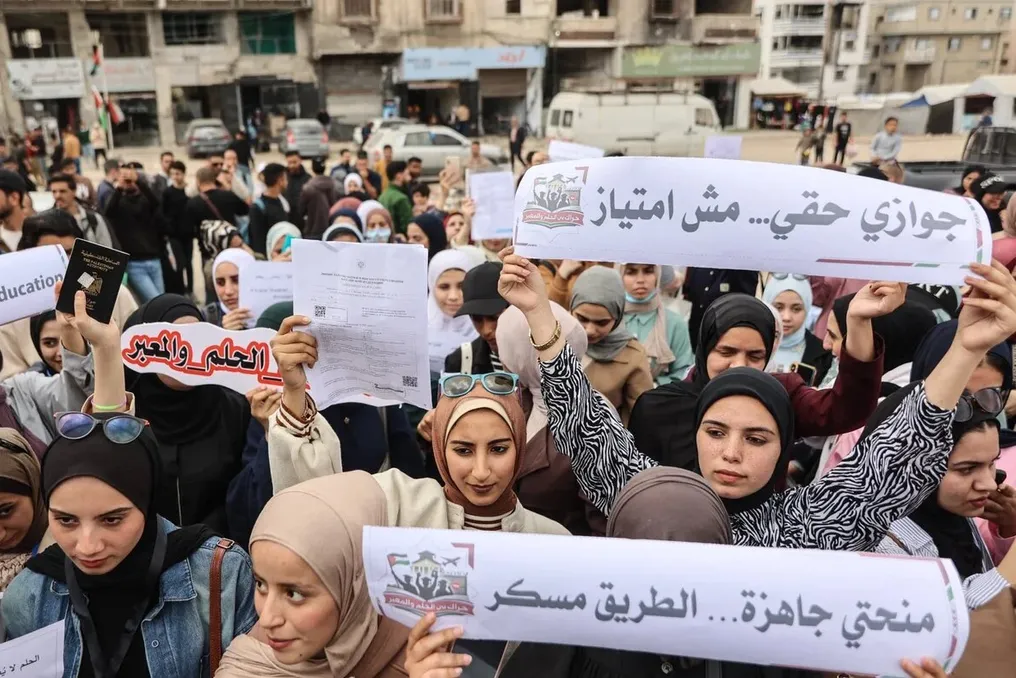
Students from Gaza have taken legal action against Ireland due to visa refusal. Hazem Faris, a 19-year-old student, was granted a full scholarship to study computer science at the Southeast Technological University in Ireland, which he saw as a chance to 'achieve his dream.' However, because Faris resides in Gaza and his family has been forced to leave their homes eight times since 2023, the Irish government's refusal to issue a visa has made his dreams impossible.
Faris is one of at least 103 Palestinian students whose visas were rejected in Ireland this year. Furthermore, the percentage of approved visas has dropped from 83.8 percent in 2025 to only 27.5 percent this year.
Last week, a team of lawyers challenged the decision by Justice Minister Jim O'Callaghan regarding the refusal, demanding that the ruling be overturned. Among the barristers involved are Blinne Ni Grallagh, who represented South Africa at the International Court of Justice in the genocide case against Israel, and Imonnn Dornan. The solicitors include Sinéad Marmion and Alanah Faulkner, along with several junior counsel.
The legal proceedings began last week with the case of Palestinian student Hafez Alraies from Gaza. Marmion reported that 26 other cases are pending. According to her, 'I think the other side is concerned about the size and speed [of the case].' Marmion and her colleagues held an administrative hearing in the High Court on Tuesday, confirming that evidence and legal documents will be presented to the court this week.
Marmion noted that they returned to court to assess the opposing side's readiness to expedite hearings, possibly next Monday. She added that 'the significance of today is that they hope to start reviewing our cases very soon.' She stated that the court recognized the urgency of the matter and is prepared to allocate time for these cases to be heard.
Phoenix Law stated in a press release that the case 'is based on our view that the minister's position is irrational, unfounded, and does not respond to the necessary urgency of our client's situation, and is discriminatory.' The representatives are asking the minister simply to change his stance and grant the visa to a client who is highly motivated to acquire skills to rebuild his life and country using those skills.
The 'Let Them Study' movement is gaining popularity both online and on the streets of Ireland and in Dáil Éireann, the lower house of the Irish parliament. Sinéad Gibney, a Social Democrats TD from Dublin Rathdown, told O'Callaghan in the Dáil last week: 'The Department of Justice asks people to get documents while most buildings in Gaza are destroyed, and over 70,000 people have died.' She asked the minister: 'When, Minister, will your government understand the situation and reverse its decision to block these students from studying here in Ireland?'
In Faris's case, for example, the refusal states that 'the visa officer is not convinced that the financial means provided are sufficient for the purpose of the visa,' despite Faris having a full scholarship. The letter also mentions that Faris 'lacks sufficient evidence of a strong obligation to return to his country' and has 'gaps in education and employment that have not been accounted for.'
For Faris, this decision was both heartbreaking and incomprehensible. He told MEE: 'I lost my home and all my belongings, including books and study materials. I tried to study under conditions of severe food and water shortages, power outages, and constant fear of bombings.' He added that 'I never stopped learning' and managed to complete his studies with a grade of 94.4 percent.
His refusal letter resembles letters received by other Palestinian students. Phoenix Law noted in its statement the 'undeniable irony that Ireland intervened in the South African genocide case against Israel at the International Court of Justice, but cannot acknowledge the problems that genocide poses to students submitting original documents in their visa applications.'
O'Callaghan responded to Gibney in the Dáil that there is an 'established process' for issuing student visas. On the streets, the 'Let Them Study' movement and this case are supported by students who hoped that Palestinian students like Alraies and Faris would join their communities this autumn.
Sean Radcliffe, chairman of Trinity BDS, affiliated with the Boycott, Divestment, Sanctions (BDS) movement at Trinity College Dublin, stated: 'They deserve to start university right now, in my classes, sitting next to me, developing their skills to one day rebuild Gaza.'
Radcliffe was one of five students who attached themselves to the Department of Justice after their visa refusals and now voluntarily assists in the students' legal cases. Similar student protests with 'empty chairs' also took place last week. For students like Faris, the lawsuit is a last chance for hope. He told MEE: 'There is now a lawsuit in this matter, and I hope the judge will consider our case fairly, and we will get a real opportunity to continue our education. I hope the outcome will be fair for all Palestinian students facing similar circumstances.' He concluded: 'All I want is the opportunity to learn, build my future, and one day use what I learn to serve my people and my community.'