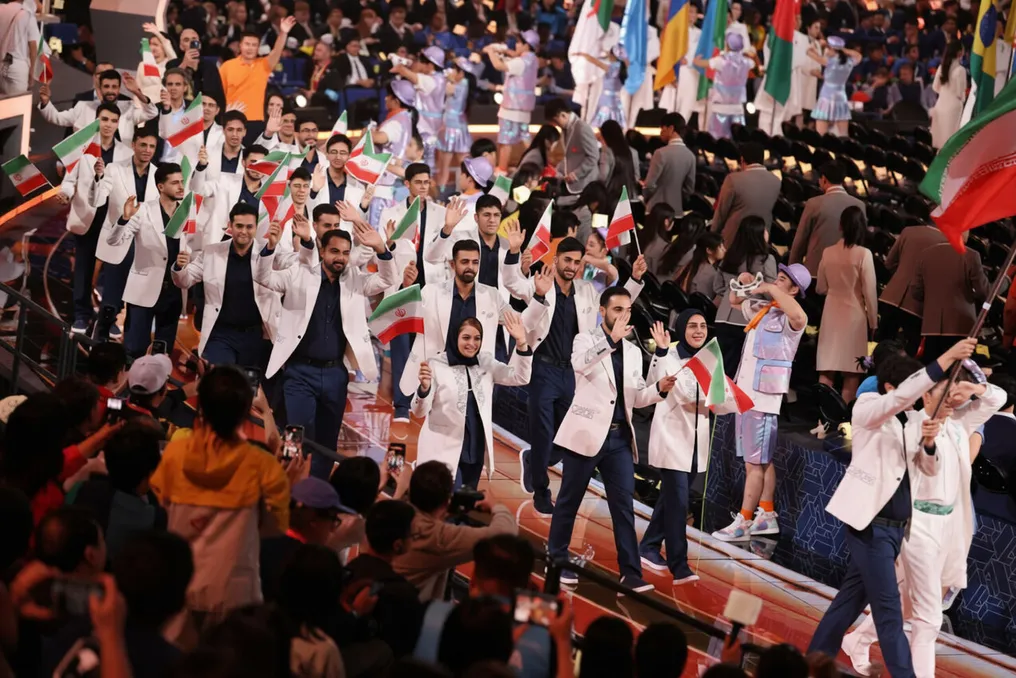
Twenty-two Iranian students participated in the 48th WorldSkills competition, demonstrating their practical skills on the international stage and winning seven medals for excellence.
The WorldSkills Competition is the largest global contest of professional skills, bringing together youth, industry representatives, educational institutions, and government officials from around the world to promote technical and vocational education.
This year's competition took place from September 22 to 27 in Shanghai, China, gathering 1400 top young specialists from 70 countries and regions to compete in 64 different professional fields. Participants included Mehrhan Rasolzadeh, who placed fourth in mobile application development; Hassan Safari and Amir-Hossein Zibai, who placed fourth in cybersecurity; Mohammad-Saleh Borhani Gilvai, who placed eighth in cloud computing; as well as Mohammad-Amin Arab-Aminabadi and Amir-Reza Beyk-Mohammaddlou, who placed 12th in IT network administration and graphic design technology, respectively. Taha Shameli and Sajjad Safari-Ghiasabad placed 15th in web technologies and mechanical CAD design.
WorldSkills is held every two years, providing young professionals with the opportunity to participate in an international competition, measure, and demonstrate their competencies. Participants are selected after thousands of local, regional, and national competitions, and their mastery sets the standard for learning systems, educators, and industries worldwide.
The next WorldSkills competition, the 49th, is scheduled for 2028 in Aichi, Japan.
Recent Achievements
Thirteen Iranian students under the age of 12 demonstrated their scientific, technical abilities, and creativity by taking second and third places in various leagues of RobotChallenge 2026, which was held in Beijing, China. RobotChallenge, one of the world's largest artificial intelligence-based robotics championships, annually gathers participants from around the world competing with autonomous robots they have built themselves.
The event started on August 8 and attracted participants from about 48 countries, including China, Russia, Romania, Iran, Japan, Germany, and South Korea. Iranian students secured second place in the technical report league, third place in the 'Senior Robot Rugby' category, and in the 'Innovation' nomination. These results highlight the capability and qualification of Iranian students in robot construction and operation, design process, problem-solving, and technical presentation effectiveness.
At the Rayan 2025 International Artificial Intelligence and Programming Competition, known as the World Finals, Iranian students showed strong results in both the AI and programming sections. Ali Safari took first place in the programming section, while China won second and third places, followed by India, Vietnam, Armenia, Serbia, and Pakistan.
In the AI section, Iranian teams—Pileh, AI Guardians of Trust, AIUoK, red-serotenin, Persistence, and GGWP—placed from first to seventh. The final round of the Rayan competition took place on Friday at Sharif University of Technology in Tehran, with delegations from 25 countries participating. The event was supported by the Vice Presidency for Science, Technology, and Knowledge-Based Economy and began on November 25, attracting hundreds of participants from the USA, Russia, China, India, Italy, Chile, Australia, Armenia, Pakistan, Bangladesh, Belarus, Afghanistan, Ukraine, Taiwan, Romania, Singapore, Poland, Slovakia, Vietnam, Serbia, Argentina, Colombia, Kazakhstan, and Ethiopia, as well as the host country, Iran.
Sixty Iranian and foreign participants took part in the individual sectional programming, independently solving nine complex algorithmic problems over three to four hours. The scientific competition aimed to advance knowledge, develop international cooperation, and establish scientific authority in the field of AI and programming. Other goals of the competition included improving algorithmic thinking, problem-solving skills, teamwork, developing innovative ideas, starting new businesses, and expanding AI engineering and programming.
At the International Science and Invention Fair (ISIF) 2025, Iranian students received three gold medals and a special award, becoming among the world's leading innovators. This competition, organized by the Indonesian Young Scientists Association (IYSA), took place in Bali from November 12 to 15. Participants competed in various fields, including biotechnology, educational technology, artificial intelligence, mathematics, engineering, chemistry, and nanotechnology.
Raman Nafarieh won a gold medal and a special award in biotechnology. A team consisting of Radin Abbasi and Sama Rashidi received a gold medal in the engineering field. Furthermore, Matin Hayati won a gold medal in educational technology and artificial intelligence. ISIF 2025 gathered a total of 800 teams from 24 countries, including China, the USA, Mexico, South Korea, Taiwan, Canada, Turkey, Luxembourg, Indonesia, and Vietnam.