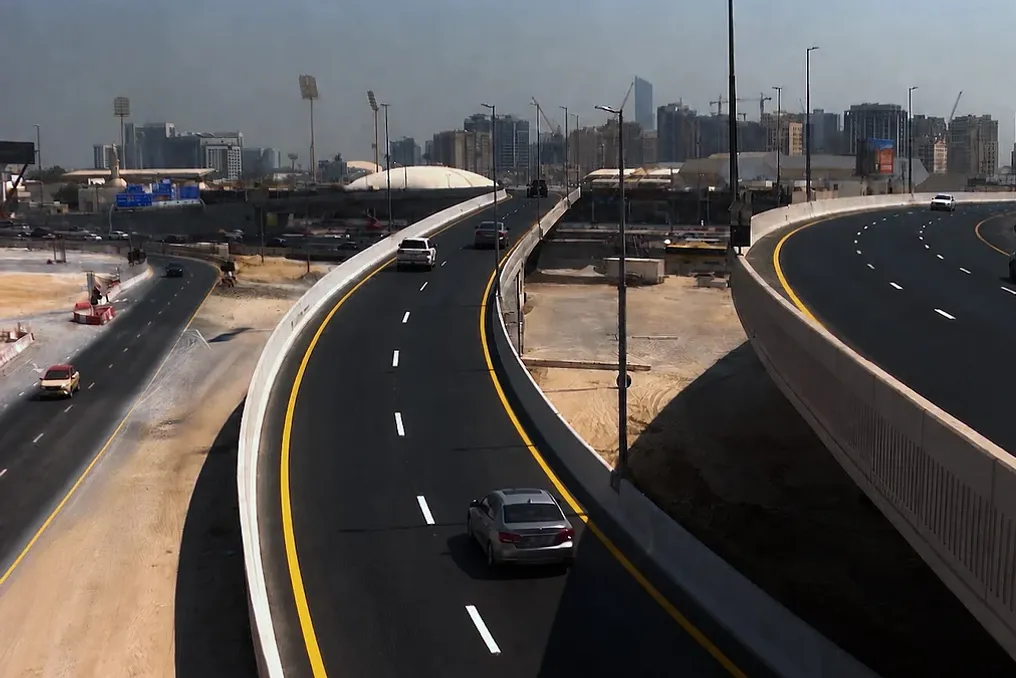
L&T Transportation Infra secures contracts worth 350 billion rupees in Dubai
Read more
Business Standard
business-standard.com

L&T Transportation Infra secures contracts worth 350 billion rupees in Dubai

Larsen & Toubro (L&T) announced on Wednesday that its transportation infrastructure division has signed two contracts totaling over 350 billion rupees with the Roads and Transport Authority (RTA) of Dubai. These contracts pertain to the development of the Latifa Bint Hamdan Corridor.

The first contract involves the construction of a new road connecting Al Heeil Road with the extension of Latifa Bint Hamdan Street. Furthermore, this project will include the construction of bridges, tunnels, and associated roadworks. The company noted that this will improve connectivity between Al Heeil Street, Latifa Bint Hamdan Street, and Al Meydan, as well as enhance access to adjacent developed areas.

The second contract focuses on developing sections of Al Meydan Street. It includes the construction of a new interchange and related ground roads to serve development projects in the area and optimize traffic flow. The scope of work also encompasses the construction of a bicycle path, which will be integrated into the existing network to form a unified route from Al Qudra to Jumeirah.

Both projects are scheduled for completion by the end of 2028. Upon completion, the entire Latifa Bint Hamdan Corridor will span approximately 12 kilometers and strengthen connections between key Dubai road arteries, including Sheikh Zayed Road, Al Heeil Road, Al Meydan Street, Sheikh Mohammed bin Zayed Road, Sheikh Zayed Bin Hamdan Al Nahyan Street, and Emirates Road.

It is anticipated that this corridor will accommodate around 16,000 vehicles per hour in both directions and facilitate over 130,000 daily trips. Additionally, travel time between Umm Al Sheif Street and Emirates Road is projected to decrease from 33 minutes to 15 minutes.

L&T is an Indian multinational company valued at $32 billion, operating in EPC (Engineering, Procurement, and Construction) projects, high-tech manufacturing, as well as products and services.

Similar stories

Dubai residents allowed to get rent refund upon early termination of co-living agreements
Read more
www.khaleejtimes.com

Dubai residents allowed to get rent refund upon early termination of co-living agreements

A new co-living law in Dubai allows residents to terminate their lease before the contract expires and demand a refund of prepaid rent.

According to Law No. 4 of 2026, the tenant has the right to terminate the lease agreement at any time, provided they notify the landlord in a timely manner. The minimum notice period is 30 days, but if the contract specifies a longer period, that one applies.

This provision is part of Dubai's new regulatory framework for co-living, although detailed requirements and licensing procedures are still being implemented. Previously, the Dubai Municipality informed Khaleej Times that the law's details would be announced, and a new service would be added to the Service Guide to simplify co-living licensing.

The law grants residents who terminate the contract according to the notification terms the right to request a refund of prepaid rent. However, the law gives the landlord the right to deduct an amount equivalent to one month's rent from the prepayment before returning the balance.

This rule is particularly relevant for those who have paid rent several months in advance. Under the new co-living system, rent is defaulted to be paid monthly unless otherwise agreed upon by the tenant and landlord. Furthermore, utility bills for electricity and water are included in the rent unless the parties agree otherwise.

The law provides a special mechanism for residents who do not receive the due funds. If the tenant does not recover the amount within 30 days after notifying the landlord of the refund request, they can file a petition with the Enforcement Court to recover the rent.

The Rental Disputes Center has exclusive jurisdiction over disagreements concerning the rights and obligations established by the co-living law. The method of providing notice may also be significant in case of subsequent disputes.

The law stipulates that termination notices can be delivered via a notary, sent to the email registered in the lease agreement, handed over in person, or delivered by any other legally approved method. Therefore, residents should ensure that the notice is submitted using one of the recognized methods, rather than relying on an informal verbal conversation.

Another important protection for co-living residents is contained in the law: a change of property owner does not automatically terminate the contract. If the co-living property transfers to a new owner, the existing lease agreement remains valid, and the resident has the right to continue residing there according to the contract signed with the previous owner.

Co-living agreements must specify the lease term and remain valid until its end unless terminated in accordance with the law. These provisions are part of a structure that formalizes co-living in Dubai through permits, registered lease agreements, living standards, and specific rights and obligations for owners, authorized institutions, and residents.

Completion of the RTA project in Dubai reduced travel time on Oud Metha and Al Asail routes from 20 to 5 minutes
Read more
www.khaleejtimes.com

Completion of the RTA project in Dubai reduced travel time on Oud Metha and Al Asail routes from 20 to 5 minutes

Drivers in Dubai traveling through the areas of Oud Metha, Al Jaddaf, Umm Hurair, and surrounding territories can now complete key journeys significantly faster thanks to the completion of a major road project implemented by the Roads and Transport Authority (RTA).

The development project for Oud Metha Road and Al Asail Street has increased the capacity of Oud Metha Road from 10,400 to 15,600 vehicles per hour in both directions, representing a growth of up to 50 percent. Furthermore, travel time has been reduced from twenty minutes to five minutes.

As part of this project, 14 kilometers of roads were constructed, four intersections were modernized, and bridges and tunnels totaling 4.3 kilometers were built, improving connectivity between Oud Metha Road, Al Asail Street, and neighboring routes.

This project serves residential and developing areas, including Zaabil, Al Jaddaf, Oud Metha, and Umm Hurair, as well as important destinations such as Latifa Hospital and Al Wasl Club. It is expected that the population in the served areas will exceed 420,000 people by 2030.

The CEO and Chairman of the RTA Executive Council, Mattar Al Tayer, stated that this project is part of a comprehensive plan to expand Dubai's road and transport infrastructure in line with population and traffic growth. He emphasized that the project's goal is not only to meet future demand but also to make daily commutes more comfortable for residents and visitors to the city.

Describing the project's role in connecting different parts of the road network, Al Tayer noted that it strengthens links between main corridors, residential areas, and service facilities while increasing intersection efficiency and road safety. He added that the project is vital for Dubai's road network due to its location and role in strengthening connections between multiple corridors, residential and developing areas, and service facilities, while improving intersection efficiency, facilitating access to key locations, and enhancing traffic safety.

Al Tayer also mentioned that the project was conceived with Dubai's future urban expansion in mind, and the infrastructure is designed to anticipate growing demand rather than just solving existing traffic problems. He reiterated that the project increases the capacity of Oud Metha Street from 10,400 to 15,600 vehicles per hour in both directions, which is an increase of up to 50 percent, and reduces travel time from 20 minutes to five minutes, which is a 75 percent time saving.

The authority reported that the changes improve the connection between Oud Metha Road, Al Asail Street, and the surrounding road network. At the intersection of Oud Metha Road and Sheikh Rashid Road, RTA added a left exit lane leading to Al Gharhoud Bridge, increasing its capacity to 1,800 vehicles per hour. Additionally, the service road on Sheikh Rashid Road between the existing bridge and the exit to Al Zahrawi Street was modernized to eliminate congestion and enhance safety.

The right turn capacity from Sheikh Rashid Road towards Oud Metha Road and Dubai-Al Ain Road was increased from two lanes to three, boosting the capacity to 4,000 vehicles per hour. A new tunnel connects the service road on Oud Metha Road with the Sheikh Rashid Road intersection for drivers heading to Bur Dubai.

Additional improvements were made at the intersection of Oud Metha Road, Al Asail Street, and Al Wasl Club Street. Two overpasses now connect Al Asail Street to Al Hail Road via Al Wasl Club Street. One bridge has two lanes and accommodates 2,400 vehicles per hour, while the second has three lanes with a capacity of 3,600 vehicles per hour. A separate two-lane bridge with a capacity of 2,400 vehicles per hour is designated for left-hand traffic from Al Asail Street towards Oud Metha Road.

RTA also improved access to Al Wasl Club, including its entrances and exits onto Al Wasl Club Street, to reduce conflicts with main traffic flow. Another two-lane bridge with a capacity of 3,000 vehicles per hour was built at the intersection of Al Wasl Club Street and Al Hail Road, serving traffic towards Al Hail Road and Business Bay crossing. Al Wasl Club Street was widened to create a two-lane exit onto Al Hail Road, along with service roads in both directions and additional parking spaces.

At the intersection of Zaabil Palace Street, Al Hail Road, and Oud Metha Road, RTA added a left exit lane towards Dubai-Al Ain Road, doubling its capacity from 900 to 1,800 vehicles per hour. A single-lane tunnel with a capacity of 1,200 vehicles per hour was also constructed to direct traffic from Dubai-Al Ain Road to the Oud Metha service road and alleviate current congestion. The project also expanded the bridge connecting traffic from Al Hail Road towards Oud Metha Road from two to three lanes, increasing its capacity from 2,200 to 3,300 vehicles per hour.


Popular