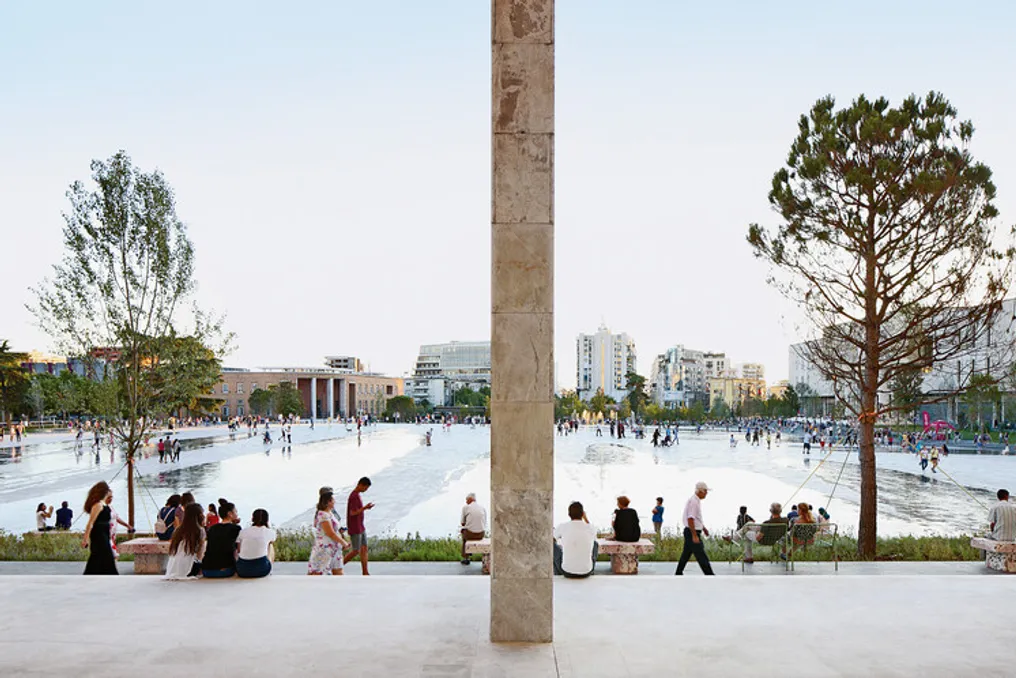
In the last two decades, Albania has stood out as one of the European territories with the highest construction activity. Various international architects have worked in the country, developing projects aimed at modifying the structure, design, and cities of a nation still recovering from previous regimes. Recognizing this evolution and the changes in the urban landscape implies accepting that behind every architectural form lies a history, and that files can provide deeper information than the architecture itself.
The book 'The Albanian Files,' edited by Anneke Abhelakh and published by Lars Müller Publishers, features a preface by Prime Minister Edi Rama. This publication gathers twenty years of work carried out by sixty international architectural firms in Albania. The volume is considered dense, and its format, colors, and striking presence function as a manifesto on the interpretation of the country's recent history, serving as an expanded document and a cartography of the vestiges of these processes.
Much of the content details power structures, hiring methods, and positions that generated controversial consequences. The revelation of these facts is seen as an act of transparency, but also as a sign that certain matters should never have been hidden. Albania, currently seeking greater territorial openness and integration into the global scene, whether through tourism or EU accession, needs this clarity.
In conversation with ArchDaily, Anneke Abhelakh addressed the files, Albanian history, architecture linked to political patronage, the asymmetries highlighted by the book, and the meaning of a record being considered proof.
Files as Instruments of Control
Abhelakh explained that the historical reading presented in Edi Rama's preface treats the file from the perspective of surveillance and control history in Albania, where cards and dossiers were compiled about citizens without their participation.
In terms of documentation, architects define what will be displayed and how their work will be recorded: most firms occupy eight pages, while those with more than ten years of operation in Albania receive sixteen. Each contribution is framed in a standardized pink structure, containing factual information such as the firm's arrival date, local collaborators, and team members, followed by an interview and, finally, a project page with location, clients, public or private contracts, and, if available, the physical dimensions of the works.
Thus, there are two forms of authorship: the self-presentation of the firms and the editorial structure surrounding them. By aggregating sixty files, elements emerge that would not be perceptible in isolation, allowing relationships, repetitions, divergences, and contradictions to become clear among them.
Freedom and Architecture
Regarding the subtitle 'Freedom and Architecture,' Abhelakh stated that during collaborations, freedom manifested as agility and, in some cases, as the absence of restrictions (such as fast licensing and few regulatory barriers).
She mentioned that professionals often used freedom in interviews to describe the environment found in Albania and what they felt capable of achieving there. Citing Lea Ypi, Abhelakh made a distinction between liberation—which implies breaking with an established order—and freedom, which refers to what follows, including the institutions and relationships that materialize it, because architecture never develops outside these conditions.
Additionally, freedom is intrinsically linked to responsibility and integrity, a duty that falls not only on the architect but also on those who commission the architecture and create the conditions for its planning. The greater the scope for maneuver, the greater this responsibility becomes.
Post-Zenghelis Evolution
Referring to the observation that, for Zenghelis, architecture has always been linked to politics as a form of engagement with common life, but distant from ideology, Abhelakh noted that the documentary files seem to have crossed this boundary twenty years later.
Zenghelis participated in the beginning of this trajectory, integrating into the jury of one of the first masterplan competitions for the center of Tirana, a moment when he and Edi Rama shared an affinity for the potential of architecture. His influence also led the Berlage Institute to establish itself in Tirana, bringing a network of architects to Albania.
Although the belief in architecture persists, Albania has changed drastically in twenty years: tourism has grown, land value has increased, and private investment and developers have gained prominence, with the continuous arrival of international firms. Architecture integrates this process, giving it a face, because behind any project, there is a complex ecosystem involving who commissioned it, who develops it, the fate of the land, and the type of city that emerges from these individual initiatives.
Unbuilt Projects
When asked how documenting a project that remains unbuilt affects its future reality, Abhelakh replied that an unbuilt project already possesses its own reality. It has the power to shape expectations about a place, attract capital, influence public debate, or enable a different future, without needing construction to generate consequences.
She emphasized that architecture has always been marked by extraordinary unbuilt projects, where an idea or proposal can impact the discipline as much as a finished work. Abhelakh does not separate the built from the unbuilt, nor the successful from the failed; together, they reveal what was imagined for Albania during that period, and the book preserves these three scenarios in the archive.
Satire and Political Patronage
Regarding Reinier de Graaf's letter, which satirizes the profession's dependence on political patronage, Abhelakh interpreted it as Reinier's action of appropriating something already established and straining it until it became uncomfortable.
The dossiers show that architects discuss political commitment, accessibility, agility, and practical effectiveness. Reinier takes this desire to the extreme, suggesting the need for a benevolent and tasteful autocrat to eliminate all obstacles between conception and execution. Satire works through exaggeration, an architectural movement of pushing an existing condition to the limit to observe its results, although it does not absolve the architect of responsibility, as the underlying desire is clearly identifiable.
The Complexity of the Subject of Study
Abhelakh commented on the fact that Edi Rama wrote the preface, being also the president of the National Territorial Council responsible for approving projects and being seen by many collaborators as the gateway to the country. She said it is impossible to narrate the transformation of architecture in Albania over these two decades without Rama being part of it, and his preface constitutes his personal account of this transition.
Flipping through the book, readers find sixty accounts from architects who narrate their arrival, contacts made, and how the projects were consolidated. In these accounts, Rama appears in various roles and perspectives, and this proximity is vital, as his testimony is not external, but rather one of the accounts to be confronted with the rest of the material.
Asymmetries and Public Reading
When questioned about the absence of Albanian architects, who appear mainly as local partners, Abhelakh recognized the asymmetry inherent in the twenty-year panorama of international firms' activity. The editorial design of the book allows this disparity to be exposed.
For her, the interesting thing is that this asymmetry transcends authorship, revealing itself also spatially and relationally: who holds the power to hire, who is hired, who develops, and where; which areas concentrate the interventions, and how different visions of the future for Albania meet and conflict in the same territory.
Finally, Abhelakh observed that, although the book continues to be a literary work, it has surpassed the field of architecture. She did not foresee the multiplicity of readings that the accumulation of information would generate. While some view it through the lens of architectural freedom and political power, others focus on what the accumulation of data itself reveals, and she is still reflecting on whether the book marked a turning point or helped create it.