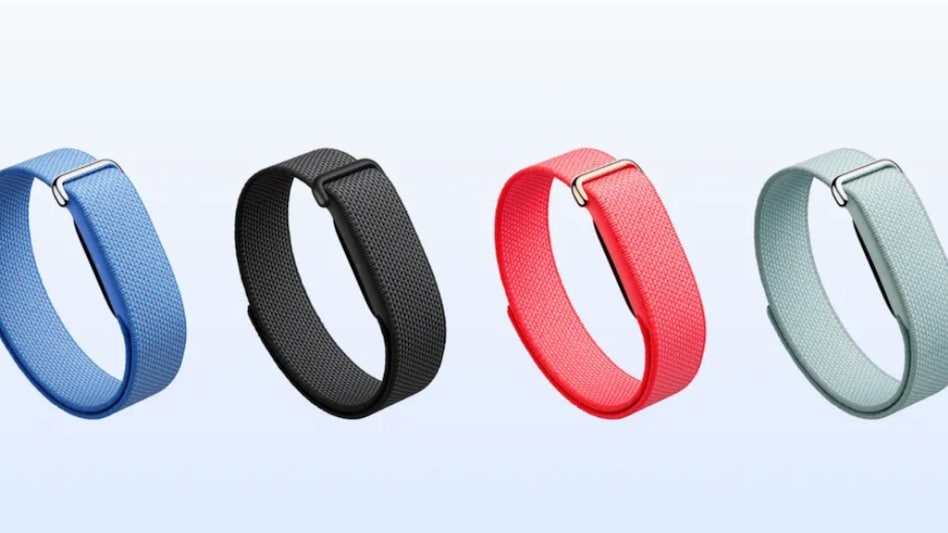
Google has introduced its affordable fitness band, Fitbit Air, into the Indian market. With the arrival of WHOOP, the trend of screenless fitness bands has grown, and now Google has also entered this space. Although it was released in the US a few months ago, it is now available in India.
This band will be available for sale from October 2nd. Its main feature is that it has no display screen. This means it will record the user's health data but will not distract by displaying messages, calls, or other notifications on the wrist. It is priced at ₹13,999.
According to Google, Fitbit Air is their smallest and lightest Fitbit tracker, designed to be worn for 24 hours. The company's focus is not on making a smartwatch, but on providing a small tracker that quietly records activity and health-related statistics. All this information can be viewed on the phone via the Google Health app.
At first glance, one might ask what the benefit of a screenless Fitbit Air is. The answer lies in its sensors and the Google Health app. This tracker can continuously record Heart Rate. Additionally, it records information such as resting heart rate, heart rate variability, different sleep stages, sleep duration, and blood oxygen levels (SpO2) during rest. It also has the facility to provide alerts related to irregular heart rhythms (Afib).
However, it is important to clarify that this is not a medical device, but only a fitness tracker. Google itself states that Fitbit Air is not a medical device and these features should not be used for diagnosing or treating any illness. The accuracy of heart rate and sleep-related data depends on several factors.
Google is integrating it with its Google Health Coach, meaning work has been done on both hardware and software. The Health Coach is designed to provide daily health and fitness suggestions by analyzing tracked data. According to the company, it can help in logging workouts, following guided exercises, and understanding activities. There is even an option to take a picture of a workout routine written on a machine or whiteboard at the gym and log it as an activity.
The removal of the screen also shows a direct benefit in battery life. According to Google, Fitbit Air can last up to seven days on a single charge. If the battery is running low, just five minutes of fast charging can provide about a day's battery life. This can be particularly useful for users who wear the tracker at night. Google claims that its light and small design is suitable for overnight wear. The company also mentions that users can wear Fitbit Air at night while using other devices like the Pixel Watch during the day so that sleep data is continuously recorded.
Despite having no screen on the wrist, all the data is available in the Google Health app on the phone. A positive aspect of this is that the need to constantly look at the screen on the wrist is eliminated. Google describes it as a device that keeps the user away from constant notifications, reducing the habit of immediately checking every message and alert due to a smartwatch.
In India, the price of Google Fitbit Air is ₹13,999, and sales will begin on October 2nd. It will be available through retail partners such as Flipkart, Croma, Reliance Digital, and Vijay Sales, in addition to the Google Store. With each purchase, users will receive a three-month free trial of Google Health Premium, allowing them to experience the full Google Health Coach. There is also a cashback of ₹1,000 when paying with selected HDFC Bank and ICICI Bank cards under the launch offer. Additionally, there is an option for a ₹1,000 cashback with 6 months of No-Cost EMI. Consumers will also be offered No-Cost EMI for up to 12 months on consumer loans.
Competing with WHOOP and other screenless trackers, Fitbit Air represents Google's participation in this growing category, focusing on health, fitness, and recovery data rather than screens and notifications. Google's specialty is its comprehensive health ecosystem. The company emphasizes data and personalized advice over hardware, as Google stated in May that its Google Health app was developed with the aim of bringing various health data together in one place.