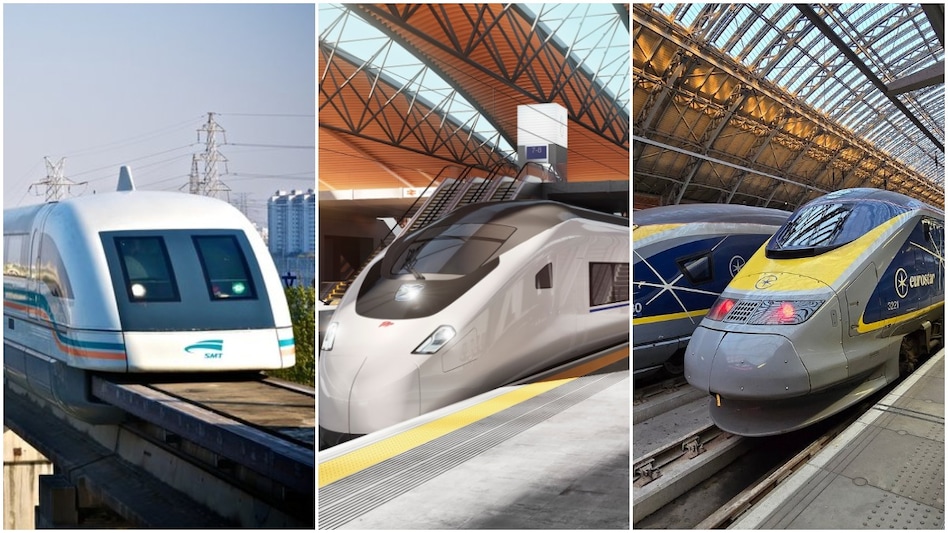
Traveling by train used to often require many hours, sometimes even an entire day. However, many countries around the world have transformed railway transport. Today, trains capable of reaching speeds from 300 to 400 kilometers per hour are running on the tracks, with some exceeding the 400 km/h mark. The most outstanding technology is Maglev, where the train moves above the tracks not through wheels, but through magnetic force.
If you are interested in which trains are the fastest in the world and India's position in this race, consider the list presented.
The leader among the world's fastest trains is the Shanghai Maglev from China, which reaches a maximum speed of about 460 kilometers per hour. This train uses Maglev technology and connects Pudong Airport in Shanghai with the Longyang Road station. Like other trains with this technology, it moves above the tracks using magnetic force instead of traditional wheels, which ensures its high speed.
Another high-speed passenger train from China is the CR450 Fuxing, which can reach speeds of up to 400 kilometers per hour. It is designed not only for high speed but also for reducing energy consumption; according to reports, it consumes about 10% less energy compared to previous models.
Among the high-speed trains is also the CR400 Fuxing from China, which travels at a speed of about 350 kilometers per hour. This train serves busy routes such as Beijing-Shanghai and Beijing-Guangzhou. Furthermore, the CRH380A Hexie from China also has a speed of about 350 km/h; during tests, this train registered a speed of 486.1 kilometers per hour. Thus, China has created not just one, but an entire network of high-speed railways.
Numerous high-speed trains also operate in Europe, covering distances faster than 300 kilometers per hour. The Spanish Talgo 350 and Avril Train can reach speeds of about 350 km/h. The design of these trains resembles a duck's beak, which is why they are called Pato, meaning 'duck' in Spanish and Portuguese. This shape was developed to ensure better stability at high speeds and when navigating curves.
The German ICE 3 train travels at a speed of approximately 330 kilometers per hour. The French high-speed machine TGV M has a speed of about 320 kilometers per hour, with a record of 574.8 kilometers per hour recorded during testing; however, it should be noted that this is a speed achieved during tests, not the standard passenger service speed.
The Eurostar e320 from Europe can also travel at a speed of about 320 km/h. This train connects cities such as London, Paris, and Brussels. Its feature is that it passes through the 'Channel' tunnel, which is about 50 kilometers long, allowing one train set to connect different countries within international rail transport.
Japanese E5 and H5 Shinkansen trains develop speeds of about 320 kilometers per hour. They are part of the high-speed rail service between Tokyo and Shin-Aomori. These trains have a pointed design about 15 meters long, intended to reduce noise and air pressure generated when the train enters a tunnel. Similarly, the Korean KTX-Cheongyong also reaches a speed of about 320 km/h, using a lightweight aluminum body for faster acceleration.
The high-speed train network is expanding beyond China, Japan, and some European countries. The Frecciarossa 1000 from Italy and the KTX series from South Korea are part of their high-speed transport systems. In Africa, the Al Boraq train from Morocco serves as an example of a high-speed railway. This indicates that the railway industry worldwide is gradually shifting towards using sets capable of covering long distances in less time.
Now let's look at the situation in India. The Vande Bharat Express has demonstrated significant changes in the direction of modern and fast rail transport in the country. Its structural power is about 180 kilometers per hour, although the speed in normal operation depends on the route and track capabilities. Vande Bharat is equipped with modern passenger amenities and safety features, in addition to achieving high speed. Moreover, India is moving towards creating a network of high-speed trains through the Mumbai-Ahmedabad high-speed rail project, which utilizes Japanese high-speed rail technology.