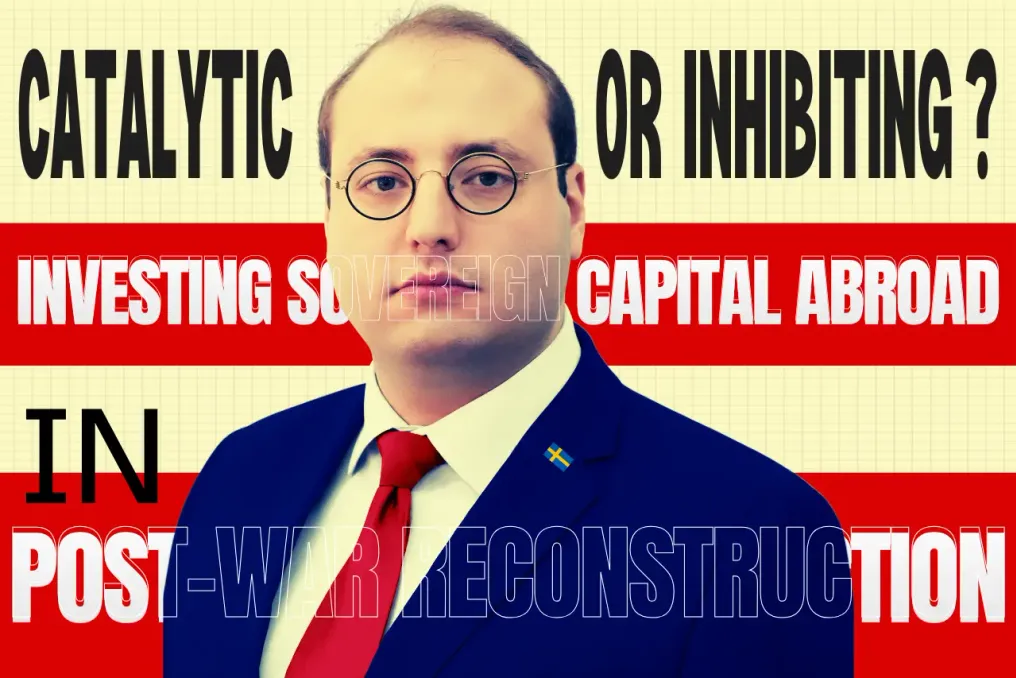
In an exclusive interview, Alex Mattsson, a Swedish associate professor and international business strategist, explains that sovereign investments in post-war reconstruction are not merely about directing capital into damaged economies. It is about how one state's resources can contribute to the economic and strategic recovery of another country emerging from conflict.
Unlike traditional international investments, such participation occurs amidst destroyed infrastructure, weakened institutions, disrupted financial systems, and severely limited investor confidence. Furthermore, political, defense, and geopolitical factors can significantly influence the investment environment. Thus, for the investing state, opportunities extend beyond financial returns to include economic partnership, diplomatic ties, regional cooperation, and long-term strategic interests.
The main objective is to ensure that sovereign capital strengthens the recovery without creating dependency, replacing private investments, or undermining local ownership. Mattsson asserts: 'The question is not how much money can be invested, but what this capital makes possible that otherwise would not happen.'
This distinction is fundamental for the sovereign investor. Although the capital originates in one country, its application takes place within the political, economic, and institutional environment of another, generating obligations and opportunities far beyond any single project. Mattsson emphasizes: 'Sovereign investments abroad should be assessed not only by what they build, but also by what they enable, what relationships they strengthen, and what choices they create for both countries.'
Investments can generate financial profit while simultaneously strengthening diplomatic ties, deepening regional cooperation, forming strategic partnerships, creating commercial corridors, supporting international coalitions, and enhancing the investing country's position in the changing international economic and geopolitical landscape.
Additionality as the Central Investment Discipline
According to Mattsson, the starting point for sovereign investments in a post-conflict country must be counterfactual analysis: what would happen if the investments were not made? This allows determining whether sovereign capital is truly additional or merely substitutes capital that commercial investors, local institutions, or other international partners could have provided.
Additionality can arise when sovereign capital goes where uncertainty is too high for private investors, accelerates recovery, supports strategically important infrastructure, transfers knowledge and technology, or strengthens institutions and domestic markets. Mattsson states: 'Additionality must be demonstrated, not assumed.'
This principle also draws a clear distinction between catalytic investments and financial substitution. If a project continues without sovereign involvement, state capital might simply displace other sources of funding. However, if the sovereign's involvement sufficiently changes the baseline conditions to attract private investors, local businesses, or institutional capital, its role becomes truly catalytic. Mattsson clearly formulates the principle: 'The goal must be acceleration, not replacement.'
This requires continuous operational analysis of what the sovereign investor can do uniquely, tactical assessment of whether this role remains necessary, and strategic analysis of whether the investment strengthens the recipient country's ability to attract and sustain broader investments independently.
Strategic Purpose, National Interest, and Economic Sovereignty
Mattsson stresses that a sovereign government must justify why it is investing abroad and why sovereign capital is the appropriate tool. Commercial returns, strategic interests, development goals, diplomatic priorities, and broader national interests can coexist, but they must not be confused. Sovereign capital has opportunity costs, as resources directed toward international objectives could have been used elsewhere.
At the same time, investments in a post-conflict country can yield tangible and intangible benefits that are not always fully reflected in traditional financial analysis. Mattsson argues: 'The thesis of sovereign investments must explain both the economic and strategic value of the relationships created.'
For the host post-conflict country, external sovereign capital also raises issues of ownership, governance, local participation, technology transfer, economic autonomy, and long-term dependency. Mattsson distinguishes between economic sovereignty and autarky, stating: 'Economic sovereignty does not mean isolation; it means having sufficient internal capacity and diversified external links to maintain meaningful choice.'
From this perspective, responsible investments should expand the economic opportunities of the host country while building strong relationships between the investing and host nations. Mattsson insists: 'The purpose of external capital should be to expand economic choice, not to narrow it.'
Diplomacy, Geopolitics, and the Intangible Value of Investment
Sovereign investments abroad inevitably operate within a diplomatic and geopolitical environment, especially when directed toward war-torn countries. Infrastructure, energy, logistics, digital communication, industrial potential, and financial relations can influence regional integration and the distribution of economic power. Investments can create channels for diplomatic engagement, strengthen bilateral relations, support regional coalitions, and foster broader international partnerships.
Mattsson notes: 'Capital deployed abroad can create influence, but responsible influence stems from creating mutual value, not dependency.'
The strategic dimension can operate at the bilateral, regional, and global levels simultaneously. At the bilateral level, investments can deepen trust and institutional cooperation between governments. At the regional level, they can link markets, supply chains, energy systems, and transport networks, creating common economic interests among neighboring states. At the global level, sovereign investments can promote broader coalitions involving governments, development institutions, businesses, and international organizations.
Mattsson warns: 'The thesis of investment should never be confused with the thesis of state governance, but the geopolitical consequences of investments cannot be ignored.'
Thus, strategic access, diplomatic support, coalition building, and international standing can represent genuine intangible benefits if they are transparently defined and assessed alongside economic outcomes.
Scope, Scale, and Speed of Reconstruction Investment
The scale and pace of sovereign investments in a post-conflict country require disciplined judgment. Moving too quickly can expose capital to risk before necessary conditions regarding security, regulation, institutions, supply chains, and demand are established. Progressing too slowly can lead to deterioration of productive capacity, lack of private investors, and increased costs of recovery.
Mattsson argues: 'The right question is not whether to move fast or slow, but where speed creates value and where patience protects it.'
The operational approach must therefore determine what is realistically functioning under current conditions, while tactical analysis must ascertain where sovereign involvement can unlock the next stage of recovery. Strategic analysis then needs to evaluate whether individual investments contribute to a broader economic ecosystem or become isolated projects. Energy, transport, logistics, digital infrastructure, housing, healthcare, education, manufacturing, and agriculture may be relevant, but sector selection must follow the pressing economic problem.
Mattsson concludes: 'Reconstruction must be consistent with the needs of the economy to become functional, productive, and investable, not with what is easiest to finance.'
Risks, Governance, and Responsible Sovereign Participation
State backing does not eliminate risks. Risks related to construction, demand, currency, politics, governance, liquidity, security, execution, and restructuring remain relevant, although the sovereign investor may possess a different capacity to absorb or manage them. Mattsson states: 'A sovereign balance sheet does not eliminate risk; it changes who is initially capable of absorbing it.'
The strategic task is to define which risks the sovereign investor must assume, which should remain with commercial partners, and which should be addressed through institutional, regulatory, or diplomatic measures.
The financial structure must support this strategic logic without becoming an exercise in financial engineering. Equity, debt, guarantees, blended approaches, and joint investments can play a role, but the instrument must follow the problem, not define it. Achieving milestones, proper oversight, transparent procurement, independent monitoring, and clear conditions for continued participation can help protect both capital and trust.
Mattsson warns: 'When state funding becomes the reason for a project's existence rather than a means of ensuring its viability, the catalytic principle is lost.'
Local Capacity, Partnerships, and Sustainable Reconstruction
Successful sovereign investments abroad must ultimately strengthen the post-conflict country's ability to own, operate, finance, and manage its economy. Therefore, from the very beginning of the recovery, local businesses, local financial institutions, workforce development, technology transfer, and management capabilities must be integrated. Otherwise, infrastructure may be completed while critical opportunities remain under external control.
Mattsson argues: 'The best outcome of recovery is not an economy managed from outside, but a locally capable economy supported by international partnerships.'
This principle also defines the difference between recovery and transformation. Recovering what existed before the conflict might reproduce structural weaknesses, whereas imposing an external economic model can undermine legitimacy and local ownership. Mattsson insists: 'Post-war reconstruction must restore functionality while creating the possibility for a stronger economic future.'
External sovereign investors can provide capital, expertise, technology, and standards while allowing local institutions and businesses to determine the evolution of the economy.
Measuring Tangible and Intangible Returns
The deployment of sovereign capital itself should not be considered proof of success. Financial indicators remain important, but sovereign investments in a post-conflict country must also be evaluated based on operational, economic, institutional, diplomatic, and strategic outcomes. Relevant indicators may include attracted private capital, growth of domestic business, productivity, trade, local ownership, technology transfer, institutional efficiency, employment, and reduced reliance on sovereign support.
Intangible benefits can include strengthened bilateral relations, regional cooperation, diplomatic access, coalition building, resilience, and greater strategic options.
Mattsson concludes: 'The real test is whether the investment creates opportunities and relationships that become more valuable and less dependent on sovereign intervention over time.'