Iran has lost substantial leverage in the Strait of Hormuz. Oil producers in the Persian Gulf, receiving significant support from the US Navy, are successfully passing crude oil through the strait despite Iran's presence.
According to data from the maritime tracking service Kpler, last week the volume of oil and petroleum product flows through this critical narrow passage averaged 13.1 million barrels per day. This is slightly less than 80 percent of the 17.1 million barrels that passed through the strait daily before the war.
The total volume of crude oil shipments from the Middle East—through and around Hormuz—shows even more impressive results: according to JPMorgan, it has returned to 98 percent of pre-war levels.
Matt Smith, Director of Commodity Research at Kpler, noted that 'given such a strong volume passing through the strait, it is evident that Iran is losing its influence over it.' This progress is the result of a complex operation involving military convoys conducting covert transits through the strait, which has helped restore significant volumes for Middle Eastern oil producers in the last couple of months.
Furthermore, oil from Saudi Arabia has returned to the strait's traffic, which was previously headed to the Red Sea after Iran's allies—the Houthis—attacked a major Saudi oil pipeline earlier this month.
A key question arises: how long can the current situation persist? US military forces are spending enormous resources in the region just to ensure oil passage, while global reserves continue to decline toward operational minimums, and fuel prices remain at record high levels.
Meanwhile, Iran, finding itself in a difficult position, is beginning to counterattack. The oil market appears to have unlimited ways to deliver oil to consumers, despite the largest supply shock in history.
According to JPMorgan, global oil reserves have decreased by approximately 2 billion barrels during the war with Iran, yet the market has held firm. It achieved this remarkable result thanks to innovative solutions such as rerouting pipelines and military-protected shuttle services, as well as increased production outside the Persian Gulf and, critically, a significant global decrease in demand.
Although oil prices remain uncomfortably high, creative market solutions have prevented crude oil from approaching the record level set in 2008.
Nevertheless, the current situation in Hormuz simply cannot continue forever. Oil is a physical commodity, and ultimately, market forces will prevail. When more raw material enters reserves than is consumed, the market will reach the long-awaited and feared tipping point where reserves are insufficient to meet demand. In such a case, oil prices must rise sharply to reduce demand and maintain balance.
No one knows when this will happen. Natasha Kaneva, Head of Global Commodity Strategy at JPMorgan, stopped trying to guess. Two weeks ago, she admitted to clients in a note: 'For the first time since the conflict with Iran, we have no baseline understanding. We simply do not know how to model the end.'
In her view, the key issue is not how long the war will last, but how long the market can sustain the physical demand for oil. These two factors may be linked: without a real resolution in the Strait of Hormuz, the world will have to hope that market reserves hold up.
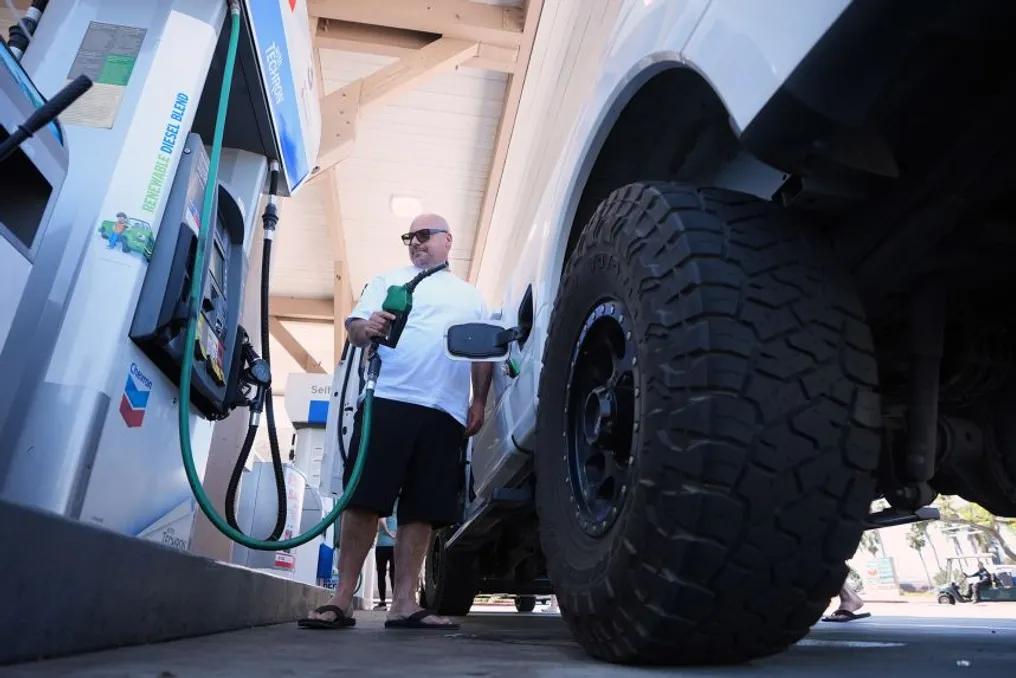
All these market mechanisms are interesting for economic theory and supply and demand analysis. However, in practice, this has had little impact on people's wallets. Oil prices remained above $90 a barrel throughout the month, and for most of September, they exceeded $100. Gas prices are close to the highest level of the war, and diesel fuel, facing the consequences of wars in Iran, Russia, and Ukraine, surpassed its previous record at the beginning of this month and costs significantly more than $6 per gallon.
Moreover, the return of oil to normal has not yet been reflected in refined products. According to JPMorgan, the volume of processed products from the Middle East remains only at 58 percent of pre-war levels, highlighting serious constraints for gas and diesel fuel.
The fact that oil prices have not yet reached $150 is a small comfort for Americans who have to spend $100 on fuel, or for businesses forced to pay high surcharges for fuel delivery.
Without new information, the market traded in recent months based on potential prospects of a peace agreement. Frequent comments by President Donald Trump about an anticipated quick deal with Iran to open the strait had an disproportionately large impact on oil prices—much more than the actual amount of oil barrels. The situation changed slightly at the beginning of this month when the Houthis attacked the east-west Saudi pipeline, temporarily halting about 7 million barrels of oil destined for the Red Sea—more than half of which was rerouted from the Strait of Hormuz. Oil approached $110 a barrel before the Saudis found another way, demonstrating astonishing adaptability and rerouting oil back through the Strait of Hormuz.
Meanwhile, satellite images from Sunday showed that all seven berths were open at two key ports on the West Coast of Saudi Arabia—Yanbu and Al-Mawajiz, indicating the resumption of the east-west pipeline operations, according to Kpler.
Natasha Kaneva noted on Tuesday that 'higher throughput should not be mistaken for improved security—rather, it reflects the industry's growing ability to operate under constant risk.' For example, she pointed out that insurance costs remain astronomically high. Insurers are currently valuing the largest class of oil tankers aged 5 to 10 years at $150 million, although the cost of building a new tanker is $135 million.
Iran, unable to pass its own oil through the strait due to the US Navy blockade and losing its key source of economic influence, has intensified attacks on tankers passing through the gulf. Smith observed: 'It is not surprising that tanker attacks have become more frequent, as Iran tries to contain transit. We should expect this to continue, as Iran seeks to regain control of the strait.'
Thus, the oil market remains at an impasse: increasingly burdensome US military efforts are sustaining an unstable status quo that continues to keep prices high for businesses and consumers.