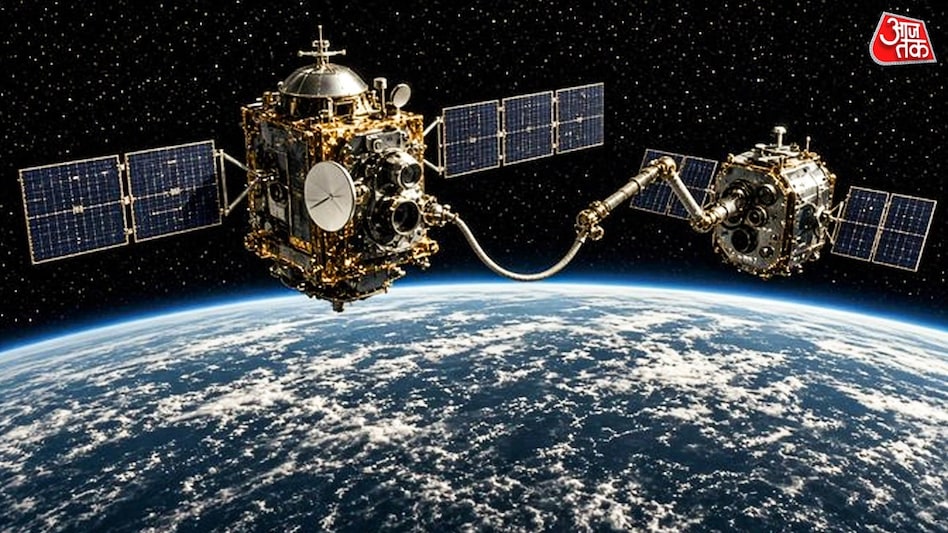
China asserts that it has achieved a significant breakthrough in the technology of refueling satellites in space. According to data from Chinese researchers, the Shijian-25 satellite delivered approximately 142 kilograms of fuel to the Beidou-2 G7 satellite, which is in a high orbit, in February 2025. Researchers believe that this procedure could extend the service life of the Beidou satellite by about eight years.
Although independent confirmation of this refueling is currently lacking, if the claim proves true, it could significantly simplify the long-term operation of satellite systems. Typically, when a satellite's fuel runs out, its continued operation in space becomes difficult, even if other systems are functional. Thus, the possibility of in-space refueling appears highly beneficial.
The Shijian-25 satellite was launched on January 7, 2025, using the Long March-3B rocket. It was developed by the Shanghai Academy of Aerospace Sciences. According to China, the mission of this satellite is to test technologies for extending the service life and refueling of satellites in space.
The process of refueling a satellite can be explained as follows: one satellite approaches another and transfers fuel to it. For this, both spacecraft must be brought into very close proximity, after which the fuel is pumped from one satellite to the other.
According to the study by Chinese scientists, Shijian-25 transferred 142 kg of propellant to the Beidou-2 G7 satellite. This, they estimate, could extend the operational period of the Beidou satellite by about eight years. This means that the need to urgently decommission a satellite with depleted fuel and launch a new one may decrease, allowing it to continue operating in space after refueling.
Nevertheless, complete information regarding this claim is not yet available. According to the report, the operation has not received independent confirmation, and some orbital tracking data casts doubt on activity between the two satellites in February 2025. Therefore, it should currently be regarded solely as a statement by Chinese researchers.
Beidou is China's satellite navigation system, used for services such as positioning, navigation, and time synchronization. The system is applied not only for civilian purposes but also for governmental and military tasks. Since the Beidou system involves numerous satellites, the ability to extend the service life of older units through refueling could ease the management and maintenance of the entire system.
Launching a new satellite into space is an expensive and complex undertaking. If, however, an older satellite can be kept operational through refueling, the need to launch new units decreases. In addition to refueling, similar technologies may be applied in the future for satellite repair and orbit modification. In the future, satellites will not just be sent into space and left there, but will also undergo maintenance. Shijian-25 represents a step by China toward testing this type of technology, but until independent confirmation of the Beidou satellite refueling in February 2025 is obtained, it remains merely a claim.