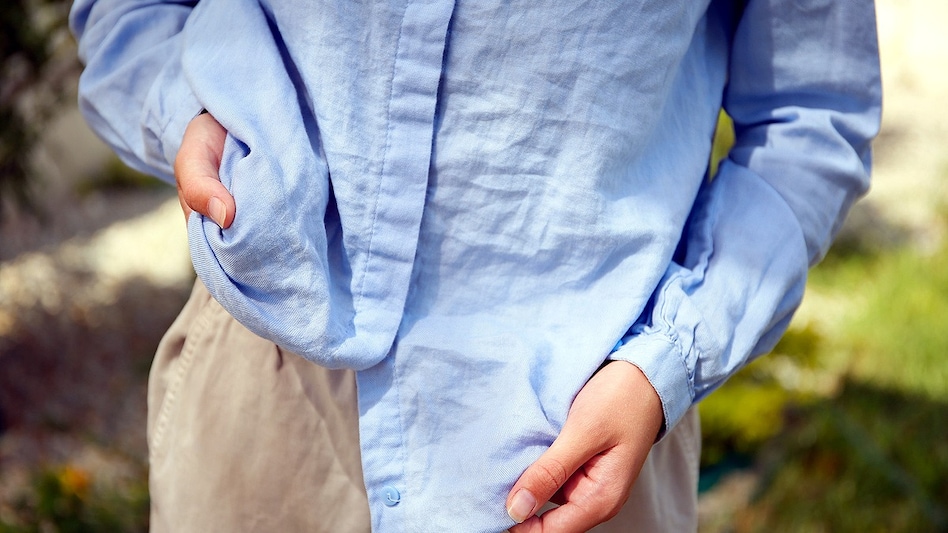
We observe daily how wrinkles appear on clothes, and then they straighten after ironing. However, this phenomenon is due to a small change occurring within the fabric fibers. This is especially noticeable in cotton and linen fabrics, which contain a substance called cellulose. Hydrogen bonds exist between these fibers.
When fabric is washed, it absorbs water. The water penetrates inside the fibers and temporarily weakens the hydrogen bonds. This allows the fibers to shift slightly. If the fabric is folded or compressed at this moment, the fibers adopt that specific position. When the fabric dries, the bonds are restored, and the fibers remain in the new position, which causes wrinkles to appear.
Most cotton consists of cellulose, which is a polymer formed from very long chains. These chains are held together by hydrogen bonds. Cotton has the characteristic of easily absorbing moisture. Upon contact with water, its fibers swell slightly and begin to move. If pressure is applied to the fabric during this process, the fibers can shift. For example, in a washing machine, clothes are constantly rotating and being compressed. Even if damp clothing is left folded, the fibers can take on a certain shape that will be fixed after drying, creating wrinkles.
Wrinkles do not only occur after washing. They also appear while wearing clothes. Body heat, humidity from sweat, and body pressure can affect the fabric fibers. For instance, when sitting for a long time near the knees, trousers, or elbows of a shirt, wrinkles may appear. This happens because the fabric is repeatedly bent and compressed in these areas. With moisture present, it is harder for the fibers to return to their original state, and after drying, the wrinkles become more noticeable.
The question of how fabric straightens after ironing is resolved by the combined action of heat, moisture, and pressure. The heat and steam from the iron temporarily weaken the hydrogen bonds between the fibers. This facilitates the fibers' ability to change their position. When we press the iron onto the fabric, the fibers straighten out and assume a smooth, flat state. After the fabric cools and dries, the hydrogen bonds are restored, but now the fibers are in a straight position, so the fabric remains smooth.
A steam iron is particularly useful for fabrics like cotton because it provides not only heat but also moisture. The steam reaches the fibers and puts them into a temporary state where it is easier for them to change. Then, the pressure of the iron helps the fibers align straight. When the fabric cools and dries, the fibers are fixed in the new, straight state, allowing even deep wrinkles to be removed.
Not all fabrics are composed of the same fibers. How quickly wrinkles appear on a fabric depends on its structure, fiber type, and manufacturing method. In fabrics such as cotton and linen, the effect of moisture is stronger, so wrinkles may appear faster. At the same time, some other types of fabrics maintain a smoother shape due to their structure. Thus, a wrinkle is not just a visible fold, but a change in the fabric fibers themselves. Water and moisture help the fibers shift, pressure bends them, and after drying, the fibers are fixed in that position. Heat, steam, and pressure from the iron alter this process, straightening the fabric.