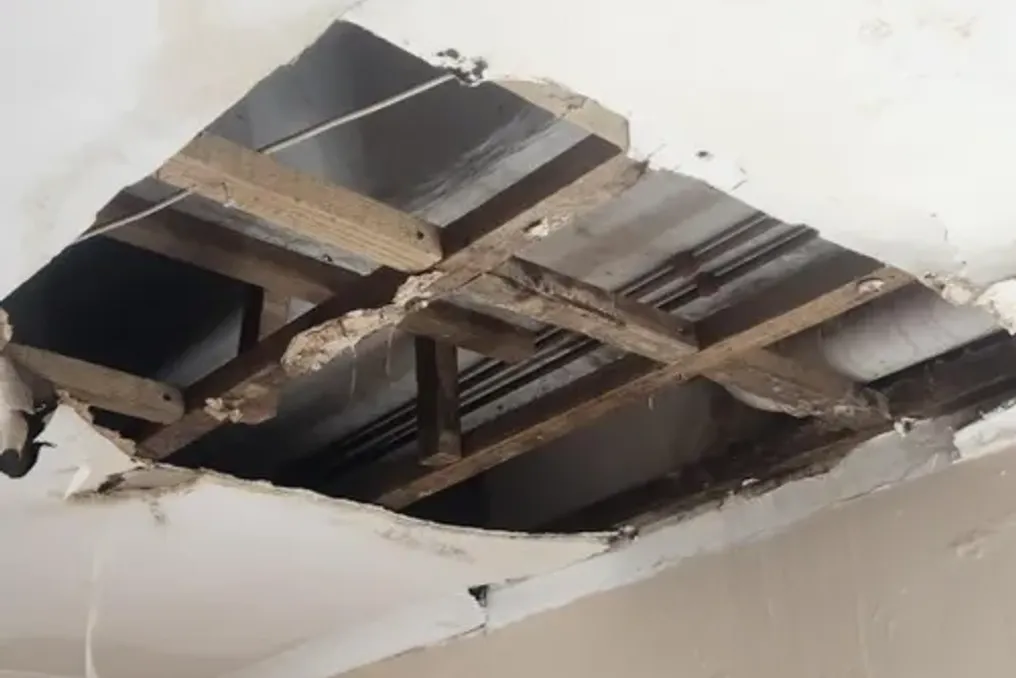
A section of the ceiling collapsed in the women's restroom on the second floor of the KwaZulu-Natal (KZN) Education Department headquarters in Durban, located in the Truro House building, over the past weekend. The collapse exposed wooden joists, pipes, and ductwork above that area.
Visiting the building on Monday, the publication IOL documented the shocking state of the KwaZulu-Natal Education Department offices in Durban. In addition to the collapsed ceiling, there was broken lighting, burst pipes, non-functional toilets, and ceilings with large holes.
During the visit, it was visible that a large part of the ceiling in the women's restroom had fallen down, leaving a gaping hole through which wooden joists, pipes, and ductwork were visible. Brown water stains were visible on the ceiling around this hole, and a row of tiles was missing from the wall beneath it. In one of the men's restrooms at Truro House, the sink was covered with a black trash bag to prevent its use.
The smell of urine was noticeable in the restrooms. Several toilets were closed with 'out of order' or 'toilets temporarily out of service' signs. Another door had a warning about a water leak, requesting the use of toilets on the third and fifth floors. In one of the restrooms, the sink was covered with a black garbage bag.
Many corridors of Truro House were dark due to non-functional lighting. Ceiling panels had detached and fallen, leaving gaps above office doors through which hanging wiring was visible. A sign warning people about the slippery floor was hanging on the wall. Some corridors were dimly lit, while some fixtures provided only a weak orange light. The walls near one of the elevators were scratched and dirty, and paint was peeling near the call buttons.
Some air conditioning units are also not functioning. In the Truro House corridor, ceiling panels fell, exposing wiring above the slippery floor warning.
IOL directed questions to the national department of education, which forwarded them to the KZN Education Department spokesperson, Musi Malambi. At the time of publication, Malambi, who was contacted for comment on Monday, did not respond.
The KwaZulu-Natal Department of Public Works and Infrastructure stated that it cannot begin repairs in Truro House because the provincial department of education never officially requested it or provided funds for the work. A department representative, Steve Bengu, told IOL: 'We are the department of learning. This means that the client department, in this case the education department, must instruct us to carry out building maintenance.' He added that the client's responsibility is also to provide funding for the maintenance work. 'As soon as such an instruction is given, KZN Department of Public Works and Infrastructure staff will enter the building and conduct an assessment to determine the way forward regarding repairs. However, we cannot initiate any processes without communication, an official request, and the provision of funding by the client department.' He also noted that they had received no official notices or repair requests from the education department.
An insider, who wished to remain anonymous, reported that the ceiling collapse was not the only problem the building has faced in recent days. This employee said: 'The ceiling collapsed last weekend in the women's restroom on the second floor. Fortunately, no one was injured. The situation here is worse than terrible. We love our jobs, but we cannot work in these conditions.'
Another insider expressed disappointment, noting: 'It is very frustrating to come to work every day and face this. How can we work normally when the lighting is out, toilets are closed, and water is leaking? This is a government building, not some abandoned property.'
Tirona Mudli from the National Association of South African Teachers (Naptosa) stated that the problems in the building are not new. She mentioned that the building had been closed by the Department of Labour for months. Mudli noted: 'Nothing has changed.'
The department closed Truro House from mid-May to the first week of June due to building defects and health hazards. Truro House was officially opened on November 16, 1990, and named after the SS Truro, which brought the first Indian contract workers to Durban on November 16, 1860. In March, the building also became a center of dispute when the DA claimed that members of the SA Democratic Teachers' Union occupied it for several days. A DA legislator, Sakhele Mngadi, then stated that union members intimidated officials and drove staff from their workplaces, making it impossible for the department to function.
At the national level, Minister of Public Works and Infrastructure Din McPherson informed the IFP MP Sifosetu Ngkobo in a written parliamentary response that as of August 1, 8465 government buildings were in poor or critical condition, accounting for about 10.8% of the state's property portfolio. McPherson specified that the repair backlog amounts to approximately 28 billion rand. He concluded that 'the repair backlog of approximately 28 billion rand will require a substantial injection of capital. Therefore, the scheduling and reconstruction plans depend on confirmation of the budget by the National Treasury and user departments.'