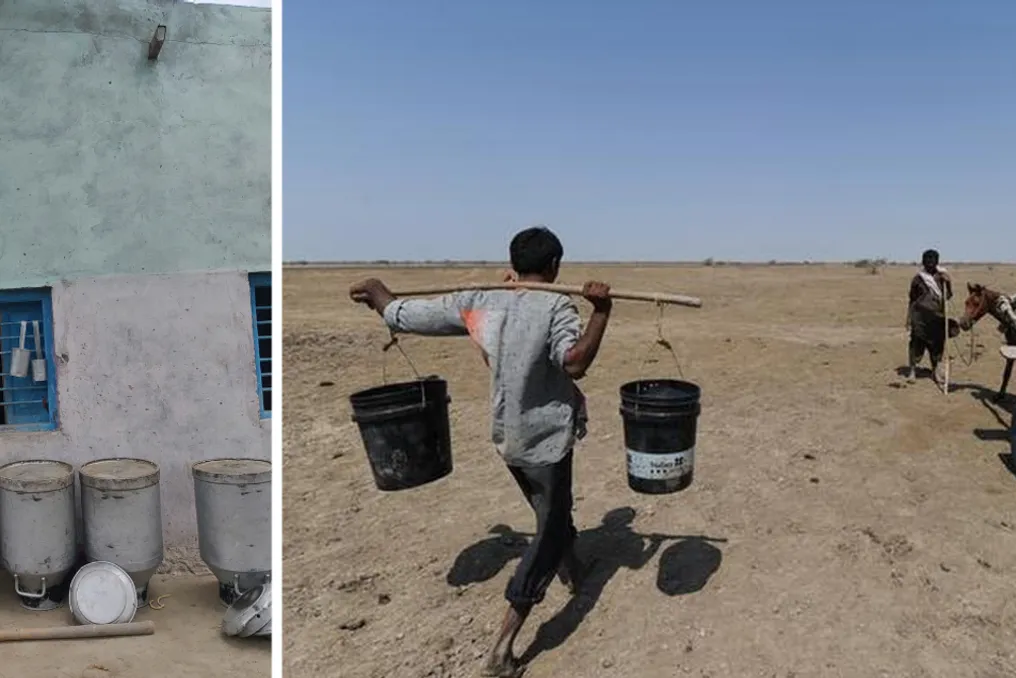
When Fauzia Sheikh arrived in Kuch between September 3 and 7, she expected to see Bani after the monsoon season: seasonal ponds filled with water and grasslands grazed by Bani buffaloes. Instead, however, she found a landscape still awaiting rain.
Sheikh told The Better India that since the monsoon had arrived, there should have been plenty of vegetation, and the area should have turned into a wetland, but it remained just land with almost no vegetation.
The lack of water was evident everywhere: ponds were dry, and rivers and seasonal water sources were depleted. The grass that supports Bani's pastoral economy had barely appeared.
The Monsoon That Did Not Come
By early September, Kuch had received only about 29–30% of the normal seasonal rainfall, and some talukas received less than a tenth of the usual amount. As early as September 2, the area recorded a rainfall deficit of approximately 60%, and by September 13, this deficit increased to 70%, with only 149.7 mm recorded against a norm of 499.8 mm.
The consequences initially affected agriculture. About 4.82 lakh hectares were cultivated this year, but only about 1.8 lakh hectares were irrigated. The total cultivated area significantly decreased compared to approximately 6.5 lakh hectares in the previous year. For farmers who managed to sow fields, the prolonged drought led to water scarcity in the harvests.
However, Bani's pastoral communities face a different problem. Their fields are grasslands, and their harvest is livestock. Furthermore, their water sources must function amidst a landscape where groundwater is often saline.
When the Grass Disappears
Sheikh visited villages and settlements where she saw how the dry landscape affected both the livestock and the people dependent on it. She noted the absence of water in the ponds and the dried-up rivers. Vegetation was sparse; Sheikh mainly observed 'gando baval', or Prosopis juliflora, an invasive species, and 'pilu', a local plant whose branches are traditionally used as natural toothbrushes.
Sheikh emphasized that gando baval does not help in this situation because animals and cattle do not eat it. For the Maldhari families, the lack of grass triggers a chain reaction: animals require more purchased feed, which makes the feed expensive. Consequently, the cattle produce less milk, and the families receive less milk for sale.
Sheikh explained that the cow lacks milk due to the lack of rain and grass. She also reported that dry fodder, which previously cost about 6 rupees per kilogram, was now selling in retail markets for about 12 rupees per kilogram. Thus, the problem is not only a water deficit but also the loss of the grass that sustains the pastoral lifestyle.
It is here that Bani's traditional water supply systems offer an important lesson. Water is present, but not always where it is expected.
For generations, the Maldharis in Bani have used 'virdas'—shallow wells dug in the bottom of seasonal ponds and natural depressions. Virdas begin with an understanding of how Bani retains rainwater. During the monsoons, rainwater collects in shallow depressions and seasonal ponds. Some of this water seeps through the soil, forming relatively fresh layers above deeper saline groundwater.
Maldharis traditionally identified these spots through knowledge passed down from generation to generation. They dig shallow wells into the freshwater layer and construct them from local materials. Varun Suchdai, a travel journalist and researcher from Kuch who has spent a lot of time in the region documenting pastoral and nomadic communities, noted that 'virdas are becoming very rare'. He added that their use and even construction are rapidly declining.
Some new virdas are being dug again this year, but there is no guarantee they will yield usable water. Suchdai warns: 'Not every virda will give you fresh water. This is a saline area, so many virdas simply draw up saline water and are useless.'
But virdas are not the only important traditional water source. Suchdai points to 'dands'—bowl-shaped seasonal water bodies scattered across Kuch. 'There are about 44 or 45 dands across Kuch. All these animals, and even people, depend on these dands for water.'
However, this year the water disappeared faster. Suchdai explained that due to a hotter than usual summer, especially in May and June, these dands dried up faster, and the grass also dried faster than normal. Citing reports, he stated that milk production dropped by about 30% in May and 50% in June, with further decline reported later.
He views these small changes as signs of climate stress: 'When milk production drops like this, it is also a sign of what the animals and the landscape are going through.'
The Ecologist's Viewpoint
Ecologist Chetan Misher believes that virdas play a role but cannot meet all human needs. He emphasized the importance of understanding what these systems were originally intended for. According to him, virdas are an ancient system, but he does not think it has failed; it remains generally the same as before, but historically it was never a source of fresh water in the modern sense.
The difference lies in what the communities historically called 'fresh' water. Misher explains that for them, fresh water is what they drink, whereas for locals, fresh water means something that is 'not too bad,' i.e., not absolutely undrinkable, and it is not necessarily as good as the water drunk in cities or elsewhere.
In the saline landscape of Bani, the water accessible through the virda can still contain significant amounts of salt and suspended particles. Misher describes it as 'very turbid water' and notes that its relative suitability was historically determined by the availability of other options.
He argues that they considered it fresh because the alternative was worse. However, he insists that this history should not be used to romanticize the system or consider it an adequate substitute for drinking water today.
Misher concludes that virdas have always existed and helped people survive, but they did not allow them to thrive. This does not mean abandoning virdas; they remain a locally understood, decentralized water source, especially in a landscape where livestock and pastoral communities need water close to their homes and grazing areas.
Nevertheless, Misher believes that the priority now is ensuring people have access to water that is truly safe to drink. He adds that land degradation due to invasive species has negatively impacted groundwater in the region, putting additional pressure on virdas. He warns: 'People have never adapted to this water. You need to provide them with better, potable water through a pipeline or cistern or any other way that can provide drinking water.'
Misher points to the dangerous situation where 'livestock and people drink the same water.' Historically, this could be inevitable because Bani is an extremely arid landscape, and during periods without rainfall, communities had few alternatives. But the same limitations should not define the future.
This makes reliable water supply infrastructure particularly important in a year when traditional sources are under pressure. A pipeline is only useful if water continues to flow.
Some Bani settlements already have piped water connections. However, a pipeline alone is not enough to ensure a reliable supply. For the water supply infrastructure to work during a drought, the supply must be regular, functional, and capable of withstanding long periods of water stress.
The way forward should not be reduced to a choice between traditional and modern systems. The goal is not to discard the old system because it is old, nor to preserve it only because it is traditional. Instead, it is about understanding what each system can realistically provide, recognizing its limits, and creating the necessary infrastructure to bridge those gaps.