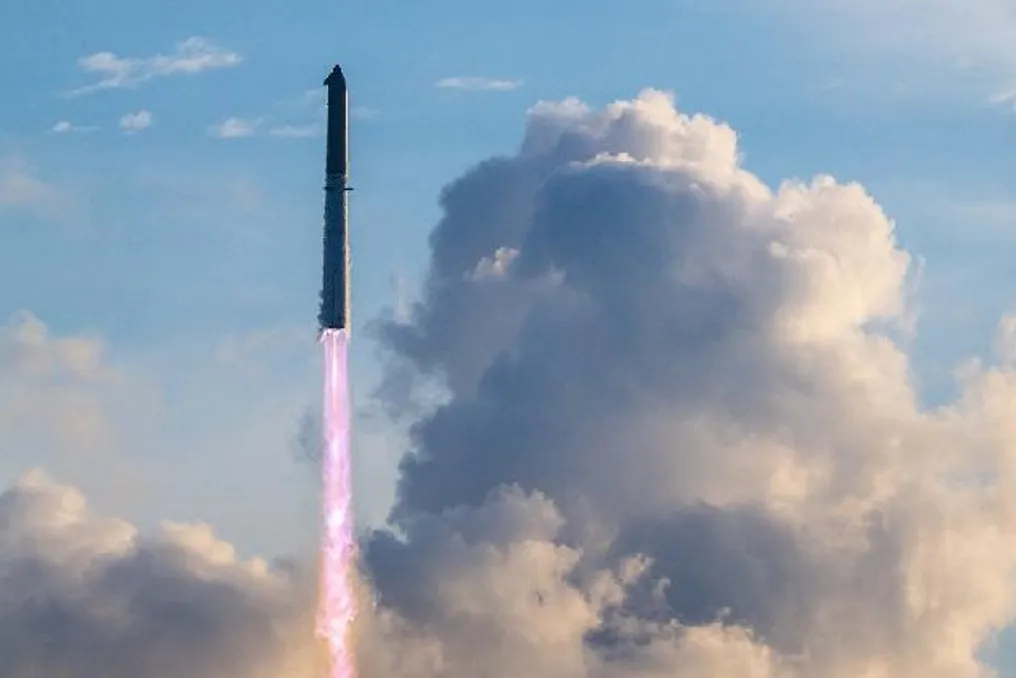
SpaceX's Starship spacecraft reached orbit for the first time on Monday, successfully deploying 26 next-generation Starlink V3 satellites, although the test mission was completed earlier than planned.
The launch took place from SpaceX's Starbase facility in Texas, USA, at approximately 7:48 AM Central Time (12:48 GMT). Shortly after liftoff, the Super Heavy booster splashed down in the Gulf of Mexico.
The upper stage of Starship successfully placed 26 Starlink V3 satellites into orbit, marking the first time these next-generation satellites have been deployed using Starship. Initially, the upper stage was scheduled to remain in flight for about 10 hours; however, due to an unexpected engine shutdown during ascent, the mission was shortened to approximately three hours.
This flight was the fourteenth integrated test flight of the Starship system.
Starship is designed for more frequent launches of SpaceX's Starlink satellites, as well as for future NASA missions to the Moon. Achieving orbit, which is a primary metric for any new rocket intended for space cargo delivery, had long remained an elusive goal for Starship. Previously, Musk predicted this would be achieved in 2022, with subsequent satellite deployment in 2023.
Since the first integrated test flight in 2023, the previous 13 test missions of Starship had been conducted in suborbital mode. Musk expressed hope that Starship could eventually conduct hundreds or even thousands of missions per year, representing an unprecedented pace in the space industry. Musk wrote on X on Sunday that 'Starship is two to three years away from hourly flights.'
According to SpaceX, the V3 Starlink satellites are capable of processing about ten times more data than the previous V2 mini-satellites, which were typically launched in batches of 20 or 30 on Falcon 9 rockets. Musk hopes that Starship will eventually launch V3 satellites in batches of 60 once the vehicle enters regular service.
Despite reaching this milestone, technical challenges remain before Starship can realize Musk's dreams of reaching the Moon and even Mars, including the need to prove the capability of refueling the ship in orbit. NASA also plans to use a modified version of Starship for missions returning US astronauts to the lunar surface.
Kathleen Carlyle, Senior Analyst at the University of Georgia Center for Security and Emerging Technology, noted that the mission demonstrated significant progress but was not 'super successful.' She stated: 'It is an achievement in terms of executing the flight and reaching orbit, but by SpaceX's own metrics and goals, they failed to complete the 10-hour flight and encountered engine issues.'
The initial plan stipulated that Starship should complete six orbits around the Earth before splashing down in the Pacific Ocean; however, the spacecraft only completed two orbits before the end of the flight. The first stage booster landed in waters near Texas, and SpaceX decided not to attempt to recover it to the launch site. The company had previously demonstrated the ability to capture the booster using mechanical 'fingers' from the launch pad.