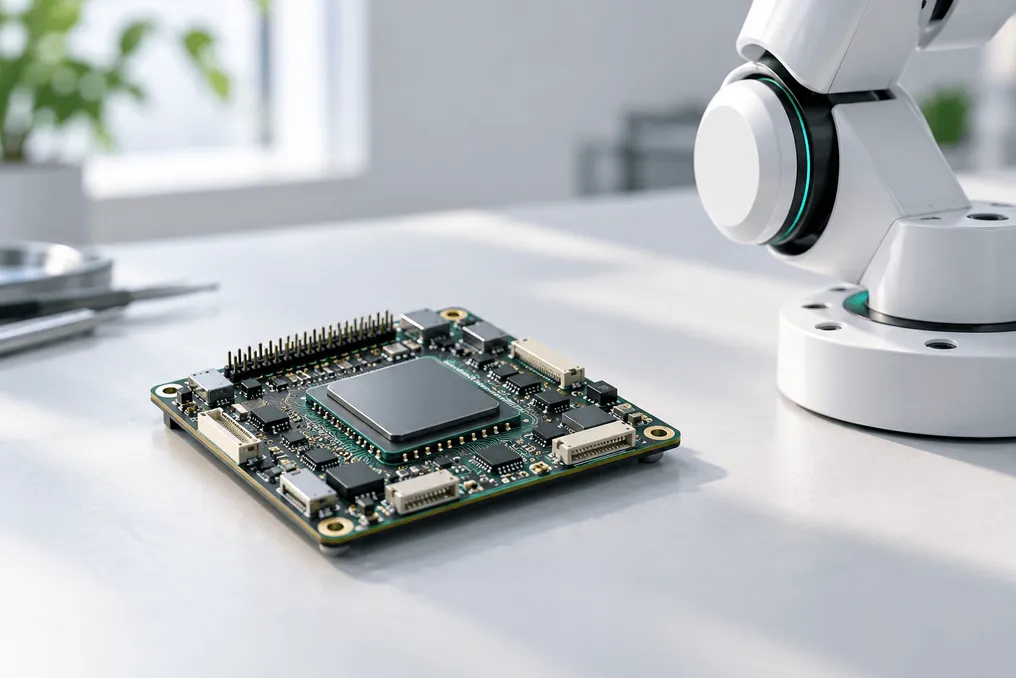
SemiDrive and Radxa introduce RoboX D9M robot motion controller based on D9-Max
Read more
Pandaily
pandaily.com

SemiDrive and Radxa introduce RoboX D9M robot motion controller based on D9-Max

Automotive chipmaker SemiDrive and open-source hardware manufacturer Radxa signed a strategic cooperation agreement on September 29th and released the RoboX D9M—a ready-to-use microcontroller for robots. In robotics, a microcontroller represents the real-time motion control layer that operates under the robot's higher-level artificial intelligence.

This board functions on SemiDrive's D9-Max System-on-Chip (SoC). Both companies stated that this solution frees robot manufacturers from the need to develop their own carrier boards, allowing teams to focus on motion algorithms and product definition.

The D9-Max chip integrates a 12-core CPU with an 8 TOPS NPU and three pairs of Cortex-R5/R5F clock cores for synchronous execution mode. It supports LPDDR4X memory at 4,266 Mbit/s and eMMC 5.1 storage, and complies with the ISO 26262 ASIL-B functional safety level. The SemiDrive product page indicates that hardware isolation allows one chip to run two systems, separating motion control from interaction, perception, display, and communication.

The 800 MHz clock cores provide a 25 nanosecond interrupt response time and can act as an EtherCAT master, while two DSPs accelerate inverse kinematics solutions. The chip is also equipped with 12 CAN FD channels, dual gigabit TSN Ethernet, a hardware security module, and is rated for an operating temperature range of minus 40 to 105 degrees Celsius. SemiDrive introduced D9-Max in May 2025 and reports that its D9 chips are in mass production with leading humanoid robot developers.

The RoboX D9M integrates this chip onto a 100 x 100 mm board, which features built-in EtherCAT, multiple CAN-FD channels, and RS485 industrial bus interfaces. The board comes pre-loaded with Linux 6.12.31, Ubuntu 26.04 LTS, and ROS 2 Lyrical operating systems, and is designed for direct connection to humanoid robots, quadruped machines, and collaborative manipulators. This is Radxa's first specialized motion controller for embodied AI sold as a complete 'board-SDK' kit for humanoid and wheeled robot manufacturers.

In addition to the product itself, the partners plan to collaborate on hardware reference designs, an open-source software stack, and a global developer community. Radxa, founded in 2012 and based in Shenzhen, manufactures single-board computers, system modules, and edge computing platforms. SemiDrive claims to have supplied over 14 million automotive chips to more than 70 automotive brands and 170 vehicle models, viewing robotics as part of its strategy to transition from automotive chips to embodied intelligence. SemiDrive founder and chairman, Qiu Yujing, noted that this partnership combines automotive-class computing power with Radxa's open-source engineering solutions. Radxa founder, Tang Liang, stated that today the biggest challenge for robot developers is not computational power, but the reliability gap between prototypes and mass production. Pricing and availability information has not yet been disclosed.

Similar stories

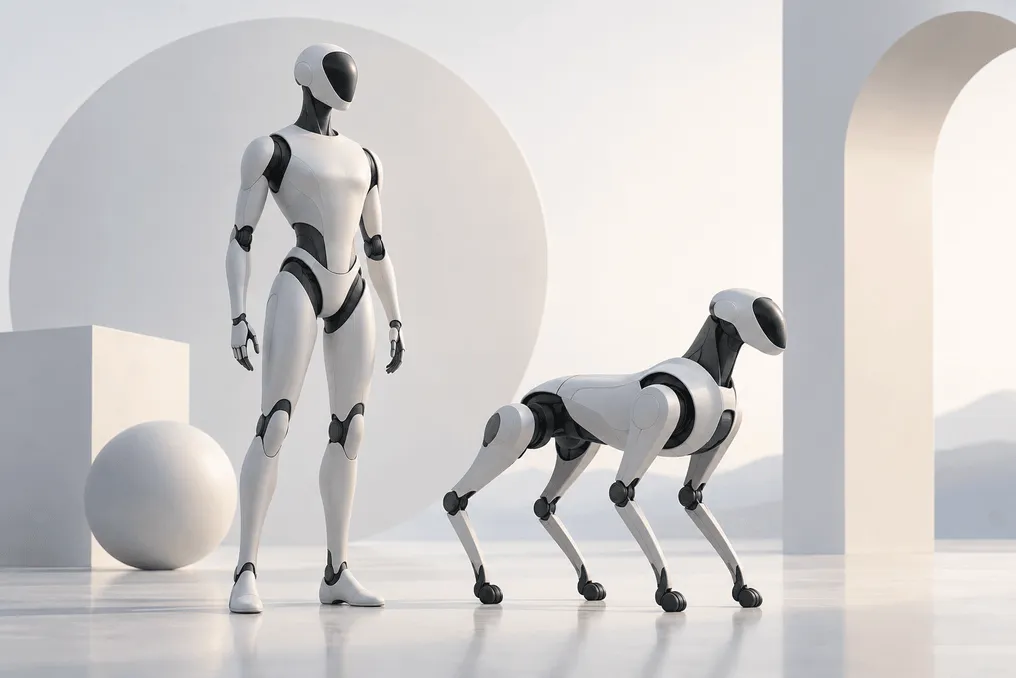
Faraday Future and Jia Yuting Unveil Nine EAI Robots Priced from $9,990
Read more
pandaily.com

Faraday Future and Jia Yuting Unveil Nine EAI Robots Priced from $9,990

Faraday Future, in collaboration with Jia Yuting, held a presentation of embodied artificial intelligence (EAI) robots on September 20th, introducing nine new robot configurations and four solutions for enhancing productivity across various industries.

These models include humanoid and quadrupedal form factors from the Futurist, Master, and Aegis lines, with a starting retail price of $9,990 USD. Jia Yuting, the founder, explained this leap forward is achieved by creating a multi-bodied robot ecosystem that relies on an overarching EAI brain, agents, skills, and real-world scenario data, without requiring equity or funding.

The next-generation Futurist model is positioned as a full-sized professional humanoid robot with 51 active degrees of freedom, which can be increased to 71 with the installation of an enhanced dexterous hand. It is equipped with two batteries totaling 1,152 Wh, provides about eight hours of standard operation, and supports autonomous charging.

The Ultra variant of this model utilizes NVIDIA Jetson Thor, providing approximately 700 TOPS, and is intended for research purposes, embodied development, corporate services, and industrial applications. The standard Ultra configuration costs $89,900, while the Ultra version is priced at $129,900.

The Master Mini is aimed at education and sports competitions. This robot, standing about 95 cm tall and weighing 19.5 kg, is available in three performance tiers (48, 117, and 200 TOPS) at prices of $9,990, $12,990, and $17,990, respectively.

The Aegis line features wheeled-legged models. The Classic Ultra-W is a lightweight companion for security, weighing about 22 kg and costing $12,990. The Mega is a medium-sized industrial unit capable of carrying a payload of up to 50 kg, climbing continuous stairs up to 25 cm high and obstacles up to 80 cm high, equipped with hot-swappable dual batteries, and providing at least five hours of unloaded operation; its price is $74,990. The Hyper is a large industrial quadruped robot designed for heavy-duty work in extreme conditions, with a starting price of $137,900.

The four solution packages cover needs in K-12 education using Blockly, Python, and ROS curricula; research; security through multi-robot patrolling and multimodal alerts; and inspection of energy, power supply, manufacturing, and mining facilities.

Faraday Future announced that its EAI robot world has transitioned to version 2.0, including humanoid, quadrupedal, and wheeled-manipulator robot families in the Futurist, Master, Aegis, Navi, and Faber models. A total of eleven models and 24 products have been presented, among which nine new configurations have been priced.

Huaruizhipu Company Unveils Praxis One Platform with Approximately 106 TOPS Edge Computing on MediaTek Genio Pro 5100 Chip
Read more
pandaily.com

Huaruizhipu Company Unveils Praxis One Platform with Approximately 106 TOPS Edge Computing on MediaTek Genio Pro 5100 Chip

The cybernetic robotics firm Huaruizhipu has introduced its Praxis One platform. This platform is an edge computing system based on the MediaTek Genio Pro 5100 chip and was demonstrated at an industry event in Hangzhou during the 9th China Robotics Summit on September 17th.

Praxis One is positioned as a high-performance computing module for heavy humanoid and robotic systems, rather than a smartphone product. It integrates multimodal tasks on the device, along with vision and language tasks and real-time motion control, onto a single chip.

Huaruizhipu emphasizes that its design differs from common separated stacks where a cognitive accelerator is placed next to a separate motion microcontroller. By integrating high-level decision-making and low-latency control on a single SoC, it achieves reduced inter-chip latency, decreased data loss, and simplified board design.

There is also a lighter version, Praxis Nano, which uses the MediaTek Genio 720 and is intended for medium robots and closed-loop motion systems with sensors. While Praxis One focuses on multimodal perception, VLA policies, lightweight world models, local large model inference, and complex task planning on more massive platforms.

MediaTek and its partners indicate that the Genio Pro 5100 is an eight-core processor based on the Arm v9.2 architecture with a 3nm process, equipped with an eighth-generation NPU capable of operating at approximately 106 TOPS. Furthermore, it supports up to 16 FHD camera virtual channels, Wi-Fi 7, Bluetooth 6.0, and optional 5G.

On-device inference of the Qwen3-7B model is estimated at about 23 tokens per second, allowing scene understanding and dialogue to be maintained even when disconnected from the cloud. The system is designed for industrial use across a wide temperature range, from -40°C to 105°C, making it suitable for deployment in factories and outdoors.

Huaruizhipu also presented complementary components of its system: peripheral data collection hardware under the brand RuiMou, a physically constrained world and robot scene model, and ready-made packages for OEMs and laboratories. The official English name of the company is poorly documented outside of Chinese materials and the website harmony-robot.com; Huaruizhipu is used here as the corporate name, and Praxis One as the trademark pending clearer global confirmation.

Popular