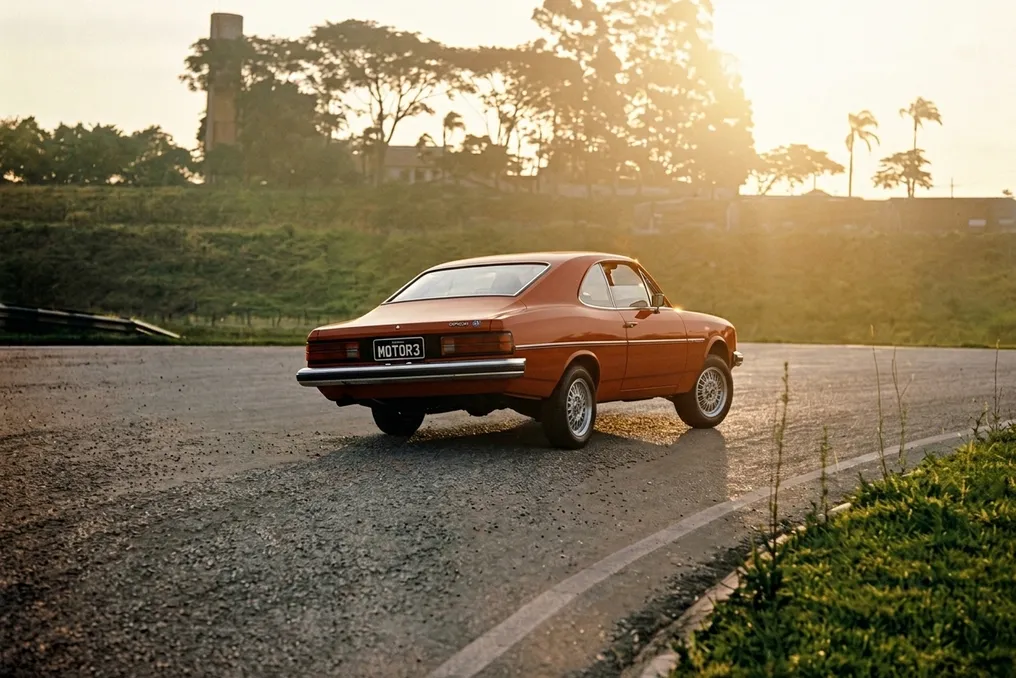
For a long period, preparing the Opala followed an established pattern, involving components such as the Iskenderian camshaft, modified exhaust manifold, Weber carburetor, distributor adjustments, cylinder head touch-ups, and, in more radical cases, a slight increase in engine displacement.
Although there were variations in this formula—such as different cams (278, 288, or 298), carburetor types (triple or central, 40 or 44), or different distributor models (reworked to prevent contact breaker float, imported from Mallory, or the Bosch transistorized 'box' model that emerged in the late 1970s)—the introduction of turbo preparations for the Opala only began in the late 1990s, gaining greater popularity after the arrival of programmable fuel injection in the late 2000s.
However, the concept of turbocharging the 250 engine predates what is imagined. In 1981, the magazine Quatro Rodas reported that the Puma GTB S2 turbo was the most powerful national vehicle of the time, as it used the General Motors 250-S engine equipped with a turbocharger, although the power output was not specified.
Additionally, Puma manufactured some GTB S4 models between 1983 and 1984, a version of the GTB with the 250-S engine equipped with a Garrett turbo and running on alcohol; three units were registered, despite imprecise records due to Puma's financial situation.
Even before the Puma GTB, there was an initiative to market turbo kits intended for the six-cylinder Opala. This project was conceived by the originator of the 250-S engine, GM engineer Roberto Beccardi, and was launched in 1978.
It is relevant to consider the historical context of 1978: Brazil had been isolated from imports for two years, while the Saab 900 Turbo was about to be launched, and the Saab 99 Turbo was already circulating, besides Porsche selling the 911 Turbo and GM and BMW already having prior experience with the technology in Formula 1, with Renault using the RS01 turbo.
In this context, the turbo engine was a novelty, but Beccardi was already betting on it to boost the Opala's performance. Beccardi possessed deep knowledge of the Opala's six-cylinder engine, having worked as chief engineer of GM's Experimental Engineering on a more powerful version of the 4100, when Bob Sharp and Jan Balder sought out the factory in late 1973 to develop an engine capable of competing against the Maverick V8, which culminated in the 250-S, homologated for competition and available in production Opalas from 1976 onwards.
The following year, Beccardi left GM and founded Enpro, located in São Caetano do Sul, with the goal of producing turbo kits for the Opala's four and six-cylinder engines. A year later, the kit for the 250-S was sold for Cr$ 50,000 (equivalent to R$ 17,500 in 2026), while the basic six-cylinder Opala cost Cr$ 131,000 (R$ 94,200 in 2026).
According to materials from the time, the kit could be installed in a new or nearly new vehicle in just one day. Enpro offered two turbocharger options, the Lacom-Schwitzer 3LD and the Garrett T04, and the package included a specific exhaust manifold, dedicated exhaust and muffler, air filter, modified carburetor and distributor, in addition to transistorized ignition.
The system operated in draw-through mode, with the carburetor positioned above the turbo, allowing the air-fuel mixture prepared by the carburetor to pass through the compressor before going to the engine. This was a relatively simple way to supercharge a carbureted engine because the carburetor operated almost at atmospheric pressure, dispensing with the pressurization of the bowl and the synchronization of fuel pressure with turbo pressure. However, gasoline also passed through the compressor, and the system made conventional intercooler use difficult.
The composition of the components indicated that Beccardi's concept was similar to that offered by European and American tuners of the time: a complete and tested solution, almost a 'plug and play' system by the standards of that time, contrasting with the piece-by-piece preparation that became common in the Brazilian market.
In September 1978, Quatro Rodas magazine reviewed an Opala 4100 Luxo equipped with the Enpro kit. The car was a complete street model, including hydraulic steering, air conditioning, and other standard features of the version, exactly as Beccardi intended for the setup.
Although the turbo pressure used in the kit was not disclosed in the magazine's test, considering that the engine continued to use regular gasoline without piston changes, and that Enpro still sold the set as a normal use preparation, a low-pressure adjustment is suggested. The data confirms this perception: the engine generated 124 hp at 4,300 rpm without the kit and reached 209 hp at 4,000 rpm with it, increasing torque from 24.9 to 33.6 kgfm at the same 2,500 rpm, representing a gain of 85 hp and 8.7 kgfm.
Despite the power increase, the engine's behavior remained similar at low speeds; the test of the time pointed out that below 2,700 rpm, the six-cylinder maintained the same elasticity as the naturally aspirated 250-S. The turbo started acting from this point, and above 3,000 rpm, the performance gain was more noticeable, without the power deficit common in turbos of that era, as seen in the Porsche 930.
In the test conducted by Quatro Rodas, the Opala reached 100 km/h in 9.85 seconds and covered a kilometer in 30.02 seconds. For comparison, an SS-6 tested two years earlier on the same track took 11.67 seconds to reach 100 km/h and 31.30 seconds to complete the kilometer. The maximum speed recorded was 200 km/h, but the Quatro Rodas tests took place at the Freios Varga proving ground in Limeira/SP, a short track with two 1,800-meter straights connected by inclined curves. As a reference, years later, Quatro Rodas took the Chevrolet Omega CD 3.0 to 206 km/h on this same track.
Above 180 km/h, however, the body exhibited vertical oscillations. According to Claudio Carsughi, who drove the car in the test, to run consistently close to the limit, it would be necessary to completely reformulate the suspension and braking system.
This occurred because the car still used original shock absorbers, while Enpro recommended Cofap gas shock absorbers, available in three calibrations, along with more resistant brake pads and Pirelli CN36 205/70 HR tires. For those who wanted to take advantage of most of the available performance, the suggestion was to opt for the firmer version of the shock absorbers, trading some comfort for stability.
It is unknown how many vehicles were equipped with the Enpro kit, but CGC (the CNPJ of the time) records indicate that Enpro only ceased operations in 1985, and reader letters in editions subsequent to the Quatro Rodas test demonstrate interest in the kit.
Furthermore, in 1981, Motor 3 magazine tested another turbo Opala developed by Beccardi, this time using the 151-S four-cylinder converted to alcohol. In this case, the carburetor was pressurized by the turbo (blow-through), requiring the fuel supply to be adjusted to the manifold pressure, but eliminating certain restrictions of the draw-through system.
This car was still in the development phase. It used a Garrett T04, considered by the team itself to be excessively large for the 2.5-liter engine (a T03 was already considered), and suffered failures during the test. Later, Enpro identified a combination of problems with the turbocharger, dirt in the carburetor, and an inadequate advance curve for alcohol.
In contrast, the naturally aspirated preparation gained a vast field of development starting in 1979 with the creation of Stock Car, where the Opala competed as a category car. Thus, cams, cylinder heads, carburetors, exhausts, compression ratios, and other solutions were continuously developed and tested in competition. These configurations stopped being mere workshop experiments, becoming effective combinations on the tracks and returning to street cars, consolidating the naturally aspirated repertoire as the classic Opala preparation.
The turbo followed a distinct path. Enpro maintained the development of the idea—the 1981 model illustrates the transition from draw-through to blow-through—but did not have the same continuous cycle of refinement that Stock Car provided to the naturally aspirated ones. This explains why, when thinking today about a 'period' prepared Opala, the initial memory falls on the Weber, the Iskenderian, the cylinder head, and the larger displacement.
Nevertheless, turbo technology was already present in 1978.