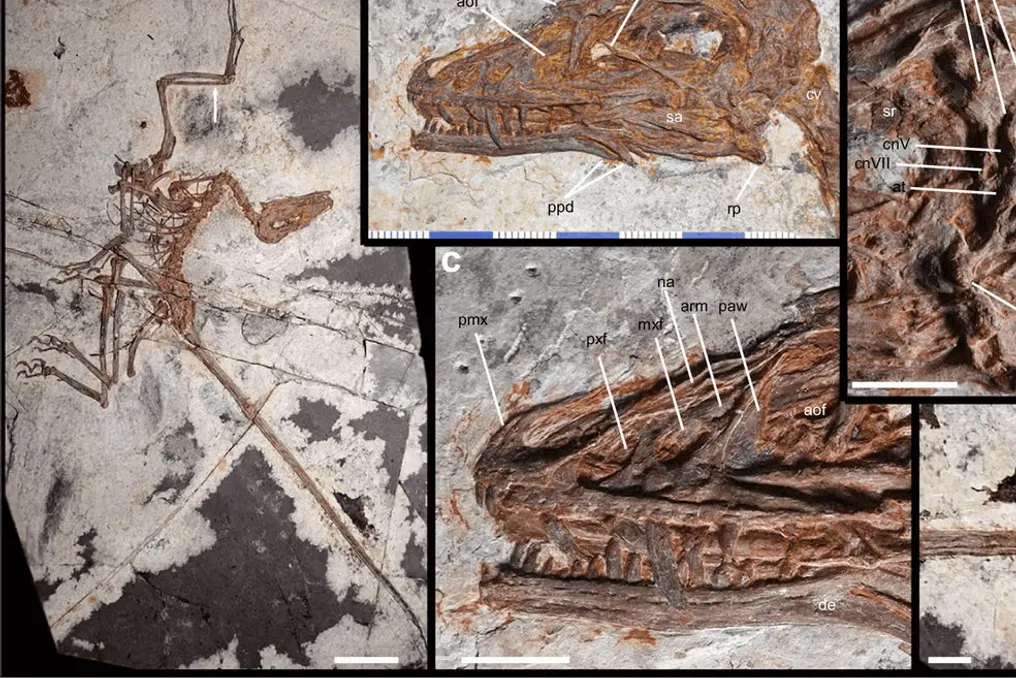
The discovery of a new feathered dinosaur in northeastern China helps scientists gain a deeper understanding of how certain traits related to flight arose in the closest relatives of birds.
The animal, named Norellraptor barsboldi, reached about 57 centimeters in length and lived approximately 120–125 million years ago during the Lower Cretaceous period. The fossil is almost completely preserved and includes parts of plumage, which is a rare and valuable find for reconstructing the anatomy of these small dinosaurs.
The study, published on Tuesday (29) in the journal Nature Communications, shows that microraptorineans, to which the new dinosaur belongs, and birds have developed a number of similar characteristics. However, the authors note that these changes appeared in different evolutionary orders.
According to the authors, this weakens the hypothesis that both taxa inherited a single set of structures related to flight from a common ancestor. The study's authors state: 'The results refute the model of common development underlying the evolution of flying dinosaurs and support multiple independent selective processes in the origin of winged groups.'
Microraptorineans were small, feathered predatory dinosaurs that mainly inhabited the territory of modern northeastern China. Some of them had long feathers on their arms and legs, which has caused debate for many years regarding how these animals developed various forms of aerial mobility.
For a long time, paleontologists debated whether the ability to fly or glide originated once in the common ancestor of birds and microraptorineans, or if the characteristics necessary for such movement could have evolved independently. For researchers, the difference in sequence indicates that both groups could have achieved similar anatomical solutions through different evolutionary paths, a phenomenon known as convergent evolution.
More about the find
The comparison revealed 57 morphological features related to flight that were common to microraptorineans and primitive birds, accounting for approximately 30% of the analyzed physical traits. Nevertheless, this does not mean the question is definitively closed; the interpretation of the independent origin of these structures continues to be discussed among experts.
Paleontologist Jesús Marugan from the Autonomous University of Madrid, for example, believes that some conclusions about the origin of flight mechanisms are difficult to prove.
The specimen was found by a local farmer near Lamadun in Liaoning Province, China. In 2023, the fossil was transferred to the GEO University Museum of Hebei. The material was extracted from the Jiufutan formation, one of the Chinese regions known for exceptional fossil preservation. The Norellraptor barsboldi specimen retained parts of its plumage and measures about 57 centimeters long, with approximately 32 centimeters belonging to the tail.
Microscopic analysis of the forearm bone also allowed for an estimation of the animal's age. The growth pattern indicates that Norellraptor died at no younger than three years old. The study of bone microstructure also revealed a different growth pattern compared to modern flying birds, which further supports the researchers' argument that the flight-related structures in microraptorineans evolved according to their own dynamics.
The name of the new species is also a tribute: Norellraptor refers to American paleontologist Mark Norell, and barsboldi refers to Mongolian paleontologist Rinchen Barsbold. Both passed away in 2025 and played important roles in research that helped establish evolutionary links between theropod dinosaurs and birds. Despite the good condition of the fossil, the authors emphasize that new specimens and additional bone growth analyses are required to determine whether the pattern identified in Norellraptor barsboldi was repeated in other bird-like dinosaur groups.