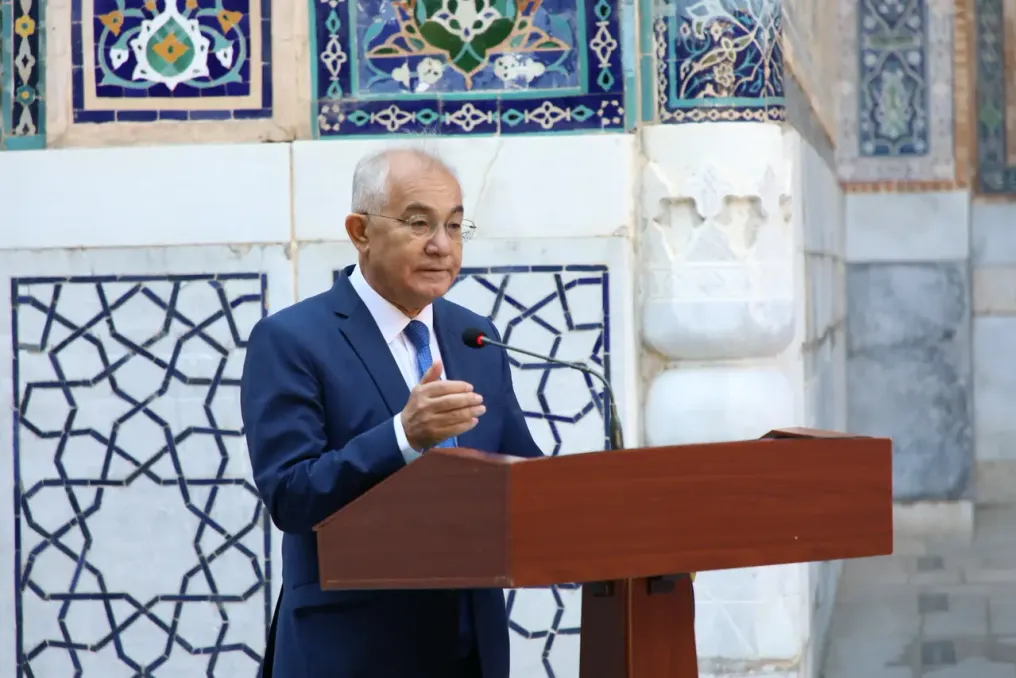
The Fifth Human Rights Forum in Samarkand concluded its final plenary session in Samarkand, gathering representatives from governments, international organizations, as well as expert and academic communities to discuss current issues of human rights and freedoms protection.
The international forum was organized by the National Center for Human Rights of the Republic of Uzbekistan together with the Ministry of Foreign Affairs, the Office of the United Nations High Commissioner for Human Rights, OSCE, the International Committee of the Red Cross, and the International Center for Development and Justice.
This year's theme was dedicated to 'the 60th anniversary of the International Covenants on Human Rights and the 40th anniversary of the Declaration on the Right to Development: Global Partnership for Human Dignity, Equality, and Sustainable Development.'
A ceremonial opening, high-level plenary sessions, events dedicated to the anniversaries of the National Center for Human Rights, and seven thematic sessions took place in Tashkent. The concluding part of the forum was held in Samarkand.
The final plenary session began with the presentation of the main findings and proposals obtained during the seven thematic sessions. Session moderators outlined the key results of the discussions and defined priority areas for further work.
Participants' proposals were consolidated for the further strengthening of the universal human rights protection system. The discussions led to practical recommendations that will be reflected in the forum's final document.
Participants were also presented with a draft final document titled 'Vision of Samarkand 2040: Global Cooperation for Human Dignity, Equality, and Sustainable Development.' This project was presented by Akmal Saidov, Director of the National Center for Human Rights of the Republic of Uzbekistan.
The use of the term 'strategic vision' in the document's title emphasizes its long-term nature. 'Vision of Samarkand 2040' aims to define future priorities for international cooperation in the field of human dignity and equality, strengthen the universal human rights protection system, and promote sustainable development.
This year marks the eighth anniversary since the establishment of the Human Rights Forum in Samarkand. Held every two years, this international congress has served as a platform for open international dialogue on a wide range of pressing human rights issues over this period.
The history of the forum began in 2018 with the Asian Human Rights Forum in Samarkand. The 2020 forums focused on youth rights, while the 2022 edition was dedicated to human rights education. The Fourth Forum in Samarkand, held in 2024, addressed environmental threats and their impact on human rights.
The fifth forum continued this thematic line, focusing on global challenges shaping the current agenda in human rights and freedoms.
Humanity today faces complex and interconnected problems. In particular, the rapid development of artificial intelligence and digital technologies opens up broad opportunities to improve the quality of life while simultaneously creating new legal and ethical risks.
Against this backdrop, improving the universal human rights protection system to reflect modern realities is becoming one of the key tasks of the international community. These issues formed the basis of the program of the Fifth Human Rights Forum in Samarkand.
During the plenary sessions, participants analyzed the 60-year experience of applying the International Covenant on Civil and Political Rights and the International Covenant on Economic, Social and Cultural Rights. They also discussed the significance of the right to development as a universal human right, global solidarity, and the further strengthening of national and international human rights protection mechanisms.
Seven thematic sessions covered civil and political rights; economic, social, and cultural rights; the rights of children, women, and persons with disabilities; the right to a healthy environment and climate justice; artificial intelligence and digital technologies; as well as the prevention of statelessness.
Thus, the forum's agenda covered a wide range of interconnected issues—from traditional human rights protection mechanisms to new challenges arising from technological, environmental, and social changes.
According to the organizers, the goals set for the Fifth Human Rights Forum in Samarkand were reflected in concrete recommendations and directions for further international cooperation.
One of the most important outcomes was the development of strategic policy recommendations. Participants put forward practical proposals for fulfilling international obligations, promoting the right to development, strengthening national human rights institutions, and integrating a human rights-based approach into sustainable development processes.
Another significant result was the expansion of international cooperation and partnership. The forum continued interaction between governments, UN bodies, international organizations, financial institutions, the academic community, and civil society.
Special attention was paid to knowledge sharing and best practices. Participants exchanged experiences in implementing national standards, institutional solutions, and evidence-based decision-making approaches in the field of human rights protection.
Strengthening national capacity was also a focus. Issues such as fulfilling international obligations, improving interdepartmental coordination efficiency, and building the capacity of national human rights mechanisms were discussed.
The forum also promoted a comprehensive human rights agenda linking human rights protection with environmental issues, climate action, the development of digital technologies, gender equality, and the protection of vulnerable groups.
Finally, participants emphasized the importance of further strengthening the Forum in Samarkand as a platform for continuous international dialogue on human rights.
At the conclusion of the forum, participants expressed gratitude to President Shavkat Mirziyoyev for his hospitality and the organization of the international event.
According to the results of the discussions at the forum, universal human rights remain the fundamental basis for international cooperation and sustainable development, while new technological, environmental, and social challenges require continuous improvement of protection mechanisms and broader international involvement.
In this context, the 'Vision of Samarkand 2040' is intended to provide a long-term foundation for further dialogue and cooperation.
The unifying idea of the forum was that human rights connect the past, present, and future, and their protection requires joint efforts from states, international organizations, civil society, as well as expert and academic communities.
The main guiding principle of such cooperation remains maintaining human dignity, ensuring equality, and respecting the rights and freedoms of every person.