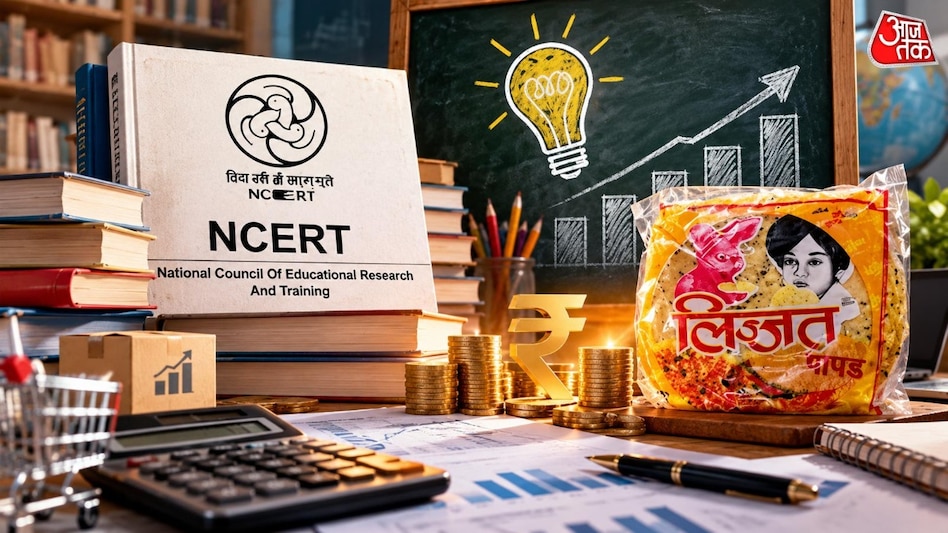
The National Council of Educational Research and Training (NCERT) has made significant changes to the new social studies textbook for Grade 9, titled 'Understanding Society: India and Beyond'. The updated curriculum now covers not only old historical topics but also modern aspects of national development, personal finance, government policy, income tax calculation, and Indian business models.
The main goal of these changes is to nurture responsible, financially savvy citizens in children who can participate in nation-building from an early age.
Under Chapter 5, dedicated to 'Managing Personal Finance', students will receive a basic understanding of personal finance. They will be taught how to calculate income tax according to the new tax system, using examples to determine the tax burden.
The syllabus emphasizes that timely and honest tax payment is the duty of every citizen, as these funds are used to finance national development and public services. Furthermore, through the example of the Ayushman Bharat scheme (AB-PMJAY), it is explained how insurance provides financial protection to low-income families during medical emergencies.
Chapter 4, which focuses on 'Governance and Public Policy', links the country's management system to its historical and cultural traditions. It includes national ideals such as 'Satyameva Jayate' from the Mundaka Upanishad and the Supreme Court phrase 'Yato Dharmas Tato Jayaḥ' from the Mahabharata.
Attention is also paid to the 'Sengol' associated with the Chola dynasty and its installation in the new Parliament building in 2023. The concept of Good Governance is illustrated by the image of a banyan tree, whose seven branches symbolize participation, rule of law, accountability, efficiency, inclusivity, responsibility, and transparency.
Moreover, through the National Education Policy (NEP 2020) and the 'Khelo Bharat Policy 2025', children are educated about policy formation processes and the role of sports in nation-building.
In Chapter 6, titled 'From Ideas to Startups', entrepreneurship is explained through examples of Indian entrepreneurs and traditional models. The history of 'Shree Mahila Griha Udyog Lijjat Papad', which began in 1959 with a small sum of 80 rupees by seven housewives from Mumbai, is included in the textbook. It is mentioned that by 2023, over 45,000 women had joined this cooperative business, which reached a value of 1600 crore rupees.
The inspiring journey of M.S. Oberoi, who started his career as a hotel porter earning 50 rupees per month and eventually created one of the largest hotel chains in the country, is also studied. Additionally, the program includes the study of the traditional banking system of the Chettiar community from Tamil Nadu, their mutual trust-based lending, and their historical trade network extending to Southeast Asia.
This section, inspired by the ideas of Swami Vivekananda, highlights the activities of over 120 unique Indian Unicorn Startups. The role of new enterprises in the e-commerce, fintech, agritech, and healthcare sectors is discussed. Startups are linked to the national goals of 'Atmanirbhar Bharat' and 'Developed India 2047'. Children are taught that business brings not only profit but also contributes to societal development through job creation, innovation, taxation, and Corporate Social Responsibility (CSR).