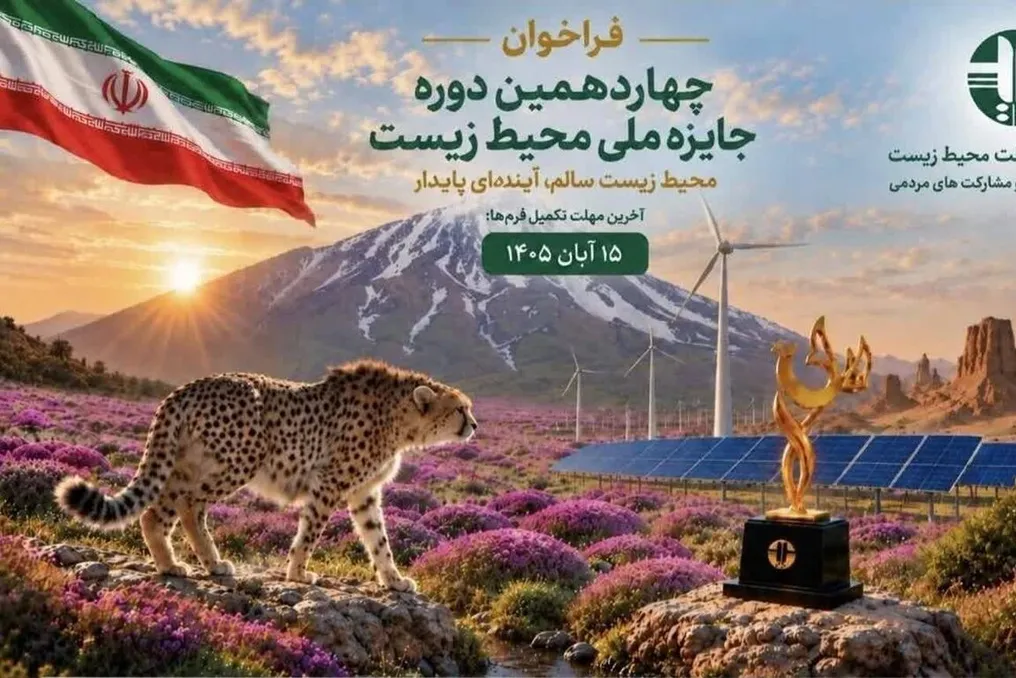
The Department of Environment (DOE) announced that the deadline for submitting applications for the 14th National Environmental Award is November 6. This year, the award will be held under the slogan 'Healthy Environment, Sustainable Future.'
The goal of this award is to develop a culture of environmental conservation, promote ecological values, identify successful individuals and effective methods, stimulate creativity, support innovative environmental protection solutions, and increase public participation, as reported by doe.ir.
Projects eligible for the award include those aimed at preventing pollution and environmental degradation while simultaneously reducing costs, protecting and restoring endangered plant and animal species or valuable habitats threatened by degradation, as well as those related to studying effective nature conservation strategies, raising ecological awareness, and implementing measures to prevent incidents resulting from ecological crises.
In September, President Masoud Pezeshkian emphasized that environmental protection is a key pillar of the nation's national and social security, insisting on the necessity of addressing natural resource preservation within this concept.
Speaking at a meeting with ecology experts on September 3, Pezeshkian stated that the government is ready to create conditions for utilizing plans, ideas, and initiatives proposed by activists and environmental specialists. He added that the government will support scientific and practical solutions to overcome the country's real environmental problems, as reported by IRNA.
The President stressed that solving environmental challenges requires close cooperation between the government, universities, the private sector, civil society organizations, and the public. He noted that this joint effort must be used to transition to sustainable management, balanced development, and the protection of the country's resources for future generations.
Furthermore, the President identified education and public awareness as crucial elements in reforming consumption patterns and nature protection. Pezeshkian warned that investing in the proper education of the next generation is effectively investing in the country's future. He cautioned that without early education of children and adolescents in the principles of environmental protection, efficient use of water and electricity, energy management, and social responsibility towards natural resources, future generations may repeat patterns of ecological degradation, even if significant funds are spent on nature conservation today.
Pezeshkian insisted that environmental consciousness must originate in schools, and proposed including in the educational and developmental process the teaching of students on the responsible use of water, electricity, gas, and other natural resources.
Other topics raised during the meeting included prioritizing water reuse and recycling, strengthening the role of ecology experts in agriculture and water use efficiency, preventing excessive mineral resource extraction, and more actively involving universities in solving environmental problems.
In June, the head of the Department of Environment (DOE), Shina Ansari, detailed various measures taken to address environmental issues, stating that national security cannot be achieved without attention to the environment. She noted that environmental degradation, air and soil pollution, and the destruction of protected areas are directly linked to environmental security.
Ansari reported that over the past Iranian year (March 2025 – March 2026), in addition to environmental problems such as drought, climate change, and dust storms, the country experienced difficult periods related to irreparable damage inflicted on civilian, cultural, and environmental infrastructure by two wars (the 12-day war last June and the recent 40-day war).
She added: 'Despite all these difficulties, the Department of Environment stood by the people and the country, striving to mitigate negative consequences and strengthen national security.' Ansari concluded that national sustainability depends on environmental security; without clean water, air, fertile soil, and sustainable biodiversity, it is impossible to speak of sustainable security.