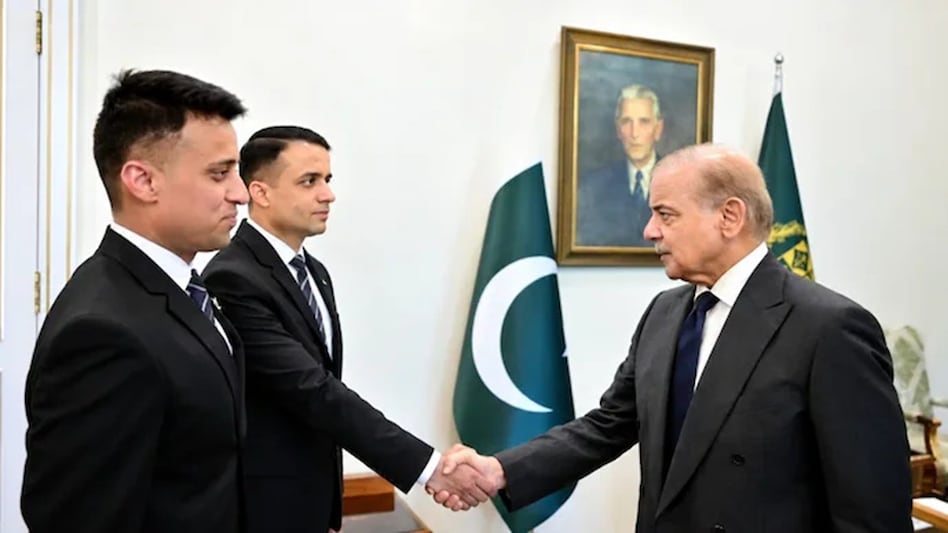
China is supporting Pakistan's space program, under which two Pakistani pilots are undergoing intensive training in Beijing. This initiative marks the beginning of a new phase of cooperation between the two countries in the field of space exploration.
The pilots, named Zeeshan Ali and Hurram Daud, are studying Mandarin, training in centrifuge conditions to endure strong gravitational forces, and practicing skills for eating, sleeping, and repairing equipment in zero gravity, preparing for a historic space flight.
The final decision on which of these pilots will go into space is expected in mid or late October. This mission was planned by China and Pakistan back in 2019.
If successful, the selected pilot will become Pakistan's first astronaut and the first foreign national to visit China's Tiangong space station. China has not yet announced a precise launch date.
Amer Gilani from the Pakistani space agency Suparco told Reuters that the training includes in-depth study of the Chinese language, mastering spacecraft systems, and adapting the body to orbital microgravity and G-forces during launch.
These two were selected from a pool of about 20 finalists, who were initially chosen from a group of Pakistani pilots and scientists. The selection was based on medical fitness, psychological resilience, and the ability to withstand G-forces, which, according to Uzair Ansari, Suparco's Director of Artificial Intelligence, is a rare quality among scientists.
Reuters specified that after completing the training, the astronauts will fly directly from China and will only return to Pakistan after the mission concludes. The selected astronaut will serve as a payload specialist, conducting scientific experiments for Pakistan aboard the Tiangong station, rather than piloting the spacecraft itself.
Suparco received over 300 proposals from universities in Karachi, Lahore, and Islamabad for orbital experiments. Chinese institutions selected four experiments related to biotechnology aimed at solving food shortages and climate change. These experiments will be developed and tested in Pakistan before receiving approval from Chinese engineers.
The Tiangong space station consists of three modules—Tianhe, Wentian, and Mengtian—and has a total weight of about 77 tons. It is used for research in life sciences, materials science, hydrophysics, and radiation effects.
This mission demonstrates Pakistan's reliance on China for crewed spaceflights, as Pakistan lacks its own orbital launch vehicle and crewed spacecraft. Within this partnership, Pakistani satellites launched by China are also involved, as well as a robot created in Pakistan that is planned for China's Chang'e-8 lunar mission around 2028.
Nevertheless, Suparco emphasized that no official agreements or negotiations regarding sending any Pakistani astronaut to the Moon have taken place. For Pakistan, this flight is the first step toward crewed spaceflight, and for China, it is an opportunity to demonstrate the international capabilities of its space station.