AI Camera in Bangalore Issues Fine for Missing Helmet on Guitar
Read more
Aaj Tak
www.aajtak.in

AI Camera in Bangalore Issues Fine for Missing Helmet on Guitar

A very unusual incident occurred in Bangalore, which revealed a significant oversight in the operation of a modern road service camera based on artificial intelligence (AI). A local resident, Souvik Datta, was riding a scooter with his wife, and a guitar was secured to his back.

Souvik Datta himself was wearing a helmet, but the guitar behind him did not have one. The AI camera installed on the road mistakenly identified the guitar as a passenger riding without a protective helmet and issued a fine for violating traffic rules.

Similar stories

Viral video of automatic trash collection machine sparks debate among social media users
Read more
www.aajtak.in

Viral video of automatic trash collection machine sparks debate among social media users

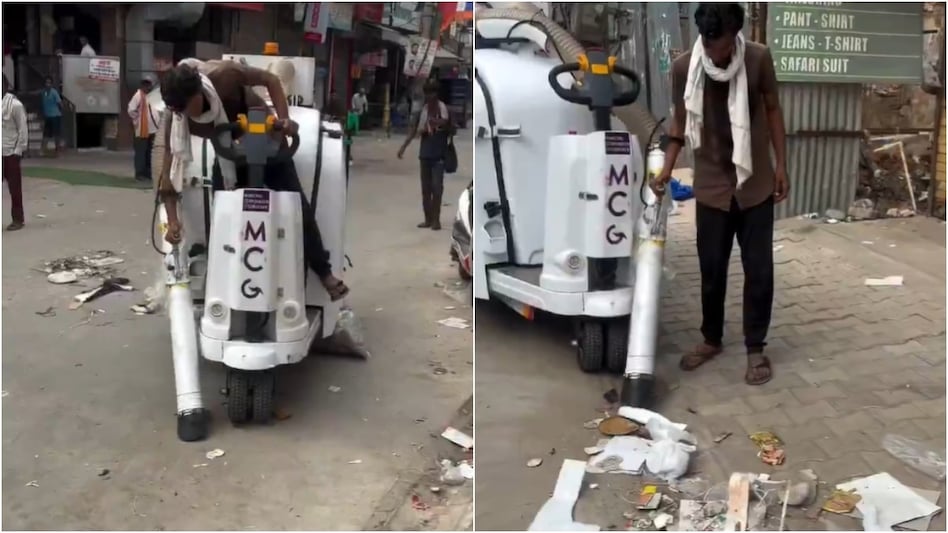
New equipment is now being used to clean up litter scattered on the streets. This small, scooter-like machine collects small debris, such as paper wrappers and plastic, using a suction system.

A video of this machine in operation was shared across social media, triggering active discussions about its functionality. According to India Today, the compact white machine bears the logo of the Municipal Corporation of Gurugram (MCG). It is being deployed as part of efforts to improve the sanitary condition of streets and public areas in the city.

In the video, the machine appears quite miniature. It can be moved along the roadside, and a vacuum hose is connected to it. Staff members hold this hose and direct it towards the trash lying on the road. As soon as the hose approaches the waste, the machine sucks it up using a vacuum. The recording shows small debris, such as plastic wrappers and paper, being drawn into the device.

Thus, this machine is designed to collect small litter scattered along roads or sidewalks, unlike large cleaning vehicles.

The main reason for the widespread discussion of this machine on social media was its designation as 'automatic.' In the post where the video was published, it was called an 'automatic trash collection machine.' However, the video shows that an employee operates the machine and manually directs the vacuum hose onto the trash. Because of this, some social media users questioned what exactly is meant by 'automatic' if human involvement is required for its operation.

A user named Ashar raised the issue of the necessity of manual labor from the employee if the collection system is claimed to be automatic. Another user on X, Nasir Said, pointed out a broader issue, noting that no machine can compensate for the negligence of citizens who lack civic responsibility. He shared his experience, recounting how he was repeatedly threatened with physical assault by people creating filth when trying to prevent disorder in India.

Some social media users also expressed doubts about how useful such a small machine could be in a large city like Gurugram, with its extensive road network. Currently, the video clearly shows the machine being used to collect small debris from the roadside using suction. The discussion surrounding this cleaning procedure arose because it was labeled 'automatic,' even though the video showed an operator controlling the machine. It remains to be seen how actively such machines will be used to improve Gurugram's sanitation and how effective they will be in street cleaning.

Vodacom implements compact antenna system to increase capacity of 4G and 5G networks in limited spaces
Read more
techcentral.co.za

Vodacom implements compact antenna system to increase capacity of 4G and 5G networks in limited spaces

Vodacom has developed and tested a compact antenna system that allows for increasing the capacity of 4G and 5G networks at sites where there is no room for additional equipment. The company plans to implement this system in various parts of its network.

System Testing

This system was created in collaboration with Nokia and underwent pilot testing in the Western Cape. It combines traditional passive antennas and 'massive MIMO' (multiple input, multiple output) active radio receivers into a single unit. The Massive MIMO technology uses large arrays of antenna elements to direct signals to individual users, which increases the station's throughput.

According to a statement from Vodacom on Tuesday, this unit operates in Massive MIMO mode simultaneously on two frequency bands: 2.6 GHz and 3.5 GHz. Operators often face the problem of lack of space on existing towers and rooftops, while building new sites is time-consuming and costly.

Vodacom reported that the pilot project demonstrated the possibility of installing this technology where limited space or existing infrastructure would hinder standard upgrades. The company now intends to deploy this system at 'certain sites requiring additional capacity.'

The company did not specify how many sites will be covered, over what period, or what capacity increase was achieved during the pilot. Beverly Ngwenya, Technical Director of Vodacom South Africa, noted in a statement that as the demand for mobile data continues to grow, it is necessary to constantly improve the network to ensure the quality and stability of service expected by customers.

Vodacom emphasized that residents of densely populated urban areas, where space is limited and expanding the network using traditional methods is more difficult, will benefit most from this technology. In such areas, users experiencing high demand should notice more stable 4G and 5G network performance, including faster data loading and smoother streaming video playback.

Popular