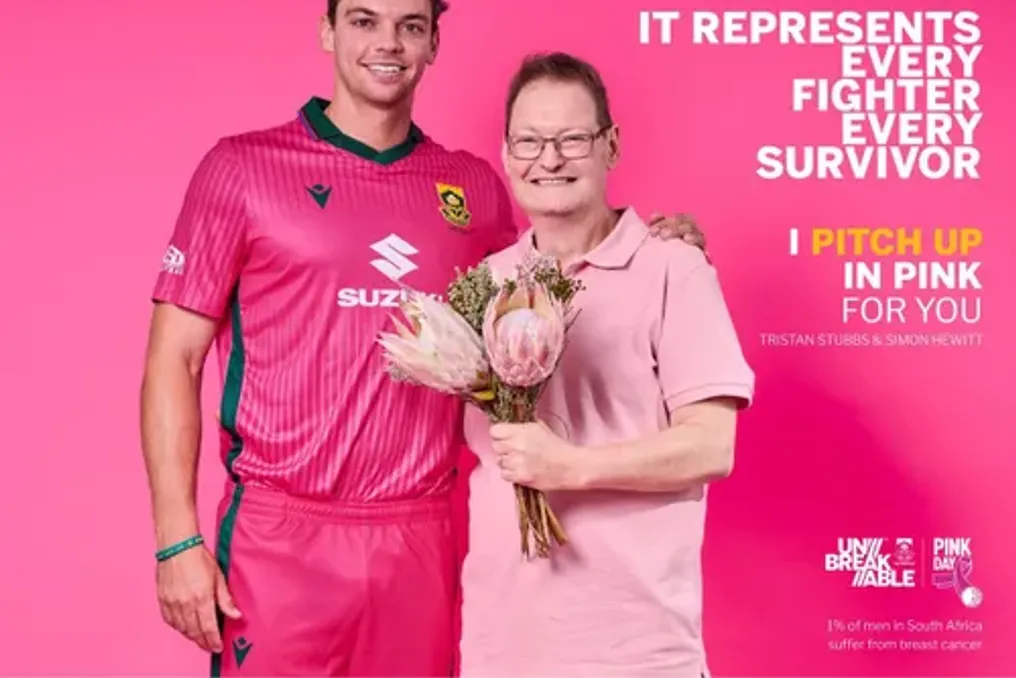
After beating stage IV breast cancer that had spread to his brain, Simon Hewitt spoke at the Pink ODI event as a 'pink unicorn' to urge men to pay close attention to their bodies and detect the disease early.
Although he calls himself a 'pink unicorn,' at the Pink ODI between South Africa and Australia, Simon Hewitt delivered a much more serious message to the public: men are also susceptible to breast cancer.
In an exclusive interview with IOL, Hewitt noted: 'I think it's really special. I walked around the field with a whole group of ladies, calling myself a 'pink unicorn,' which seems very fitting today.'
The Pink ODI, held at the Wanderers Stadium on Sunday, aimed to raise awareness about breast cancer, which affects about one percent of men in South Africa. Every player for the Proteas team wore the name of a cancer survivor on their jersey, and Tristan Stubbs wore Simon's name.
Hewitt is one of the few diagnosed in May 2024 with Her2-positive, estrogen-positive breast cancer—one of the most aggressive forms of the disease. At the time of diagnosis, he was already in stage four.
Following six intensive rounds of chemotherapy in June, a CT scan in September revealed the alarming news of cancer metastasis to the brain.
He emphasized that there is a stigma associated with cancer, suggesting it only affects one gender, race, or age group, but this is untrue. Hewitt stated: 'Men can get breast cancer just like women. As men, we must be as aware of what our bodies are telling us and actively listen.'
He added that such events help raise awareness, reminding people: 'Guys, if you feel a little unwell, you need to listen to what your body is saying.' He clarified that this is not an issue exclusively for women or men, nor is it limited to the elderly or young—the disease makes no distinctions.
After discovering the cancer spread to his brain, Hewitt underwent 10 sessions of radiation therapy, followed by a grueling three-month wait for treatment results. By April 2025, Hewitt received confirmation that there was no threat.
Since then, he has been taking Herceptin and Perjeta, which are targeted drugs designed to prevent breast cancer. However, in January, these medications began to lose effectiveness, forcing Hewitt to seek an alternative protocol.
'Now I have switched to a different regimen—not chemotherapy, but completely different treatments, and I must be honest, it made a huge difference. I experienced severe side effects from chemotherapy, but with the treatment I am receiving now, I can do what I do today: stand here on the field, be active, and help raise awareness.'
Although constant fatigue was Hewitt's earliest symptom, he strongly urges the public not to ignore subtle warning signs. He recalled: 'A lump the size of a 'golf ball' near my collarbone was a serious sign, although I didn't pay it proper attention at first.'
He advises: 'If something feels wrong, pay attention. Over the last two and a half years, I have realized that your body is an incredible communicator. We must listen to what our bodies are telling us and heed these warnings. If I had reacted when I first felt unwell, we might have caught it at stage 2, and the entire outcome could have been completely different. But I was stubborn and just kept moving forward.'
Hewitt's advice is simple: 'If something feels wrong, pay attention to it. Don't just swallow painkillers hoping everything will be fine. See a doctor. It is worth having this conversation, getting blood tests, and checking tumor markers. Get checked early—it could save your life.'