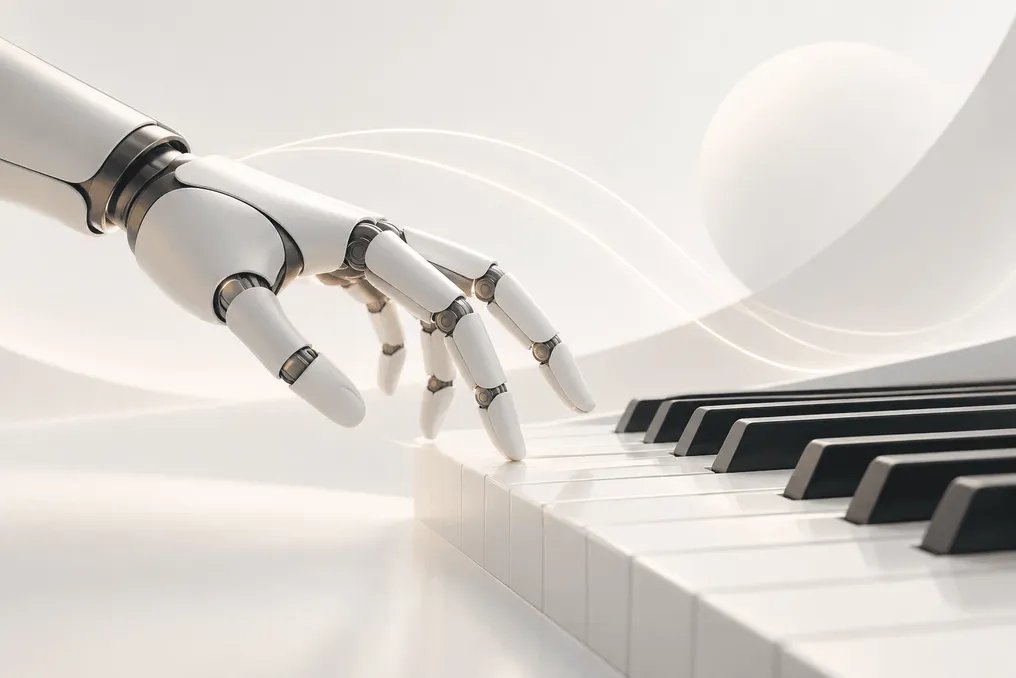
MirrorMe Technology has released its agile hand, VIVA, alongside the embodied musical model CADA, demonstrating what it calls the first-of-its-kind real-time four-handed piano performance controlled by both human and robot.
The company's official English name is MirrorMe, which can be verified at mirrormetech.com; the product trademarks are VIVA and CADA. According to information obtained from Caijing and OFweek, this significant milestone was achieved around September 24, 2026. The company explains that the name VIVA is related to the energy of 'vivace,' and CADA relates to expressive passages in the style of a cadence.
The focus is primarily on the hardware. MirrorMe asserts that VIVA utilizes a composite transmission based on a tendon-cable mechanism and linkage, allowing actuators to be placed behind to reduce overall mass, while the linkages maintain the rigidity and strength of the fingertips. The claimed joint speed exceeds 1000 degrees per second, and the peak force of a single finger is about 33 N, which, according to the company, is sufficient for performing fast passages and forte dynamics on a real piano.
The design aims to overcome the typical trade-off in dexterity between strength, speed, and fine coordination, all required in piano repertoire, including scales, tremolos, and note repetition with strict timing adherence.
CADA represents MirrorMe's specialized music stack. The overall model interprets musical intentions expressed in natural language; the music generation model creates the melody and arrangement; and the performance policy model translates the expression into commands for VIVA regarding finger placement, contact, force, and timing. Each cycle closes a creation-performance-perception-evaluation-learning loop based on real audio and movement, allowing the same composition to improve during rehearsals instead of reproducing a fixed trajectory.
One of the published four-handed pieces, 'Viva la Vida: Nueva Vida,' was generated through human-model interaction and subsequently studied and adjusted directly on the device. MirrorMe views music as a dense testing ground for cognitive, creative, and precise motor skills within the Distributed Embodied Intelligence Architecture (DEIA), which connects large language models, vertical foundation models, and robotic bodies. Although the company also sells full-sized humanoid platforms like Bolt and others on its English website, this release focuses on the technical specifications of VIVA and the demonstration of the closed-loop four-handed cycle, rather than the financial narrative.