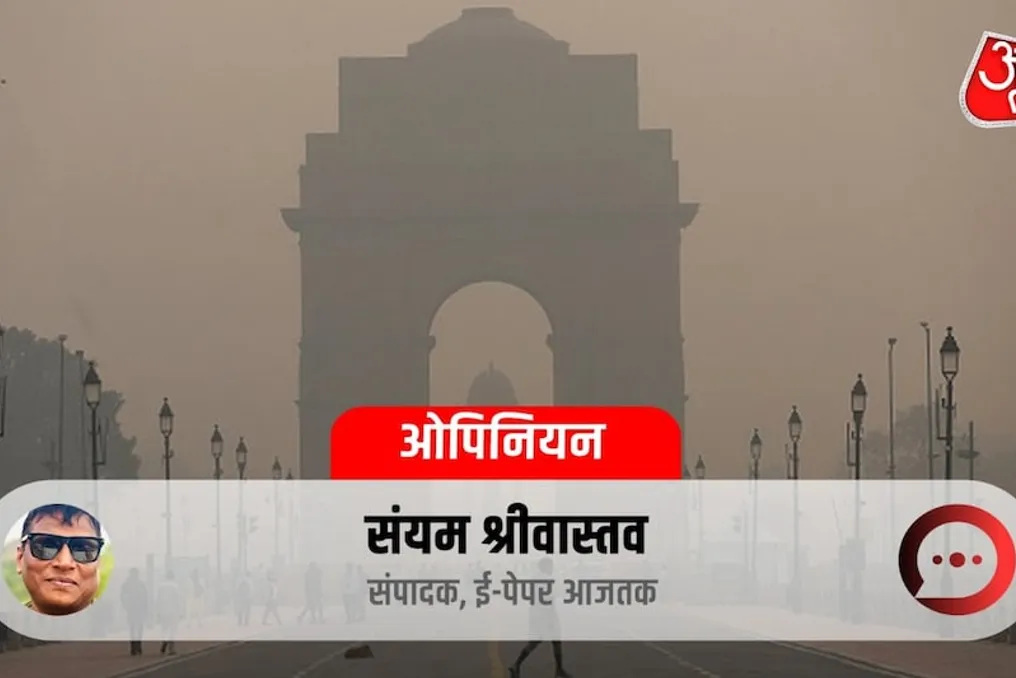
The government has taken timely measures to prevent Delhi from turning into a gas chamber during the winter period. Every year, when October-November arrives, the air in Delhi-NCR becomes toxic, prompting authorities to introduce various restrictions. This time, the Delhi government decided to prepare in advance by banning demolition work and open civil construction projects from November 1st to January 31st. Furthermore, construction and demolition activities will be completely suspended from December 10th to January 20th.
Strict decisions are necessary to combat pollution. The air quality in Delhi is not a problem of one specific administration or one season. Every winter, the deterioration of air quality negatively affects the health and standard of living of millions of people. Therefore, it is welcome when the government prepares in advance, strengthens supervision, and takes action against pollution sources.
However, this strategy has another side that must be considered with equal seriousness. The ban on construction activity directly affects thousands and millions of workers whose income depends precisely on this work. A large number of workers in Delhi-NCR come from states such as Bihar, Uttar Pradesh, Jharkhand, and Rajasthan, and they work in the construction sector. Many of them earn daily wages to support their families. For them, a four-month or one-and-a-half-month construction ban means not just a project halt, but a threat to their very existence.
This raises the question: is halting construction the most effective way to fight pollution? In reality, construction itself is not synonymous with pollution. There are detailed rules and Standard Operating Procedures (SOPs) for controlling dust during construction. Measures such as spraying water when cutting roads and conducting work, covering soil and building materials, using fully enclosed vehicles, prohibiting the stockpiling of construction waste on roads, and monitoring dust-generating zones have been established.
So, what is the problem? The problem is largely related to compliance and control. If water is regularly sprayed at the construction site, materials are covered, waste is not left exposed, trucks drive covered, and dirt on the road is immediately cleaned up, then dust spread can be controlled to a large extent. The Central Air Quality Commission (CAQM) also recognized in February of this year that dust generated during construction and demolition constantly contributes to pollution, and deficiencies in compliance were found during inspections.
Thus, the government knows about the problem and has rules to treat it. The difficulty lies in ensuring the enforcement of these measures. Interestingly, the problem of rule compliance is not limited only to private developers. Government agencies also often fail to adhere to the same precautions during road construction and repair as expected from private contractors. Roads are dug up, earth and waste remain on the sides, water is not sprayed for many days, and building materials lie exposed. Under such conditions, it is natural to ask: how to solve the pollution problem simply by banning private construction if government projects themselves do not comply with dust control rules?
The Delhi government also mentioned the use of the Dust portal and AI-based cameras for monitoring. These technologies are used to monitor construction sites larger than 500 square meters, which is a good initiative. However, the technology will only be effective if the information obtained from it is immediately used to take action. If a camera records a violation, but officials take several days to act, the technology remains merely a showpiece.
The main challenge for the government is this: it must move beyond the 'stop work' policy in pollution control. Why not allow work to continue on construction sites where rules are being followed? And why shouldn't large fines, work suspension orders, and accountability for officials be established for those who violate the rules? This would create a clear distinction between those who comply with norms and those who violate them.
Yes, temporary stoppage may be justified in areas with extremely high pollution risk or where dust control is impossible. But in general circumstances, stopping construction should be a last resort, not the first. This is especially relevant for Delhi-NCR, where residential, road, metro, hospital, and other public projects are continuously underway.
Furthermore, the government should consider alternative measures for construction workers. If a complete construction ban is imposed for a certain period, employment assistance can be organized for affected workers, skills training can be provided, or they can be connected to other public works. The cost of reducing pollution should not be borne by a person whose income is already limited.
A long-term ban on construction activity affects not only workers' earnings but also the pace of urban development. In rapidly growing metropolises like Delhi-NCR, construction of roads, flyovers, metros, housing, etc., plays a key role in development.