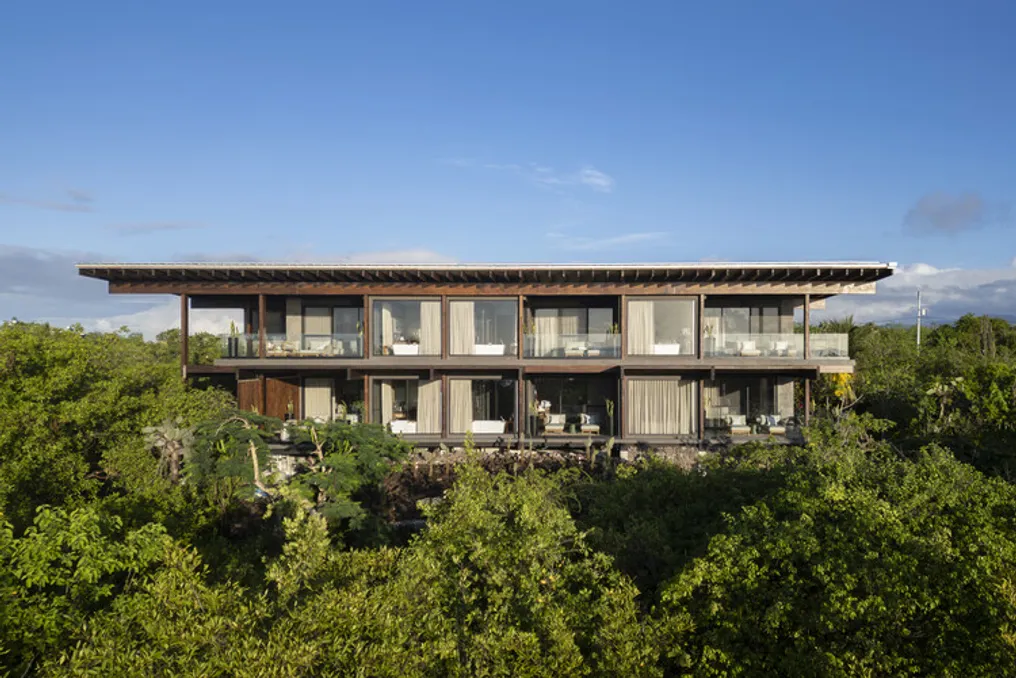
The project team presented details about Hotel Finch Bay, highlighting the intrinsic connection of the Galapagos Islands with the history of evolution, whose observations by Charles Darwin influenced evolutionary theory. These islands remain a place of constant adaptation, where life, landscape, and human presence coexist in a unique manner.
Over the years, the Hotel Finch Bay Galapagos Hotel has developed in this setting, acting as a link between visitors and one of the planet's most remarkable natural environments. The most recent intervention consisted of expanding the hotel with new suites, while maintaining the original architectural philosophy: developing constructions that integrate into the landscape without competing with it.
Located on Santa Cruz Island, near Puerto Ayora, the hotel is organized into several small-scale volumes arranged around a central landscaped area. This arrangement allows the architecture to maintain a secondary role relative to the surrounding vegetation, topography, and coastal environment.
Construction in Galapagos poses considerable challenges, including strict environmental regulations, complicated logistics, and material scarcity, demanding high-level planning. For this reason, the expansion was planned from the outset using a prefabricated construction system. The components were designed, coordinated, and manufactured in Quito before being sent to the islands for assembly, which resulted in a significant reduction in construction time, material handling, waste, and impact on the construction site.
The main structure uses laminated teak sourced from cultivated forests, offering a renewable structural system with a considerably lower carbon footprint than many traditional options. The efficient and adaptable construction system is complemented by prefabricated cement floor panels with polyurethane insulation and light internal partitions. Furthermore, prefabrication aided in quality control, resource optimization, and minimizing interference in such a delicate ecosystem.
The choice of materials reinforces the connection to the location. A sober and timeless palette, composed of wood, volcanic stone, concrete, and neutral finishes, was selected not only for its visual aspect but also for its resistance, low maintenance needs, and ability to age naturally in a challenging coastal climate.
The sustainability approach encompasses aspects beyond physical construction. Broader environmental strategies of the hotel include rainwater harvesting, wastewater treatment, recycling programs, energy efficiency measures, and the installation of photovoltaic panels.
In summary, the result is an expansion that maintains the identity of Finch Bay, proving that sustainable architecture arises from essential choices: how to build, which materials to use, and how subtly architecture can coexist with an extraordinary landscape.