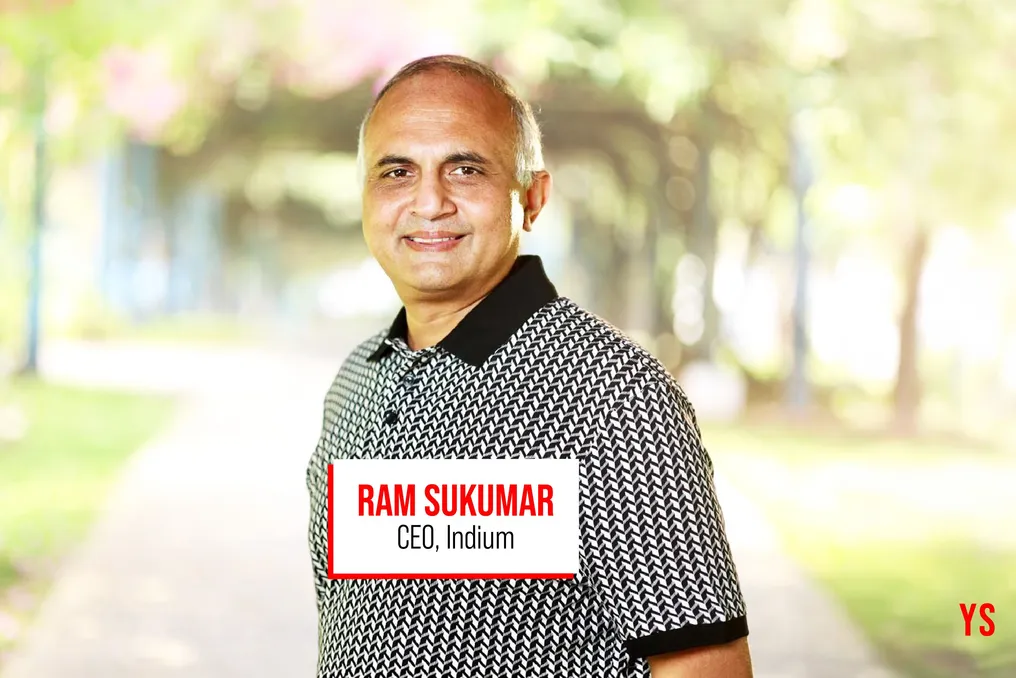
Every few years, Ram Sukumar undertakes remakes of the film 'Indium'. He believes that artificial intelligence represents his best chance at the moment.
One Friday morning, near the home where Kamal Hasan grew up, Ram Sukumar spoke about tennis. After playing the night before, he decided to swim in the morning, and by the time his interlocutor arrived, the stiffness had completely passed. He was concerned about the trip, as he came from ECR—a road connecting Chennai to Bogemian Pondy, which is a long journey across the entire city. He apologizes twice for this, accepts coffee, and suggests meeting halfway at the office in Guindy, but it was too late.
The meeting took place in the conference room of the company's head office on Eldams Road. Sukumar, dressed in a linen shirt and jeans, smiled easily and first talked about recent stories of his interlocutor before moving on to his own.
The office has its own history. 'This has been our lucky office since 2015,' he notes. Since then, Indium has used it as its headquarters, although most of the work is concentrated in Guindy, Hyderabad, Bengaluru, Thiruvananthapuram, and Kochi.
Sukumar quickly reveals his privileges. 'I was born with a silver spoon,' he says. 'My story is not about rising from poverty to wealth, but it is slightly different. It has its ups and downs.'
The whole family was in business: his father, uncles, and grandfather, as well as his mother's side, were involved in trade and managed firms that thrived in Chennai in the 70s and 80s. He grew up in comfortable conditions, studied at Padma Seshadri in Nungambakkam, and then went to BITS Pilani in Rajasthan to study mechanical engineering.
Pilani changed him the most. He never had to support himself, but life in a dormitory far from home forced him to do so. He still maintains close ties with this company, which later played an important role.
Next came a master's degree in industrial engineering and operations research at the University of Massachusetts Amherst. Operations research is an older field related to using data to make better decisions, and in his opinion, it is 'the foundation of machine learning, which is today AI.' Programming was not in his plans until a classmate from IIT Madras, who later created his own unicorn, directed him to a teaching assistant position in the computer science department.
'And then I realized I loved it. I love programming, I love code, and I love technology,' he shares.
After that, he started working as a developer in Boston, using C and Unix, and then early Visual Basic. He was on an H-1B visa, and a green card was likely to appear in a couple of years, but this didn't attract him much. The desire arose to return to the family business.
He and his cousin Vijay Balaji registered Indium in 1999 and fully started operating in 2000.
Then came 2001. The September 11 attacks froze spending in the American tech market just as Indium was trying to get off the ground, and in the same year, he and his father suffered serious financial losses at home. The family money he could rely on suddenly disappeared.
'Thus, despite my wealthy roots, when I founded Indium, we were a startup without the investment I could have attracted,' he recalls. For meetings in Mumbai, he traveled by train to save on airfare.
Initially, Indium dealt with small parts of ERP (Enterprise Resource Planning) work, like everyone else. Then, an advisor, Mani Subramaniam, previously working at IBM, advised the cousins to choose one thing and master it. He pointed them to software testing, which most of the industry ignored, and since they lacked funds for wide distribution, they followed his advice.
By 2004, one India was not enough, so they created a company in the US and gradually gained clients there, mainly through friends, family, and Pilani alumni. In 2007, they attracted funding from a small fund managed by Ajith Isaac and Sarath Reddy, two businessmen with successful companies. The check arrived around October.
By January 2008, the entire industry was experiencing a collapse. Sukumar and Vijay immediately approached their new investors and laid out all the problems. As he says, one of their strengths is 'we always received bad news in the elevator, and good news on the stairs.' The idea was to get bad news to management quickly, while good news could take longer.
'I think none of us panicked. I think we said, okay, this will pass,' he asserts. They were right. The business recovered in 2009, and 2008 remains the only year since 2003 when Indium did not make a profit.
Investors also provided proper board advice. Before that, the cousins ran Indium in a founder-centric style, and he values the discipline added by the board of directors highly.
By 2012, he saw how far testing alone could take you. Clean testing firms of that time, such as RelQ and AppLabs, were eventually acquired by larger players because a company that only tests software can only grow to a certain limit.
His long-standing interest in operations research returned. At that time, everyone was talking about big data: Cloudera, Hortonworks, Hadoop, and he wanted Indium to be in the data and machine learning space. The board looked at it differently, and they had their reasons. Testing was profitable and provided a good dividend yield to shareholders, and no one else could say how big the data market would become or if a small firm from Chennai could take a place in it.
Their response nevertheless left the door open. If he wanted to do it, he could do it himself.
He did so in 2013 by creating a separate company called Noah Data. 'It was just my passion. I want to deal with data,' he says. Several people were doing everything themselves, and money was scarce, which reminded him of the early days of Indium, and he has a name for that. 'It was bootstrap 2.0 in my life.'
Big data never became as big as everyone predicted. But the work of Noah Data was reliable enough to attract clients like Uber and Lam Research, which a small testing firm would have struggled to reach.
By 2017, each company was losing business because it couldn't offer what the other offered, so in 2018, they merged. Investors were in their tenth year, when most investors want to exit, and Sukumar came up with another five-year plan. They still supported him.
'A funny thing is that we exceeded this five-year plan in just two and a half years,' he notes.
Before the merger, Indium grew by approximately 25% per year. After it, this rate approached 50% per year on average, excluding the calmer COVID year, and around 2021, the staff almost doubled, from 1000 to 2000 people.
'My entrepreneurial philosophy has always been to surround myself with the right experts, learn from them, and constantly invent new things,' he says.
He means this. In 2021, when Indium's revenue was around $20 million, and Sukumar was targeting $100 million, he brought in Catalincs, a consulting group founded by former Cognizant executives Ramkumar Ramamurthy and Rajesh Balaji. The board asked why, as things were going well. He felt that the next stage required a different way of thinking.
The consultants discovered a blind spot common to people starting companies young. Sukumar had never worked 20 years in a large IT firm, so acquiring new clients came naturally to him, but developing existing accounts, which he calls farming, received much less attention. This changed starting in 2021.
Between 2021 and 2023, Indium nearly tripled, from approximately $20 million to $60 million. The leadership team also changed, as it did five years prior. His rough rule is that about half of the people make it to the next stage.
'Because otherwise, it would be like trying to run with an iron ball in your hand, which slows you down,' he says. He is also interested in talking about old-school testers who reinvented themselves and whom the company now sets as an example.
By then, the 2007 investors had been in the company for 15 years and wanted to leave. Baring Private Equity Asia, now EQT, invested in January 2024, and Sukumar warmly welcomes the fit. EQT strengthened the board, helped hire senior executives, and taught the company, which had never bought anything in 25 years, how to conduct deals. He admits he had no experience in this.
Experion, with about 400 people in Kerala, joined in November 2024. Growth since then has been maintained at 23% in the first year with EQT and 27% last year, and he expects about 20% this year. He knows that maintaining this pace when the firm exceeds $100 million is difficult.
Debt was a personal issue for him. Indium never took out loans, and his difficulties in 2001 arose from family-level debts. With EQT, he learned how dollar debt is structured and how its risk is tracked, and says he is no longer afraid of it. Indium still retains about 20% of its revenue as operating profit.
He doesn't buy for the sake of buying, and the entire past year passed without deals because nothing fit. Data and analytics account for about 25% of the business, and he wants this to be closer to a third.
Indium survived 2001, 2008, and Covid. When asked how AI relates to this, he makes it clear that it is a more complex problem.
In previous crises, every company did roughly the same thing. They cut costs, sent employees home, and weathered the year. 'Managing this crisis, I wouldn't say, was easier, but decision-making was simple,' he says.
AI gives the company a choice, and that is what makes it complicated. The firm can continue to operate as before and look fine for a while. 'This challenge is very different from whether you have the option to do something or not,' he says. For him, the answer is to move early. 'It is important that we don't just sit at the crossroads waiting for something to happen.'
Indium's main bet is a platform called LIFTR, which the company began developing in March 2024, long before most of its clients started talking about AI. Someone on the team asked to create it, and Sukumar gave them the mandate and a year without question.
'LIFTR wasn't my idea; I just had the audacity to approve it,' he says.
LIFTR consists of modules. One reads old software, such as a 20-year-old COBOL system that few understand, and determines how to modernize it. Others process testing and data, and one for application maintenance will appear soon.
Even the gaming segment has its module. Indium has been in the gaming sector for over ten years through a division called iXie, which accounts for about 8% of the business and handles design, development, and testing for studios such as Zynga and Krafton. The work is mainly related to casual mobile and web games, with nothing for casinos or real money. In early September, iXie launched its own version of the platform.
Testing now accounts for about 20% of Indium's business, and one might think that AI would eat into this share. Part of that is happening.
'The surprising thing is that this disruption actually turns out to be a very positive disruption for us,' he says. Now Indium offers clients the same testing work with 25% fewer people. This allowed them to secure a contract from a major American bank.
He divides the work into two parts. AI in engineering is using Indium AI for faster software creation and testing, and LIFTR is here. AI for business is clients using AI in their work, such as in insurance claims or wealth management, where Indium has a product called AI Alpha. He admits that the second side is still in its early stages.
Internal changes within the company are mandatory. Everyone is evaluated based on AI skills according to their role, so a salesperson takes a different test than an AI engineer. There is a barrier to overcome. 'You must meet certain minimum thresholds to have a future at Indium,' he says. He himself passes this test.
'I constantly tell my team that we must compare ourselves to a technology service company being born today,' he says. A company founded this week would think about AI first in everything, and he wants Indium to think that way.
He has seen hype come and go. Around 2018, headlines claimed that programmer robots would destroy the BPO industry. 'Nothing really happened. BPO still exists,' he says. He believes that AI is a much more significant shift, and he expects a purge before things settle down and growth resumes.
He believes size helps. 'We are not too small, and we are not so big as to be very monolithic in how we operate.'