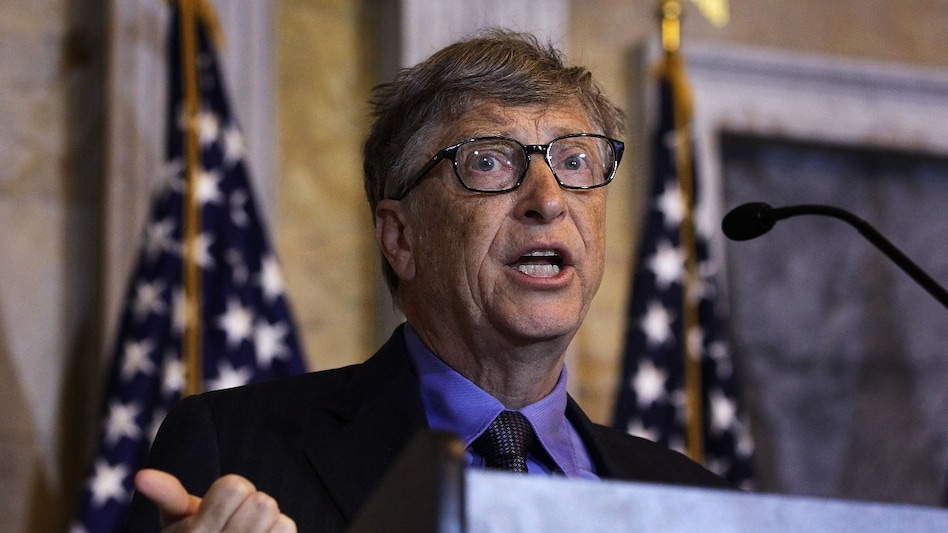
Despite enormous global enthusiasm for artificial intelligence (AI), discussions about its associated dangers are growing in parallel. Microsoft co-founder Bill Gates issued a serious warning about AI, adding further intensity to this debate.
Gates stated that AI has become so powerful that its misuse could lead to catastrophic consequences, including the death of up to a billion people. However, Gates clarified that he is not asserting that AI will necessarily cause such a number of deaths; rather, he believes that existing and future capabilities of AI could be exploited by malicious actors to inflict large-scale damage.
During a conversation with Christine Welker on NBC Meet the Press, Gates was asked whether AI is capable of destroying humanity. He responded that AI certainly possesses sufficient power to trigger events that could lead to the death of a billion people.
However, Gates' concerns are not limited to science fiction scenarios where AI robots turn against humans. His primary worry is that humans themselves might use AI to carry out destructive actions. He specifically highlighted threats related to cyberattacks and bioterrorism. In his view, AI could be employed in cyberattacks capable of paralyzing vital services such as hospitals or power grids.
Thus, the danger lies not in AI suddenly deciding to attack humans autonomously. The main question is how quickly and on what scale powerful AI tools can be utilized by unscrupulous individuals.
Gates' warning came at a time when voices within AI companies themselves are also raising concerns about the risks associated with this field. For instance, Dario Amodei, CEO of Anthropic, has also spoken about the risks of cyberattacks and bioterrorism linked to the misuse of AI. Recently, some major figures in the AI industry have discussed the need for more robust security systems and regulations.
The most interesting aspect of this entire discussion is that the very companies developing AI are now facing the question of whether relying solely on their internal safety policies is adequate. Gates believes that self-regulation—that is, companies creating rules for themselves—is insufficient. In his opinion, governments, law enforcement agencies, and leaders must also determine what monitoring and safety rules are necessary for AI.
Gates is not categorically against AI. This is the second, equally interesting side of the situation. He believes that AI could bring about huge changes in the future in fields such as disease treatment, education, and agriculture. His concern is not about stopping the use of AI, but about controlling its pace so that people have time to react before irreparable damage occurs.
Major technology corporations worldwide are rapidly advancing in the AI race between America and China. In this environment, the question arises whether the pursuit of greater security might slow down the pace of AI development. Gates argues that necessary security measures should not completely halt AI progress. He cites examples of monitoring systems that could detect if AI is being used for cyberattacks or bioterrorism, emphasizing that this does not require a complete stop to AI development.
Perhaps the real threat does not come from AI itself, but from humans. AI itself has no human intentions, but it can multiply human capabilities exponentially. If this power falls into the hands of an unscrupulous individual, criminal organization, or dangerous network, the level of damage could be far greater than with modern technologies. Bill Gates' statement about 'a billion deaths' points precisely to this fundamental question, representing not a prediction, but a warning about the potential harm from the misuse of AI. As AI becomes increasingly powerful, this discussion extends beyond just technology companies and becomes a global one.